Showing posts with label Antonioni. Show all posts

Tuesday, June 25, 2019

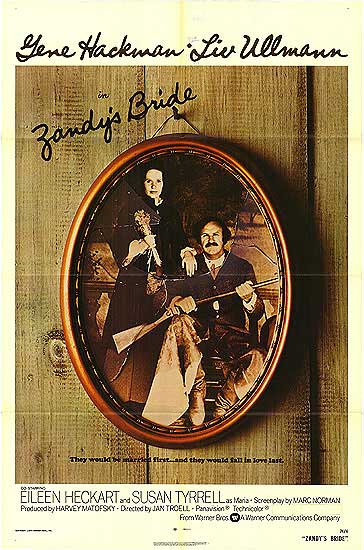
Zandy's Bride

From virtually the very beginning, in 1922 when, at the invitation of Mary Pickford, Ernst Lubitsch left his native Germany and moved to Southern California to make the film Rosita, successful foreign filmmakers have found the Hollywood pilgrimage irresistible. Lubitsch was followed, in no particular order, by F. W. Murnau, Victor Sjöström, Mauritz Stiller, Fritz Lang, Jean Renoir, Rene Clair, Max Ophüls, Michelangelo Antonioni, Milos Forman, Roman Polanski, Ivan Passer, Jan Kadar, Bill Forsythe, Louis Malle, Paul Verhoeven, Lina Wertmüller, Phillip Noyce, Peter Weir, Fred Schepisi, Lasse Hallström, Denis Villeneuve, Alfonso Cuarón, Guillermo del Toro, Alejandro G. Iñárritu ... the list is depressingly long. Lubitsch enjoyed a long and fruitful (in both commercial and creative terms) career in Hollywood. A majority of the others did not. For most, it gave their incomes a boost, but it took a significant toll on their art. Some of them managed to return to their native countries, with sad results. Their subsequent films failed to pick up the thread that they dropped upon going west.

The Swedish filmmaker Jan Troell (pronounced like Noël), who routinely directs, writes, photographs, and edits his films, is an exception to this dismal rule. The international success of his two-part epic film The Emigrants/The New Land (1972), about a Swedish family's migration to America in 1850 was noticed sufficiently by Warner Bros. that he was offered to direct a script based on the novel The Stranger: A Novel of the Big Sur by Lillian Bos Ross. Troell didn't like the script and turned it down, but on reading the novel, part of a Big Sur Trilogy, he was impressed enough by it that he found another writer, Marc Norman, to adapt it. Troell called the film Zandy's Bride (1974).

The "story" of the film is, despite the rewrite, unremarkable: Zandy Allan, a cattle rancher in Big Sur, needs help running things, but instead of looking to hire extra hands, he opts for a mail order bride from Minnesota. He finds an ad in a newspaper classified section:

RESPECTABLE spinster, American stock, wants life in the West. Wishes to marry. Reply P.O. Box 192, Minneapolis, Minnesota.

He puts on a clean, ill-fitting white shirt and rides all the way down to an incongruous outpost smack on the coast where the woman from Minnesota, Hannah Lund, has just arrived by stage. After sizing each other up, he chides her for lying (by 7 years) about her age, telling her she's "on the long side of child-bearing."

Immediately we are faced with incongruity. The leads are Liv Ullmann and Gene Hackman. Ullmann had shown up to act in the film, whereas Gene Hackman showed up to be Gene Hackman. In every film he's exactly the same, no matter how he's dressed or what he's saying. Ullmann is given so little to work with, but you can see her working with it, filling out her period costume like she's been dressed like that all her life, assured, responsive, engaged with her role and the "West" that Troell introduces to us. She makes us wonder what drove her to place that ad. Gene Hackman interests us only so far as his actions divulge, and his limitations are visited upon Zandy.

The two are married then and there, and after the long ride back up the mountain Zandy stables the horses and returns to the house to find Hannah passed out in bed in her traveling clothes. There follows a scene that makes it very hard for us to like Zandy much further. "I got the right!" he screams as he violently rapes her. The following morning he acts like what transpired either didn't happen or was unimportant. He spends the day with his cattle and returns to find some improvements to what Hannah calls his "pigsty." Gradually they wear each other down - she growing tougher, he growing gentler. The result is, of course, no surprise, but the progress to the film's anticlimax holds a few surprises. Some beautiful scenes unfold as Zandy becomes captivated by the beauty of Hannah, reminding me how, for about a decade, between Persona and The New Land, everyone seemed to be in love with Liv Ullmann. Jordan Cronenweth does capture some lovely images: of Zandy and Hannah at table, lit by the light coming off a basket of wildflowers on the table between them, or Zandy watching in admiration as Hannah brushes her long blonde hair by the firelight. Cronenweth certainly might have had some guidance from Troell, or indeed from George Oddner, who is listed in the end credits as "consultant to Jan Troell". Some things, however, don't work so well. Like the scene in which Zandy engages in hand to claw combat with a not very large black bear. The bear-mawling of Leo DiCaprio in The Revenant, albeit abetted by CGI, has set an impossibly high bar for any such scenes.

Troell was promised that he could also operate the camera, but the American cinematographers' union threatened to fine the appointed director of photography (Jordan Cronenweth) $500 every time Troell touched the camera. The result of depriving Troell of access to the camera, which introduced more cooks to the kitchen, is what really prevented Zandy's Bride from getting off the ground. “The biggest difference for me about working in America was the number of people around the camera. In the centre, it’s the same, the relationship between the director, the actors and the camera." (1) Troell started in film as a cinematographer, and he had operated the camera in his four feature films in Sweden. Forced to block only actors (deciding where they should stand in relation to the design that isn't his own), instead of his camera taking part in the blocking must have been crippling for Troell. The photography of his Swedish films is a marvelous voyage of discovery for the viewer.

Zandy's family - father, mother, and a brother - are introduced, only to give the viewer a good idea where Zandy learned about domestic violence. A Mexican woman, Maria Cordova (played by Susan Tyrrell, who was misidentified as "Maria Cordova" in The New York Times review of the film)(2), with whom Zandy has a history, gives the story - and Zandy - an excuse to go astray from Hannah's story, which is the reason the film exists. At least Tyrrell doesn't subject the viewer to her usual crazy lady schtick, for which she was nominated for an Oscar in John Huston's Fat City (1972).

Zandy's Bride gave me the feeling that what attracted Troell to the story's possibilities in direct human terms was precisely what turned critics away from it. You find yourself waiting for something to happen in the film and then you realize what happened went right on by without your noticing it: the gradual action of one force upon another, each resistant to the influence of the other, in which the trajectories of both are eventually altered. The notion that Zandy's Bride is somehow in the tradition of a Western is more than a little silly when you remember that Troell accomplished one of the greatest sequences on the theme of the West in The New Land, when Karl Oskar's brother Robert and his slow-witted friend Arvid trek all the way to California to strike gold, to encounter only death and disappointment. Troell's camera showed us no sweeping vistas, no Monument Valley horizons, no sense of immensities except what the face of Eddie Axberg, who plays Robert, discloses. It is all up close, through the mud and the dirt and the pain, with a bare minimum of dialogue and a handful of other actors. Yet it says so much more about the tragedy of the West than a thousand Westerns.

Zandy's Bride got some positive notices, but not enough with which to build a Hollywood career. Troell returned to Sweden none the worse for his experience. The most significant reason for Troell's failure in Hollywood was much more fundamental than his lack of control over the camera: a filmmaker's nationality is essential to his work. Remove him from his native soil and native language - his ethos - and he is more than simply uprooted. He has lost his frame of reference, his ability to navigate the strange new world around him. Troell returned to Sweden to make Bang! (1977), and finished Hurricane (1979), which Roman Polanski was hired to direct before his sexual predilections ended his own Hollywood career. While making Hurricane, Troell met the Swedish journalist, Agneta Ulfsater, who would become his wife. So Troell emerged the winner from his encounter with Hollywood.


(1) Troell to Michael Dwyer, "A Life Calling the Shots," The Irish Times, May 21, 2009.
(2) Howard Thompson, The New York Times, May 20, 1974.


Saturday, April 20, 2019

Bibi


The 90th birthday of Max von Sydow was celebrated on April 10, and on April 14 news of the death of Bibi Andersson went round the world. Of course I knew of her from the Bergman films I've seen throughout my life. Her beauty and graceful presence gave The Seventh Seal and Wild Strawberries an unexpected charm. As the nurse in Persona, she was dominant by design, since her patient, Liv Ullmann, had lost the power of speech. She came across as the less neurotic of Bergman's actresses, though her characters were never without their own secrets (this was Bergman country). I think I liked her best as the sole woman between two men in a film I first saw only a few years ago, largely because it was deemed a much lesser effort from Bergman, known as The Touch, produced by the American ABC Pictures Corp. Though with English dialogue and starring the big box office draw of the day, Elliott Gould, it was made entirely on Bergman's terms, shot in Sweden (on the island of Götland, adjacent to Fårö).

If nothing else, what an opportunity to be introduced to a bonafide Bergman film, for audiences who don't watch films in a foreign language - foreign films in more than one sense of the term. There were two versions, reportedly, but the one in which the Swedish actors speak their lines in Swedish has been misplaced. It was known as Beröringen. But the principal actors all speak their own English dialogue. Both Bibi Andersson and Max von Sydow had appeared in American films, and could speak English accountably. I don't recall reading a single approving review from the time of its release, either from the daily reviewers like Vincent Canby and Roger Ebert, or from "highbrow" critics like John Simon and Stanley Kauffmann. It bombed at the box office and became an embarrassment for Bergman. I don't know if he regarded it as anything more than a fat check. It was revived in 2011 at New York's Lincoln Center and was eventually released last year on DVD/Blu-Ray by Criterion. Since then it has been the beneficiary of a kind of forensic criticism that merely reminds us of the current paucity of films worth viewing. This practice of locating films, that were previously regarded as unworthy of praise, out of their context of 30, 50, 70 years ago and hoisting them up as somehow undeserving of this initial appraisal and now much worthier of praise than ever before is a kind of retroactive cruelty that contemporary critics, in these threadbare days of the film medium, carry out on films from the past.

I don't know how Bergman approached the writing of his script, but the results make me think that he purposely dumbed it down for audiences that were perhaps unaccustomed to the intensity of his writing in Swedish. The dialogue is at times both stilted and banal. In the last scene of the film, Karin has told David that it's over between them. David tries to stop her: "It hurts physically being without you," he tells her. "It's like a constant ache ... I can't live without you. It sounds so utterly ridiculous to hear myself say 'I can't live without you,' but it's true."
KARIN: "Don't say anything more. It just makes it more difficult."
DAVID: "You can't just leave me like this. Please don't go."

When Antonioni wrote the script of Blow-Up with Tonino Guerra in Italian, he got Edward Bond, the British playwright, to translate the dialogue into English. I can't believe Bergman didn't consider doing the same. Some of the dialogue in The Touch is painfully artificial, and only reinforces what Swedish critics always complained about in Bergman's films, his flowery, formal dialogue.

Now for the procedural part. Right out of the gates, Elliott Gould's character, David, comes across as an ass (Karin's husband, Andreas, even shows us a slide show with some pictures of a donkey, not knowing that David has just professed his love for Karin). Since this is a tribute to Bibi Andersson, let me get Elliott Gould out of the way. He loves the film. When it was screened in Brooklyn in 2008, the only print available then was Gould's personal print. He is the only American actor ever to appear in a Bergman film, so he has reason to be delighted by it. But the film portrays him as a bounder from beginning to end. If you ever wondered why Bergman picked Gould to play the American archaeologist in the script, it becomes obvious in his first scene with Max von Sydow. Physically, they are like Jacob and Esau (even when Gould shaves off his beard after the film's midpoint - and then grows it back). Sven Nykvist's lighting of the first sex scene between Gould and Andersson is as kind to Gould as it's possible to be. I couldn't find a single reason, aside from sheer boredom, why Karin jumps into bed with him. Andreas is a very successful doctor whose practice takes up much of his time. It isn't a job he can simply let go of at quitting time. Max von Sydow makes him attentive, vulnerable, and sympathetic. Andreas is an utter bore, but at least Von Sydow delivers his lines with conviction. Gould's readings, especially when the lines are so stilted, are plain awful. He should be proud of being chosen by Bergman, even if he is rather oblivious of Bergman's motives for choosing him. David blunders his way into the lives of a contented Swedish couple, shakes things up between them, and then gets indignant when Karin shows him the door. In a way, The Touch is Bergman's revenge on the Americans and ABC Pictures Corp.

But The Touch, even with all of its inadequacies, is worth watching because of Bibi Andersson, who makes Karin completely substantial, no matter how inexplicable the situations seem. The role was intended for Liv Ullmann, who was unavailable at the time of shooting. Andersson thought she was unsuited for the role, but I can't imagine Liv Ullmann in the part. Andersson lends total authenticity to every scene she's in, and she's in nearly every scene. When she learns that her mother has died in hospital, she is left alone with her body. What do you do in the presence of the dead? Even when it's someone who was very close to you. Karin walks quietly around the bed. Bergman focuses on her mother's face (her eyes are partially open), her hands. Finally, Karin sits down beside the body, takes her hands, embraces her. She waits when the nurse retrieves her mother's wedding rings, then collapses in the cloakroom. And now Bibi Andersson is dead.

When the film wasn't received well, accused of "banality," Andersson defended it: "So long as we are banal human beings with conflicts that are often banal, I think it would be becoming if we were to embrace banality with at least a smile of recognition." I have no problem embracing banality. I'm simply not accustomed to doing it in an Ingmar Bergman film. A great many artists eventually fall into self-parody. They simply can't maintain the same level of intensity for very long. That The Touch is Bergman Lite became all the more obvious when he followed it with Cries and Whispers and Face to Face, films that are flawed, but intensely concentrated.

When Shirley Horn died a number of years ago, I thought that when great singers and film stars die, their work, which was our introduction to them, and which is really our only contact with their lives, will always be there. Thanks to Bergman (and a few other Swedish filmmakers), Bibi Andersson's immortality is secure.

Thursday, December 6, 2018

Hobbitual

For everything, it seems, there is a category, a classification, or a genre to which it must be assigned before any discussion of it can get off the ground. I recently blundered onto a blog devoted to film wherein the author described what are now known as "art-house films" and their relation to "other film genres". It's probably no accident that the contemporary film consumer should have come up with the idea of placing films that defy categorization - like Renoir's The Rules of the Game, Antonioni's L'Avventura, Ozu's Late Spring, and our very own category-defying Citizen Kane - in a separate section of the Netflix catalog. There was simply nowhere else to put them. I posted a comment on the blog, asking, "Since when is art a 'genre'? Unless you have conceded, at last, that L'Avventura is art and The Searchers is a Western?"

Every writer who attempts a work of fiction works in two directions. They work to set down a record of the world as they see it or as they think it really is. But they also work, whether they know it or not, to record their visions, a world that exists only inside their heads. So however much they might strive to be "objective" and be nothing more than a pair of eyes, sacrificing their egos to the objects of their love, every word they write is a personal choice that inevitably reveals their presence in the created work.

For the past few decades, a seismic shift has occurred in American popular culture. Its first manifestations occurred in the mid-1970s, when two filmmakers, Steven Spielberg and George Lucas, rose to such unprecedented prominence that they eventually established their own production companies, enjoying artistic freedom that rarely existed before. And they made a number of films that set box office records. The films they produced are examples of what I would call belated juvenilia - films that abide by an implied pact between the filmmaker and the viewer that adulthood is regrettable and that the point of their lives sometime prior to adulthood is not just preferable but endlessly renewable.

Go back still further in American pop culture to the 1950s, when the dictatorship of youth transformed popular music. A generation of Baby Boomer teens, with disposable incomes of their own, took music away from their parents' generation and haven't relinquished it since. So instead of songs written by and for adults, speaking from an experience of life and of love, exploring and satisfying that experience in creative ways, songs were passed into the hands of children who needed nothing but lyrics that strung together comforting platitudes through endless variations of cliché. A generation of singers, whose oldest survivor today is Tony Bennett, that responded to the challenge of singing and creating standards in ways distinctive enough to make the standards their own, were replaced by singers whose talents were drowned out by the screams of teen-aged girls, singing songs that addressed the problems of teenagers.

And if you look back still further to 1937, to popular fiction, an otherwise insignificant book called The Hobbit was published in England, quickly followed by an edition in America. It was an elaborate fantasy story marketed to children, replete with maps and illustrations of hobbit characters, as well as various elves and dwarves that inhabit an alternate world that existed long before industry and technology, where magic antedates religions, reminiscent of Europe's oldest fairy tales that emerged from extinct mythologies. The author of The Hobbit was J. R. R. Tolkien, a most unlikely teller of fairy tales: an Oxford scholar of philology, of ancient dead languages and the epics and sagas written in them. Spending most of his creative life with these languages and their obscure significance and meanings known only to him and his colleagues, Tolkien tried, evidently, to expand and improve on them, without having to appeal to any scholarly authority, but deriving from scholarship of the highest authority. But it was marketed as a children's book.

So serious was Tolkien, however, that his fairy tales should be taken seriously, when he learned of an American publisher's interest in The Hobbit that expressed their intention to publish color illustrations to supplement Tolkien's own drawings, Tolkien wrote to his British publisher, Allen & Unwin, “It might be advisable, rather than lose the American interest, to let the Americans do what seems good to them - as long as it was possible (I should like to add) to veto anything from or influenced by the Disney studios (for all whose works I have a heartfelt loathing).”

According to his biographers, Tolkien had gone to see Disney's first feature-length animated film, Snow White and the Seven Dwarfs, accompanied by fellow Oxford don C. S. Lewis, and took umbrage at the depiction of the dwarfs. Who else but the creator of a (literary) world filled with elves and dwarves [to use Tolkien's spelling] should sit in judgement of Disney's silly misrepresentation of a classic fairy tale? What probably bothered Tolkien the most was that audiences took to Disney's film precisely because it is unlearned. Otis Ferguson, who called Snow White the best film of 1938, said that he found "something beautiful about all of it, I think, because it does not try to be wise about fairy tales, or fairy talish about its birds, rabbits, people." (1)

In 2009, I wrote in a post called "The Fairest of Them All" the following: "It was perhaps inevitable that folk tales should have been exiled to the nursery. before we renamed them fairy tales and heavily censored them, they were a kind of cultural subconscious. The original tales, like the ones collected by the Brothers Grimm, are filled with strange imagery and associations that only an ethnographer would understand." Or, indeed, a philoligist. But Tolkien rejected my hypothesis: "Folk-lore origins (or guesses about them) are here quite beside the point. It is of little avail to consider totemism." This line is from Tolkien's essay, "On Fairy Stories" in which he addressed the subject with much feeling and authority. What is most clear from my reading of the essay is that Tolkien wanted to rescue fairy tales from the nursery and convince people that they were worthy of being taken seriously. "Is there any essential connexion between children and fairy-stories? Is there any call for comment, if an adult reads them for himself? Reads them as tales, that is, not studies them as curios. Adults are allowed to collect and study anything, even old theatre programmes or paper bags."

Tolkien described how he himself came upon fairy stories:

"I was keenly alive to the beauty of 'Real things,' but it seemed to me quibbling to confuse this with the wonder of 'Other things.' I was eager to study Nature, actually more eager than I was to read most fairystories; but I did not want to be quibbled into Science and cheated out of Faerie by people who seemed to assume that by some kind of original sin I should prefer fairy-tales, but according to some kind of new religion I ought to be induced to like science. Nature is no doubt a life-study, or a study for eternity (for those so gifted); but there is a part of man which is not 'Nature,' and which therefore is not obliged to study it, and is, in fact, wholly unsatisfied by it."

But one important aspect of Tolkien's "escape" into fairy stories was his first-hand experience of war. He served in the British Army in World War I and his experience created in him a profound hatred for the modern world. "A real taste for fairy-stories was wakened by philology on the threshold of manhood, and quickened to full life by war." In other words, his discovery of ancient languages at university, followed by the traumatic experience of war, gave him a place of refuge from the modern world that could create such things as the maxim gun and mustard gas, whose effects on human beings he witnessed in the trenches.

But the subject of writing stories exclusively for children became an issue for Tolkien when his Lord Of the Rings trilogy was published, books that he insisted were written for an adult audience rather than for children. Literary critics (some of them anyway) took exception with Tolkien's claim. One review of The Rings that has had its own kind of immortality was written by Edmund Wilson. "Oo, Those Awful Orcs" is available for perusal in Wilson's collection, The Bit Between My Teeth, but, curiously, it is available online, quoted in its entirety, on some Tolkien fanzine sites, where Wilson's essay is used as an illustration of the lengths to which a literary critic will go to express his skepticism of their religion.

"Dr. Tolkien has announced that this series – the hypertrophic sequel to The Hobbit – is intended for adults rather than children, and it has had a resounding reception at the hands of a number of critics who are certainly grown-up in years." But Wilson, who had previously expressed his distaste of detective and horror fiction, refused to taken in by Tolkien's fairy stories. "One is puzzled to know why the author should have supposed he was writing for adults. There are, to be sure, some details that are a little unpleasant for a children’s book, but except when he is being pedantic and also boring the adult reader, there is little in The Lord of the Rings over the head of a seven-year-old child. It is essentially a children’s book – a children’s book which has somehow got out of hand, since, instead of directing it at the “juvenile” market, the author has indulged himself in developing the fantasy for its own sake ... An impotence of imagination seems to me to sap the whole story. The wars are never dynamic; the ordeals give no sense of strain; the fair ladies would not stir a heartbeat; the horrors would not hurt a fly."

Instead of simply dismissing Wilson's review as the expression of opinion that it is, and agreeing to disagree, some of these online Tolkien sites interrogate - feebly - Wilson's own motives for not falling in line with their orthodoxy. Especially since Wilson briefly examines the psychology of Tolkien's fiercest supporters - their insatiable taste for what I identified above as Belated Juvenilia:

"Now, how is it that these long-winded volumes of what looks to this reviewer like balderdash have elicited such tributes as those above? The answer is, I believe, that certain people – especially, perhaps, in Britain – have a lifelong appetite for juvenile trash. They would not accept adult trash, but, confronted with the pre-teen-age article, they revert to the mental phase which delighted in Elsie Dinsmore and Little Lord Fauntleroy and which seems to have made of Billy Bunter, in England, almost a national figure. You can see it in the tone they fall into when they talk about Tolkien in print: they bubble, they squeal, they coo; they go on about Malory and Spenser – both of whom have a charm and a distinction that Tolkien has never touched."

Perhaps in anticipation of Wilson's incredulity, Tolkien, in his "On Fairy Stories" essay, attacks the criticism directly:

"I do not deny that there is a truth in Andrew Lang's words (sentimental though they may sound): 'He who would enter into the Kingdom of Faerie should have the heart of a little child.' For that possession is necessary to all high adventure, into kingdoms both less and far greater than Faerie. But humility and innocence - these things 'the heart of a child' must mean in such a context - do not necessarily imply an uncritical wonder, nor indeed an uncritical tenderness. Chesterton once remarked that the children in whose company he saw Maeterlinck's Blue Bird were dissatisfied 'because it did not end with a Day of Judgement, and it was not revealed to the hero and the heroine that the Dog had been faithful and the Cat faithless.' 'For children,' he says, 'are innocent and love justice; while most of us are wicked and naturally prefer mercy.'”

The issue arises again whenever J. K. Rowling's Harry Potter books are examined by anyone other than fans of the books. They wonder that such "young adult" fiction [a stupid term, equal to "old child" perhaps?] that centers on the fantastic adventures of adolescents in an imaginary world should attract adult readers. I won't go there, since I have never read any of Rowling's books, and the films did nothing to change my mind. (I loved, however, all of the great old actors in the films, some of whom we have since lost to various ailments of extreme old age.) I could, but I have not, expressed the wish that Harry Potter had come along in 1970, when I might have been (but wasn't) more amenable to its attractions.

Tolkien wrote about one of the requirements of reading fairy stories, the "suspension of disbelief."

"Children are capable, of course, of literary belief, when the story-maker's art is good enough to produce it. That state of mind has been called 'willing suspension of disbelief.' But this does not seem to me a good description of what happens. What really happens is that the story-maker proves a  successful “sub-creator.” He makes a Secondary World which your mind can enter. Inside it, what he relates is “true”: it accords with the laws of that world. You therefore believe it, while you are, as it were, inside. The moment disbelief arises, the spell is broken; the magic, or rather art, has failed. You are then out in the Primary World again, looking at the little abortive Secondary World from outside. If you are obliged, by kindliness or circumstance, to stay, then disbelief must be suspended (or stifled), otherwise listening and looking would become intolerable. But this suspension of disbelief is a substitute for the genuine thing, a subterfuge we use when condescending to games or make-believe, or when trying (more or less willingly) to find what virtue we can in the work of an art that has for us failed."

But this is precisely where I find myself when I read Tolkien, or listen to popular music (which includes several genres, like rock, pop, rap/hip hop, country, et al), or watch the Indiana Jones or Star Wars movies - on the sidewalk outside, in the Primary World, my credulity reawakened, my disbelief functioning fully.

All of which reminds me of a remark made by G. B. Shaw in reference to the faith we have developed (even while some of us - including the current American president - seem to have abandoned) in Science:

"I have pointed out on a former occasion that there is just as much evidence for a law of the Conservation of Credulity as of the Conservation of Energy. When we refuse to believe in the miracles of religion for no better reason fundamentally than that we are no longer in the humor for them we refill our minds with the miracles of science, most of which the authors of the Bible would have refused to believe. The humans who have lost their simple childish faith in a flat earth and in Joshua's feat of stopping the sun until he had finished his battle with the Amalekites, find no difficulty in swallowing an expanding boomerang universe."

Look out. The Flat-Earthers are back.


(1) Otis Ferguson, "Walt Disney's Grimm Reality," The New Republic, January 26, 1938.

Friday, October 6, 2017

Le Amiche


There are moments in some of Michelangelo Antonioni's films in which one of his characters is obviously bored and can't seem to find anything to occupy them. They are extraordinary moments because they are so courageous - provoking critic John Simon to ask how a filmmaker can accurately portray boredom without boring the audience? Comparably, how can a filmmaker accurately portray superficiality for the entire length of a film without seeming to be superficial?

Antonioni's fourth film, Le Amiche (The Girlfriends) looks inside the world of a circle of fashionable women in Turin. Every one of them, including a talented artist invited to exhibit her work in New York, is a sphinx without riddles. Even Rosetta (played by Madeleine Fischer), who fails in a first attempt at suicide and succeeds in a second, throws herself at the husband of a friend, who is poorly equipped to love anything but his own illusions of artistic talent.

A professional woman, Clelia (Eleanora Rossi Drago), arrives in Turin to oversee the opening of a fashion salon and is plunged into this tepid pool of nullities when she happens to find herself in a hotel room adjoining the one in which Rosetta has taken an overdose of sleeping pills. She is pulled into the group of Rosetta's friends - Momina, Nené, and Mariella - out of curiosity about the lives of these privileged women (whom Clelia had once held in contempt) and about Rosetta's motive for taking an overdose. 

Men play various roles in their lives, as lovers and husbands (or both), but they are, typically in Antonioni's films, colorless and ineffectual. Gabriele Ferzetti plays Lorenzo, husband of Nené (Valentina Cortese) and lover of Rosetta. And it's as if his role is a dry run of Sandro in L'Avventura, also played by Ferzetti - another disaffected artist (an architect) who always manages to let the women who love him down. Then there is Cesare (Franco Fabrizi), architect for Clelia's salon and estranged husband of the permanently unfazed Momina (Yvonne Furneaux). Carlo (Ettore Manni) presents Clelia with a sentimental journey through her working class origins, but he is also a big letdown as we watch him at the film's conclusion hiding behind a mobile newstand as Clelia's train pulls out of the station.

We, too, become involved with Rosetta's troubled life, but not because she is any more substantial than her friends. She throws her life away, after all, because she is rejected by Lorenzo. She is unable - or unwilling - to see his advances for what they are, as definitive proof of his unreliability. For his part, Lorenzo refuses to leave Nené because she alone understands this about him. ("But why do you still love me?" he asks her. "Perhaps because I pay such a high price for you," she replies. Valentina Cortese even places her hand on the back of Gabriele Ferzetti's head, the same gesture used by Monca Vitti at the end of L'Avventura.)

Clelia manages to avoid prolonged suffering over Rosetta's suicide by throwing herself into her work, returning to her job in Rome. She is the most complex character in the film by far because she is the most self-sufficient. Carlo represents her sentimental nostalgia for her youth in Turin. Wandering the streets looking for furniture for her salon, she and Carlo happen upon her old neighborhood. She even thinks she recognizes a woman from her past life, now older, and wonders if she herself might have turned out like she did if she had stayed in Turin. Carlo even suggests that they might have married. But Clelia is too intelligent to give in to such daydreams. And so, ultimately, is Carlo.

Winter in Turin. The cinematography, by Gianni di Venanzo, is superb, especially in the exteriors of Turin and an excursion to the sea that is supposed to cheer up Rosetta. The beach in winter is cheerless ("Look how dirty the ocean looks!" Momina exclaims), but it provides Antonioni with opportunities for some striking compositions - figures grouped in foreground and background, a slight movement of the frame taking in a pair of lovers in the sand. And always Rosetta isolated against the surf. Some of the girls express concern, but Momina tells them, "Listen, if she would throw herself into an ocean like that, there's really no hope." Rosetta eventually throws herself into the still dirtier Po River.

Antonioni based his film (liberamente ispirato) on the next-to-last work published in the lifetime of Cesare Pavese, who committed suicide (in a hotel room) with an overdose of barbituates in 1950. In his novella, Tra Donne Sole (Among Women Only), Pavese's strategy was to introduce to an established milieu a character from the outside who provides us with an objective view of it and his own inability to engage with it, either because he doesn't have the proper emotional equipment or simply because he or she is incapable of escaping from their native solitude.

By making Rosetta's motivation for killing herself more explicit than in Pavese, Antonioni somewhat lessens its impact. That Pavese's suicide was partly motivated by his fizzled affair with Hollywood starlet Constance Dowling may have been in Antonioni's mind. Still, it is a plot device from a filmmaker who would eventually eschew plot altogether in his best work.

Antonioni uses his long takes effectively. The film looks splendid, as every Antonioni film does. I watched as eight principal characters - five women and three men - systematically fail one another until one of them can't take it any more and drowns herself in a river. The remaining characters blame one another or console one another, but nothing changes except Rosetta is no longer there to disturb the sleek surface with her troubled presence. It reminded me at times, unflatteringly, of a Visconti film.

A curious encounter occurs near the end of the film that has no bearing on the story. At the Turin train station, Clelia is waiting for Carlo to appear before her 10 PM train departs. She stops at a phone booth and tries to call him. A man, with his back to the camera, acts as if he recognizes Clelia or wishes to speak to her. When he approaches her we see him smiling at her, but she simply gives him a deprecating look and walks away to her train. There are similar scenes in both L'Avventura and La Notte in which Antonioni shows us women (Monica Vitti and Jeanne Moreau) being confronted by the unwelcome attention of men. In both cases, the woman walks away and the film resumes on its course. One is left wondering if such scenes represent Antonioni's attitude toward the human male or toward a certain class of Italian males.

Unlike Pavese's novel, which was published in 1949 when Italy was still regaining its feet, what the film exudes from the start is affluence. The women are all dressed like they stepped out of Vogue, circa Winter 1957. (All of the clothes in the film were supplied by the House of Fontana.) In fact, the actors' clothes are more than a little overwhelming. Even Rosetta is dressed in an evening gown and earrings when they find her after her suicide attempt. This was always Antonioni's chosen world, and he would explore it in his subsequent work, with the exception of the experimental Il Grido.

I'm guessing that the smothering fashionable clothes was Antonioni's point - that these people, as much use as so many tapeworms, are so frivolous, what they wear is what they are: fashion statements that are timely for only the moment, chic but shallow. He would visit the world of fashion again in Blow-Up, in which he was absorbed by the life of a successful young photographer and by what he witnesses - or thinks he witnesses - take place in a pretty little London park.

Looking back on Antonioni's career, every film that he made prior to L'Avventura (1960) was a failure. But they weren't all the same failure. Since every film he made in the '50s leads us to L'Avventura, one of the greatest films ever made, we can be thankful for them. In every one of them, in The Story of a Love, The Lady Without Camellias, even in the muddled Il Grido and the three-part I Vinti, we can see that Antonioni was reaching for something he couldn't quite grasp. In Le Amiche, however, he managed to touch, at moments, what he was reaching for. It is the best of his films before L'Avventura. If any other director had made it, its admirable qualities would've caused us to remember him. Asked in an interview when Le Amiche was released what advantage, if any, he had over Cesare Pavese, Antonioni said simply "I'm alive."

Tuesday, January 26, 2010

Remastering the Film: Michelangelo Antonioni


Michelangelo Antonioni's death on the same day as Ingmar Bergman's (30 July 2003) was comparable to the deaths of F.Scott Fitzgerald and Nathaniel West within twenty-four hours of each other, December 21-22, 1940 (West was on his way to Fitzgerald's funeral when he was killed in a car accident). And although Antonioni was 94, and had not made a film unassisted since 1982, his very existence was a reminder of how brilliant film was capable of being.

With the three films that make up a loose trilogy, L'Avventura (1960), La Notte (1961), and L'eclisse (1962)(1), Antonioni expanded the supposed limitations of film expression. He proved that imagery alone was capable of supporting immense thematic and emotional weight.(1) And he arrived, in L'eclisse, at a nearly plotless narrative. Prior to L'avventura, with his adaptation of the Cesare Pavese novel Tra Donne Sole, known as Le Amiche (1955), Antonioni had already demonstrated an impatience with conventional plotting. In his next film, Il Grido (1957), he moved even further away from pat explanations for his characters' actions. He also drew the ire of his actors, who were never given what they regarded as proper motivation in their roles. (Richard Harris, who would appear in Red Desert (1964), called Antonioni a "quasi-intellectual".)

In 1957, actress Monica Vitti joined Antonioni's Milan theater group, Teatro Nuovo. Whatever her shortcomings as an actress, Vitti became something of a muse for him - so much so that her departure from his work was disproportionately felt. In 1965, Antonioni signed a contract with Carlo Ponti for three films to be made in English, which necessitated his departure from Italy, first to England for Blow-Up (1966). Though it inspired alot of spirited discussion, Blow-Up is a beautiful but ultimately hollow film. While Dwight Macdonald commented that it was a relief to get away from "the miseries of Monica," Vernon Young wrote that Blow-Up "pleaseth the eye but sticketh not in the memory."

His second film in English, Zabriskie Point (1970), was an embarrassing failure, a paean to the youth "counterculture" movement which was then all the rage. After his controversial documentary on Mao's China, Chung Kuo, Cina, which was not shown until 2004, Antonioni fulfilled his contract with Ponti with The Passenger (1975). Regarded highly by some (3), it is handcuffed by a preposterous, pseudo-Pirandellian plot about the ultimate shakiness of identity.(4) Stanley Kauffmann commented that, if viewed simply as a thriller, it is successful.

In 1985, Antonioni suffered a debilitating stroke which left him unable to walk or to speak. He managed to make himself understood to a female companion, who became his unofficial interpreter thereafter. This enabled him to work, and he made Beyond the Clouds (1985), with the help of director Wim Wenders. Antonioni repudiated Wenders work, however, and cut out nearly all of it from the finished film. Visually refulgent, it was welcome but saddening. He also contributed an episode to the anthology film Eros (2004).

While John Simon continues to insist that Ingmar Bergman is the greatest artist the cinema has yet produced, I think that Antonioni is far more integrally important. And Bergman, great as he was, never made a film to equal L'Avventura, which holds riches that will be prized for generations to come.


(1) In an interview with Peter Bogdanovich, Orson Welles once again showed off his cluelessness: "I don't like to dwell on things. It's one of the reasons I'm so bored with Antonioni - the belief that, because a shot is good, it's going to get better if you keep looking at it. He gives you a full shot of somebody walking down a road. And you think, 'Well, he's not going to carry that woman all the way up that road.' But he does. And then she leaves and you go on looking at the road after she's gone." (This Is Orson Welles, Bogdanovich, 1992.)
(2) Some critics have attempted to make it into a quartet with the inclusion of the inferior Red Desert (1964).
(3) Roger Ebert, who originally called the film "pretentious," now says, "I admire the movie more 30 years later. I am more in sympathy with it."
(4) The credit for the script lists Antonioni, Mark Peploe (brother of Clare, who was Antonioni's mistress at the time) and Peter Wollen, author of Signs and Meaning in the Cinema (1969), which is easily one of the most impenetrable books ever written about film.

Wednesday, January 6, 2010

Remastering the Film

When Charles Thomas Samuels (1936-1974) was writing his unfinished book, Mastering the Film, which was to be his overview of film from the perspective of its greatest directors, he arrived at a list of twelve filmmakers, each of whom had created at least two great films and had arrived at an individual style. The twelve filmmakers were Antonioni, Bergman, Bresson, Clair, De Sica, Fellini, Hitchcock, Olmi, Reed, Renoir, Truffaut, and Vigo.

The structure of Samuels' book appeared to force some of his choices upon him. His prejudices took care of the rest. For example, Samuels was honest enough to admit to feeling "deracinated" by the work of Asian filmmakers, and disqualified himself from passing judgement on them. Clearly, Jean Vigo did not live long enough to show us the full extent of his gifts. What remains is tantalizing but ultimately unsatisfying. I agree with Vernon Young's assessment of the work of René Clair, which he epitomized as "champagne on corn flakes." My own estimation of Bresson's work is common knowledge to readers of this blog. I would add that his hatred of actors is typical of filmmakers who insist on absolute control of every aspect of the creative process. Antonioni hated actors as much as Bresson, but at least he recognized that he needed their contribution to his work. The less said about Hitchcock, the better. His influence on the work of Truffaut was deleterious in the extreme.

Due perhaps to a lack of enthusiasm from publishers, the reception of his book of interviews with many of the his chosen filmmakers, Encountering Directors (1), and his own unforgiving self-criticism, ultimately resulting in his suicide, Samuels came nowhere near to finishing Mastering the Film. Tantalizing fragments were published posthumously both in his honor and to provide financial relief for his surviving wife and children.

I hang on to the memory of Samuels if only because film criticism on the level at which he was writing for publications like The American Scholar and The Hudson Review remains extremely rare, and because, knowing the lengths of his commitment to what he wrote and what he was writing about, I know that I will never be as good a critic as he was.

The following exchange between Samuels and Michelangelo Antonioni, included in Encountering Directors, reveals just how much Samuels expected of film, and one of the reasons that his splendid book was so slighted by journalistic reviewers:

Samuels: By the end of L'avventura, Sandro recognizes that his promiscuity is harmful to Claudia, with whom he has had the one intense relationship of his life, so far as we know. Do you mean us to believe that his ensuing guilt (inspiring him to tears) is an error because what makes him feel this guilt are conceptions of romantic love and personal responsibility that have become irrelevant burdens?

Antonioni: Sandro is a character from a film shot in 1960 and is therefore entirely immersed in such moral problems. He is an Italian, a Catholic, and so he is a victim of this morality. What I said awhile ago is that such moral dilemmas will have no right to exist in a future that will be different from the present. Today we are just beginning to glimpse that future, but in 1960 we lived in a country with the Pope and the Vatican, which have always been extremely important to all of us. There isn't a school in Italy still, not a law court without its crucifix. We have Christ in our houses, and hence the problem of conscience, a problem fed to us as children that afterward we have no end of trouble getting rid of. All the characters in my films are fighting these problems, needing freedom, trying to find a way to cut themselves loose, but failing to rid themselves of conscience, a sense of sin, the whole bag of tricks.

Samuels: I don't think you're proposing something that's only a matter of time. Would it indeed ever be good to dispense with the bag of tricks, as you call it? I wonder if we shouldn't be more proud of this tradition going back to Homer than of the trip to the moon. Speaking only for myself-no, I'm sure I speak for others, too-the ending of L'avventura is so powerful because Sandro has the conscience to regret what he has done. To feel such regret, one has to believe in the supreme importance of human responsibility, and I can't conceive of art without that belief.

I could not begin to write as comprehensive a study as Samuels devised. But if I were to come up with my own list of filmmakers to include in such a study, it would look like the following.

Gianni Amelio (b. 1945)
Michelangelo Antonioni (1912-2007)
Bruce Beresford (b. 1940)
Ingmar Bergman (1918-2007)
Jean-Pierre Dardenne (b. 1951) Luc Dardenne (b. 1954)
Federico Fellini (1920-1993)
Shohei Imamura (1926-2006)
Hirokazu Koreeda (b. 1962)
Akira Kurosawa (1910-1998)
Yasujiro Ozu (1903-1963)
Jean Renoir (1894-1979)
Vittorio De Sica (1901-1074)
Bertrand Tavernier (b. 1941)
Jan Troell (b. 1931)
Zhang Yimou (b. 1951)


Several filmmakers who did not make my list, for one or another reason, would make my list of Honorable Mentions: Claude Autant-Lara, Robert Bresson, Luis Buñuel, Claude Chabrol, Kon Ichikawa, Masaki Kobayashi, David Lean, Louis Malle, Ermanno Olmi, François Truffaut, Carol Reed, Andrzej Wajda, and Lina Wertmuller. I will expound on my choices next week.


(1) In his interview with Bresson, Samuels quoted a proverb that best explains the critical reception of Encountering Directors: "A jackass can look into a mirror, but a philosopher can't look back."

Tuesday, October 13, 2009

Sight Unsound

In 1962 , Dwight Macdonald - political radical and cultural conservative - was asked to contribute to a poll being conducted by Sight & Sound for, to use their own words, the ten "best films of all time." Macdonald duly submitted his list (1) with the following comment, "What no Chaplin, no Stroheim, no Dovchenko, no Pudovkin, no Clair, no Pabst, no Murnau, no De Sica, no Rossellini, no Visconti, no Fellini, no Ford, no Wellman, no Flaherty? Well, it's your idea." He then wrote a piece for Esquire about the poll, comparing the previous list from 1952 to the results of the 1962 poll (2).

Since I like exercise for its own sake, and since there have been four more Sight & Sound Critics' Polls since Macdonald compared the first two, I will try to bring Macdonald, who has been dead - and sorely missed - since 1982, up to date by examining the polls, their consistencies and inconsistencies. I have expressed my own opinion of such polls elsewhere (3), but there is a mania for them among critics and filmgoers, which is a direct reflection of the absense of serious thinking and discussion about films.

The point of conducting the critics' poll only every ten years is, I suppose, meant to bestow on it some sense of historicality. But by waiting so long between polls, during which time a new generation of critics has appeared with their own pet peeves and axes to grind, not to mention a new generation of filmmakers that has its own ideas about what a film should be, the very notion of consensus is challenged. I am, for one, rather glad that there were no pollsters in the 1940s, '30s and '20s to remind us what a wilderness the film world was before De Sica and Kurosawa, Renoir and Carné, or even before sound was added to sight. Trying to imagine what a 1932 Critics' Poll would have looked like (4), with its purists hanging on tenaciously to the lost art of the silent film, while newcomers dismissed them as prehistoric, is proof of how far film has come in a relatively brief period of time. But even such attempts at comprehensiveness have not prevented the poll from being topical.

In the 1972 poll only five titles survived from the '62 poll: Citizen Kane (#1), Ugetsu (#10), La Regle du Jeu [why the pretense of titles in French but not in Russian or Swedish or Italian?] (#2), Battleship Potemkin (#3) and L'avventura (#5). The rising and falling fortunes of old artists was more to blame than the introduction of new talent. The rest of the list shows the extent to which the reputations of two filmmakers dominated critical thinking then: Orson Welles' The Magnificent Ambersons (in the shattered edit, tied for #8) and Ingmar Bergman's Persona (tied for #5) and Wild Strawberries (tied for #10). The dropouts were Greed, Bicycle Thieves, Ivan the Terrible, La terra trema and L'Atalante. (5)

The disappearance of Greed from the poll was encouraging. Stroheim's star would never rise again, not even after the 1999 "restored" version was released to some acclaim. Nor would Visconti's, whose La terra trema was a rather unsettling combination of neo-realism and homoeroticism (Visconti had a predilection for casting catamites in all his films). Ivan the Terrible seems almost sclerotic today. L'Atalante is utterly charming and would reappear in the 1992 poll at #5. Periodically, certain films are re-discovered when restored prints are made available, as with L'Atalante, The Rules of the Game, The Passion of Joan of Arc, Vertigo, Sunrise, etc.

Of the new additions in the '72 poll, the most pleasant surprise is Keaton's The General (tied for #8). the realization of Keaton's superiority to Chaplin, even if it does not lessen Chaplin's genius, was one of the most heartening mutations in cinematic taste of the past fifty years. What puzzles me is the rather back-handed tribute paid Ingmar Bergman, whose Wild Strawberries and Persona are considerably overrated. The biggest movement on the '72 poll was the appearance, at #4, of Fellini's 8 1/2.

Not surprisingly, then, by the time the '82 poll appeared, both Bergman films had dropped out, along with Mizoguchi's Ugetsu and Dreyer's Passion of Joan of Arc, although it would reappear in '92 tied for #10. Welles still clung to the cat-bird's seat with his Kane and Ambersons. Between '72 and '82 an unprecedented seven films clung to a place in the polls: Kane (#1), Rules (#2), 8 1/2 (#5), Potemkin (#6), L'avventura and Ambersons (tied for #7) and The General (tied for #10). Three new titles on the '82 poll show the direct impact of the auteur theory: Singin' in the Rain (tied for #3), Vertigo (tied for #7) and The Searchers (tied for #10). That all three are American genre films did not seem to faze the critics who voted for them. The happiest addition was Kurosawa's Seven Samurai (tied, unbelievably, with Singin' in the Rain). None of the films on the list happened to have been made during the intervening ten years, which is a trend that continued through the present 2002 poll.

Five titles survived the next decade for the '92 poll: Kane (#1), Rules (#2), Vertigo (#4), The Searchers (#5) and Potemkin (in a four-way tie for #6). Dreyer's Passion of Joan of Arc reappeared in the tie for #6, along with L'Atalante, which makes me wonder if the critics were beginning to keep tabs on the old polls. Kurosawa, #3 in '82, is replaced by Ozu's Tokyo Story. Though magnificent, it seems to be the token Japanese title of the decade. The victims of the interim decade were Singin' in the Rain, 8 1/2, L'avventura, Ambersons, and The General. Two new titles to the poll were Ray's Pather Panchali (#6) and Kubrick's 2001: A Space Odyssey (#10). The Kubrick film that belongs on the poll is, of course, Dr. Strangelove. But the pseudo-intellectuality of 2001 made the critics seem smarter than they are. The Ray film is obvious lip service, since he died in April of that year.

Having lived with the choices for the latest poll, published in 2002, for seven years, I am as astonished at the persisting critical reason represented by Kane (#1, as usual), Rules (#3), Tokyo Story (#5), Potemkin (tied for #7), and 8 1/2 (tied for #9) as I am at the growing critical aneurism that put Vertigo at #2, The Godfather(s) at #4, 2001 at # 6, and Singin' in the Rain at #9. But where discrimination is most needed, and most to be expected, as when a person involved in the life of international film who has some knowledge of its history and the ability to distinguish between the films that conform to his subjective tastes (gustibus) and those that take powerful exception to them, is called on to submit his list of the Top Ten Films, it is sorely lacking in at least half of those critics consulted by the British Film Institute. But like all the other arts, the talent necessary to make a great film, and to a lesser extent the faculty needed to recognize it, is a matter of only a few. The size of an audience for, say, The Passion of Joan of Arc is miniscule compared to the number of viewers who flock (which best describes it) to see the latest X-Men or Tarantinto film. In fact, to adapt the Matthew Arnold maxim, you can clear a crowd faster with the word "Ozu" than with a firehose. But many critics like to pretend that there is a middle ground on which a popular film can also be deemed art, and that this extremely narrow ground is as broad as the Susquehanna River Valley.

No music critic who is worth reading would argue that Beyoncé is a good singer. No decent food critic would state that pizza is good food. No theater critic worth a damn would claim that Spamalot is a good play. And yet film critics routinely hand out praise for trash like Inglorious Basterds (or is it Basturds?) and The Dark Knight.

While I understand that such things as the Sight & Sound Critics' Poll is compiled from extremely divergent sources, and that de gustibus non est disputandum, I believe there is good reason to question the sanity of a critic who thinks that Touch of Evil and L'Avventura can be mentioned in the same breath. Placing a film like Vertigo or The Searchers alongside The Rules of the Game and Tokyo Story is tantamount to saying that Patricia Highsmith is the equal of William Faulkner or a Japanese manga is comparable to Kawabata.

Singin' in the Rain is a good musical, but it belongs to a genre and is subject to a specialized set of standards that Citizen Kane, obviously, is not. No one would think of judging Seven Samurai according to the quality of its songs or its choreography. And no one would argue, who has any reason at all to argue, that Silk Stockings is a poor musical because its characters and its situations are unbelievable.

So when Sight & Sound persists, as it has for the past sixty years, in proudly publishing the results of its Critics' Poll, with films like 8 1/2 and The Passion of Joan of Arc sticking out between recognizable rubbish like The Godfather(s) and 2001: A Space Odyssey, the significance of the poll is seriously compromised, if not nullified.


(1) Macdonald's list: 1. The Birth of a Nation (D.W. Griffith) 2. Intolerance (D.W. Griffith) 3. October (Sergei Eisenstein) 4. Sherlock Jr. (Buster Keaton) 5. The Gorky Trilogy (Mark Donskoy) 6. The Grand Illusion (Jean Renoir) 7. Citizen Kane (Orson Welles) 8. Les Enfants du paradis (Marcel Carné) 9. Hiroshima mon amour (Alain Resnais) 10. L'Avventura (Michelangelo Antonioni. (see http://jdcopp.blogspot.com/2007/12/sight-and-sound-ten-best-films-in.html)
(2) The polls can be viewed here: http://www.bfi.org.uk/sightandsound/topten/.
(3) See http://tangodelviudo.blogspot.com/2008/12/critical-cretinisms-top-tens.html.
(4) If I had been around in '32, and lived in Paris, my list would look like this (in no order): The Passion of Joan of Arc (Dreyer), M (Lang), I Was Born, But... (Ozu), The Gold Rush (Chaplin), Potemkin (Eisenstein), L'Age d'Or (Buñuel), Sherlock Jr. (Keaton), The Blue Angel (Sternberg), Le Million (Clair), The Phantom Carriage (Sjöström).
(5) A conspicuous lacuna: from 1952 to 2002, there has never been a film from the French New Wave anywhere near the top ten.

Monday, September 7, 2009

Gerry


Gus Van Sant has always seemed to me a filmmaker who refuses to be taken seriously. His films have either been unbearably pixilated, blatantly commercial or portentously obvious. Gerry (2002), however, is formally exceptional, even if it, too, is ultimately disappointing.

Assuming that they started with a premise, perhaps nothing more than the misadventure of David Coughlin and Raffi Kodikian in Rattlesnake Canyon, New Mexico in 1999 (1), Van Sant, Matt Damon and Casey Affleck, who are credited with the "screenplay", took a camera and crew to Death Valley and Utah (along with a sojourn in Argentina, thanks to a threatened SAG strike, which never materialized) and shot enough footage to illustrate the experience of two men who park their car and go for a hike in street clothes and without provisions (water, a map, a compass, a cellphone) on a "wilderness trail". After a remarkably short period of walking, and after nonchalantly departing from the otherwise well-marked trail, they find that they cannot find their way back to their car. What follows, though predictable (else why come this far?), is curiously absorbing, thanks to Harris Savides' camerawork, partaking of the ordeal like a participant, and because of Van Sant's refusal to indulge in any kind of dramatic emphasis, so that scenes, if one can call them that, occur without any sense of causation or connection.

Van Sant was probably just trying to demonstrate how the dialogue would probably have sounded between the two friends, without trying to use it as a means of our getting closer to them. The result is dire for the film, however. The problem with Gerry is that the characters are not delineated in any way. There is not even an attempt to give them names. Van Sant stated in an interview (2) that either character, or both, could be "Gerry" and that a working title for the film was The Actual Gerry. But to make a strained point, it would have taken very little to give these two men sufficient identity to make them resemble real people. It would also have helped if Damon and Affleck had tried to keep straight faces while delivering some of their purposely nonsensical and bootless dialogue.

Gerry reminded me of the Australian film, Japanese Story (2003), in which two people - a man and a woman - find themselves stuck (literally at one point) together in the Outback. One of them dies, by accident, and the other has to explain how it happened, first to the police, then to the man's bereft family. Whatever the shortcomings of that film, it at least invested the two people with identities, personalities, histories.

Van Sant, who remade Hitchcock's Psycho shot for shot, clearly believes (as Hitchcock himself believed) that as long as a film has formal integrity, other elements like story and character (i.e., "content") are unimportant. (3) The film is certainly formally interesting. It takes liberties with duration that remind me, irresistibly, of Antonioni. In a small way, Gerry could have been the film that Antonioni had made in America, if only the wrong people had not met him at the airport in 1968. (4) There were moments, watching Damon and Affleck walking in or out of the frame of such desolate beauty, that it seemed like glimpsing them on the surface of Mars. (5) Shot in three separate geographical locations, Savides works wonders bringing it all into a harmonious whole. Though time-lapse shots are used too much, who can object to so much throwaway beauty as the frame captures? There is a spectacular shot just after the murder when we see clouds racing away from us with the white ground alternating in shadow and light. The shot is a powerful metaphor of the ordeal that had just ended for one of the men and is just about to end for the other.

In the last scene of the film, Gerry (Matt Damon) is sitting in the back seat of another car, his face showing few traces of his perilous hike but a sunburn and a look of tired shock. He looks around him inside the car and sees a small boy beside him and a man driving the car. The man glances at Gerry in the rear-view mirror - and us, now looking from Gerry's perspective. I felt just like that man, wondering who on earth this Gerry in the back seat could be, no closer to understanding him at the end of the film than I was at the beginning.

(Here is something to ponder: what if neither Gerry was a smoker? What would they have used to make fire?)


(1) The NY Times review of a chronicle of the ordeal can be found here: http://www.nytimes.com/2003/09/07/books/two-went-out-one-came-back.html
(2) The interview: http://splicedwire.com/03features/gvansant.html
(3) The choice of Psycho was not, of course, a coincidence. Hitchcock made it in a hurry and it exposed the ugliness of much of his thinking about people - particularly women.
(4) I mean, of course, the Peploes.
(5) Roger Ebert wrote, with my, for once, full agreement: "We have lost the original eight hours of Greed (1925), Erich von Stroheim's film that ends with its heroes lost in Death Valley, but after seeing Gerry, I think we can call off the search for the missing footage."

Sunday, July 12, 2009

Marcello Mastroianni: I Remember


Because he knew he probably hadn't much time left, Marcello Mastroianni held nothing back from his companion, Anna Maria Tato, who made the film, Marcello Mastroianni: Mi ricordo, si, io mi ricordo (1997). The result is one of the most moving personal testaments on film - so wistful and thoughtful, yet so unrepentent and proud of a life that he wouldn't have lived any other way, even if it had granted him another few hours or even a few more years of life. So enriched by a life that he chose to live a certain way, as a sensualist devoted to pleasures that sometimes weren't very good for him, Mastroianni refused to shirk the blame. "Let people live and die as they choose," he says at one point, as he puffs away at a cigarette, knowing well enough that they have cut short his life. (He died of pancreatic cancer before the film was released.)


He was not the greatest Italian screen actor, but for more than twenty years everyone wanted him in their films. And because he was Mastroianni, everyone wanted to see them. He was so contemptuous of his Latin Lover image, but he was a strikingly handsome man (even though he complained that his nose was too small).(1) And he was not afraid of either playing old men or of growing old. He mentions how he got the idea of reprising his role of Domenico Soriano, the Eduardo De Filippo character in Marriage Italian Style, but as an old man. And he phoned Sophia Loren to ask her if she would like to play Filumena opposite him again. "But Marcello," she replied, "I'm still young!"

He became Fellini's surrogate in La Dolce Vita (1960) and 8 1/2 (1963), but he was also in the best films of so many other directors, like Bolognini's Il Bel'Antonio (1960), Germi's Divorce, Italian Style (1961), Zurlini's Family Diary (1962), and Monicelli's The Organizer (1963). He was one of Antonioni's few sympathetic male leads in La Notte (1961). He was a marvelous Meursault in Visconti's excellent but near-forgotten adaptation of Camus' The Stranger (1967). And he gave De Sica his greatest commercial successes opposite Sophia Loren in three films, the best of which is the splendid Marriage Italian Style (1964).

He played a homosexual persecuted in fascist Italy (once again opposite Sophia Loren) in Scola's A Special Day (1977). He was funny as an Italian actor struggling to make it in Paris in Yves Robert's undervalued Salut l'Artiste (1973). He was so subtle and dignified as an aging Casanova in Scola's La Nuit de Varennes (1982). He managed to keep his head above the ugliness of Marco Ferreri's La Grande Bouffe (1973). And he was great as Pirandello's Henry IV in Bellocchio's otherwise disappointing film.

He wasn't an intellectual, thank goodness. But he was an extremely intelligent man. The best moments in I Remember are when he doesn't talk about films, but when he becomes philosophical, when he speaks about life, and its brevity. "It's ridiculous, when you think about it, around 50 cigarettes a day for 50 years makes almost one million cigarettes. It's enough to cover the sky over Rome. But why? You know it's harmful, and yet you continue. Does it help fill a gap? Even though I admit that it's harmful, I'm sick of Americans. They go too far. What do they want? To put smokers in a ghetto? Let people live and die as they choose."

He is haunted by an old memory of a train ride during the war. The lights had to be extinguished because of possible enemy planes. The train he was on was crowded with people. He lit a cigarette, and for a moment his face was illuminated by the flame. Suddenly someone kissed him passionately in the darkness. "I never saw who she was, if she was young or old. I never saw her. At the first stop, still in the darkness, the whole group got off. I never knew whom I kissed. I'm sure it was a woman, but was she pretty or ugly? In any case, the kiss was beautiful.It lent a romantic aura to my ridiculous journey. How many years have passed? Yet that moment is still present. It's one of my most vivid memories.

He speaks about his life as a "luxury tourist" - choosing roles in films because it will take him to a place (Greece, Russia, Argentina) he had never been before. He knew Proust, but he was also wise enough to expand on him: "Proust said: 'The only true paradises are those we have lost'. Those words are justifiably famous. I should like to add that there may be paradises even more pleasant than lost ones: those we have never seen, the places and adventures that we can sense. Not behind us like lost paradises that fill us with nostalgia, but ahead of us, in a future that one day, like a dream coming true, we shall be able to attain. Maybe the appeal of travel lies in this charm, in this nostalgia for the future. This force makes us fantasize, or fool ourselves, about travelling and finding, in an unknown station, something to change our lives. Perhaps you are no longer young when you are able to regret and love only the lost paradises. . . . As young men, the countries we don't know and dream about seem beautiful and mysterious compared to the places we live in. Perhaps the love of travel in linked to this dream that makes distant places more mysterious and more real than the ones we know."

The film is beautifully photographed by Giuseppe Rontunno, who worked with Mastroianni several times, on some of his best films. Anna Maria Tato had the good sense to place Mastroianni against beautiful landscapes, rivers and mountains, as he speaks of his past. In a strange way, it makes the past almost present in the film. In the last sequence of this very long (198 minutes), but never boring film, Mastroianni is standing with the mountains of Portugal behind him (where he was making his last film). He seems unusually frail, and is wearing a cape over his shoulders. And it is only until the last moment, when he points, that we see he is using a cane. "There's a wonderful tale by Kafka called The Next Village: 'My grandfather used to say that life is amazingly short. When I look back, it is all so condensed in my mind, I can't understand how a young man can ride to the next village without being afraid that the span of time in which a happy life unfolds is far too inadequate for such a ride.'

"When I was young, life seemed long and endless to me. Now, though, when I look back, I sometimes say: 'When did I make that film? Five years ago?' 'Fifteen years ago, you mean!' 'Fifteen tears ago?'

"When a young man mounts a horse for this ride, he thinks it will be an endless, eternal journey. Then, on reaching a certain age, he realizes that the next village wasn't that far away. That it really was a very short ride indeed. Life, at a certain age, you realize it has gone by. And the village is there, so close."


(1) In a famous 1977 interview with Dick Cavett, he confessed that he couldn't possibly be a Latin Lover because he was not "a tremendous fucker." Sophia Loren, who was sitting beside him, tried to excuse his remark because he didn't speak very good English, but Mastroianni defended his choice of words.

Friday, October 5, 2007

Charles Nicholl: In Love With Being Lost

There is a magnificent poem by a 20th-century Scots poet named Norman Cameron called "The Voyage to Secrecy":

The morn of his departure, men could say
‘Either by such a way or such a way,’
And, a week later, still, by plotting out
The course of all the roadways round about,
‘In these some score of places he may be.’
How many days the voyage to secrecy?
Always the milestones by the road hark back
To whence he came, and those in idleness
Can bound his range with map and compasses.

When shall their compasses strain wide and crack,
And alien milestones, with strange figures,
Baffle the sagest of geographers?


The poem, virtually forgotten but for some out-of-print anthologies, is a marvelous evocation of a common desire: to lose oneself. Great novels like Pirandello's The Late Mattia Pascal and films like Antonioni's The Passenger explore much the same territory - the flight beyond the boundaries of selfhood, of identity.

Where could such a journey begin? And where could it possibly lead? Charles Nicholl, who has written several splendid books (about Arthur Rimbaud in Africa, Walter Raleigh's last voyage and his own strange visit to Thailand), also reviews books on similar themes. Christians in a Pagan Place is a book review on a woman's visit to Pitcairn Island, the refuge of the Bounty mutineers. To circumvent the popups and ads, I reprint it here.


Serpent in Paradise by Dea Birkett, Picador, pounds 16.99

Though her destination was not notably dangerous, Dea Birkett's journey to Pitcairn Island strikes me as remarkably intrepid. Known to historians as the last resting-place of the Bounty mutineers, to philatelists as a much-prized postmark and to nostalgic imperialists as a last remnant of the British Empire, Pitcairn is a mere speck in the South Pacific, a mile long by a mile and a half wide. Its 18th-century discoverer, Captain Philip Carteret, described it as "scarce better than a large rock in the ocean".

It is 1,000 miles from the nearest large island, Tahiti, and more than 3,000 miles from New Zealand, whence it is nominally governed by a British High Commissioner who has never visited it. The 1991 census gave the population as 40; by the time Birkett arrived it was down to 38. The island's telephone system consists of one party line, its school has nine pupils, its fleet a pair of longboats named Tug and Tin. Herein lies the intrepidity, in this mix of remoteness and claustrophobia. It is like being stuck in a small village several weeks' journey from anywhere. Add to this the ascetic rule-book of Seventh Day Adventism - drinking and smoking are illegal, dancing and cards frowned upon - and you have a destination more forbidding than the deepest jungle or the iciest pole.

This sort of assignment is Birkett's forte. Her book Jella described a journey on a cargo ship from Lagos to Liverpool. She is one of a tough new breed of woman writers, like the Antarctic traveller Sara Wheeler. She feigned a tenuous research project on the Pitcairn postal service, and packed a trunk with writing equipment, mosquito repellent, a copy of Return to Laughter by the anthropologist Elenore Smith Bowen, a large tin of instant coffee, and "enough tampons to last until my menopause". After many false starts, she got passage on a Norwegian cargo ship plying out of Houston, Texas. Nearing Pitcairn the captain used a chart compiled in 1825 - the most recent available. Arriving, she is immersed in the rough, awkward intimacy of this remote and inbred community. She is disappointed to find that the "home in paradise" she has dreamed of "resembles a second-hand electrical appliance shop". She is warmed, puzzled and sometimes seared by her hosts, Irma and Ben, and their son Dennis - who is asserting his independence by moving 50 yards up the street - and the large spider which lives in the "duncan", or privy. Her story is told with candour and humour. She is spikily observant, but there is a deep background note of tenderness for these hardy people.

She has some tough trips aboard the longboats, but the deeper dangers are personal - flickerings of sexual attraction, old feuds, loneliness. "There was a pattern to Pitcairn which I could not see, a rhythm which I could not hear, like a dog's whistle when I wasn't a dog." At times she almost buckles under the pressure and longs to say, "I'm off for the weekend. See you soon!" "But there was nowhere to go . . . It was the same heavy air, the same tangled weed and trees, the same clawing mud on every corner of the island." And behind it hovers the ghost-ship Bounty, a true but fantastic story in which "what had happened and what we wanted to have happened were from the very beginning confused".

Little is known about the lives of the nine mutineers who settled on the uninhabited island in January 1790, with assorted Tahitians, under the leadership of Fletcher Christian. Most, including Christian, were killed by Tahitians in 1793, but one John Adams lived until 1829. Mystery surrounds his identity: there is no John Adams on the Bounty's muster-list. There are reasons to believe he was Able-Seaman Aleck Smith, but a more colourful theory suggests he was Christian. Birkett visits Adams's grave, but later learns it was a fake. The original is in the National Maritime Museum in Greenwich, as is his blond pigtail, catalogued blandly, length 190mm, width 16mm: "The length and width of a garden worm."

Most of today's Pitcairners are direct descendants of the mutineers. The surname Christian still flourishes, and confers power and status. In the last pages Birkett writes that "We all hold a place within our hearts - a perfect place - which is in the shape of an island. It provides refuge and strength . . . My mistake was to go there." It was certainly not a mistake in terms of good copy. Whatever her regrets, she has written a charming and perceptive account of life in this curiously dour tropical paradise.


(Charles Nicholl "Books: Christians in a pagan place". Independent, The (London). May 31, 1997.)