From virtually the very beginning, in 1922 when, at the invitation of Mary Pickford, Ernst Lubitsch left his native Germany and moved to Southern California to make the film Rosita, successful foreign filmmakers have found the Hollywood pilgrimage irresistible. Lubitsch was followed, in no particular order, by F. W. Murnau, Victor Sjöström, Mauritz Stiller, Fritz Lang, Jean Renoir, Rene Clair, Max Ophüls, Michelangelo Antonioni, Milos Forman, Roman Polanski, Ivan Passer, Jan Kadar, Bill Forsythe, Louis Malle, Paul Verhoeven, Lina Wertmüller, Phillip Noyce, Peter Weir, Fred Schepisi, Lasse Hallström, Denis Villeneuve, Alfonso Cuarón, Guillermo del Toro, Alejandro G. Iñárritu ... the list is depressingly long. Lubitsch enjoyed a long and fruitful (in both commercial and creative terms) career in Hollywood. A majority of the others did not. For most, it gave their incomes a boost, but it took a significant toll on their art. Some of them managed to return to their native countries, with sad results. Their subsequent films failed to pick up the thread that they dropped upon going west.
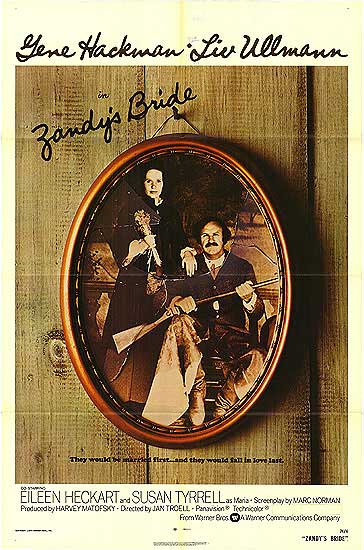
The Swedish filmmaker Jan Troell (pronounced like Noël), who routinely directs, writes, photographs, and edits his films, is an exception to this dismal rule. The international success of his two-part epic film The Emigrants/The New Land (1972), about a Swedish family's migration to America in 1850 was noticed sufficiently by Warner Bros. that he was offered to direct a script based on the novel The Stranger: A Novel of the Big Sur by Lillian Bos Ross. Troell didn't like the script and turned it down, but on reading the novel, part of a Big Sur Trilogy, he was impressed enough by it that he found another writer, Marc Norman, to adapt it. Troell called the film Zandy's Bride (1974).
The "story" of the film is, despite the rewrite, unremarkable: Zandy Allan, a cattle rancher in Big Sur, needs help running things, but instead of looking to hire extra hands, he opts for a mail order bride from Minnesota. He finds an ad in a newspaper classified section:
RESPECTABLE spinster, American stock, wants life in the West. Wishes to marry. Reply P.O. Box 192, Minneapolis, Minnesota.
He puts on a clean, ill-fitting white shirt and rides all the way down to an incongruous outpost smack on the coast where the woman from Minnesota, Hannah Lund, has just arrived by stage. After sizing each other up, he chides her for lying (by 7 years) about her age, telling her she's "on the long side of child-bearing."
Immediately we are faced with incongruity. The leads are Liv Ullmann and Gene Hackman. Ullmann had shown up to act in the film, whereas Gene Hackman showed up to be Gene Hackman. In every film he's exactly the same, no matter how he's dressed or what he's saying. Ullmann is given so little to work with, but you can see her working with it, filling out her period costume like she's been dressed like that all her life, assured, responsive, engaged with her role and the "West" that Troell introduces to us. She makes us wonder what drove her to place that ad. Gene Hackman interests us only so far as his actions divulge, and his limitations are visited upon Zandy.
The two are married then and there, and after the long ride back up the mountain Zandy stables the horses and returns to the house to find Hannah passed out in bed in her traveling clothes. There follows a scene that makes it very hard for us to like Zandy much further. "I got the right!" he screams as he violently rapes her. The following morning he acts like what transpired either didn't happen or was unimportant. He spends the day with his cattle and returns to find some improvements to what Hannah calls his "pigsty." Gradually they wear each other down - she growing tougher, he growing gentler. The result is, of course, no surprise, but the progress to the film's anticlimax holds a few surprises. Some beautiful scenes unfold as Zandy becomes captivated by the beauty of Hannah, reminding me how, for about a decade, between Persona and The New Land, everyone seemed to be in love with Liv Ullmann. Jordan Cronenweth does capture some lovely images: of Zandy and Hannah at table, lit by the light coming off a basket of wildflowers on the table between them, or Zandy watching in admiration as Hannah brushes her long blonde hair by the firelight. Cronenweth certainly might have had some guidance from Troell, or indeed from George Oddner, who is listed in the end credits as "consultant to Jan Troell". Some things, however, don't work so well. Like the scene in which Zandy engages in hand to claw combat with a not very large black bear. The bear-mawling of Leo DiCaprio in The Revenant, albeit abetted by CGI, has set an impossibly high bar for any such scenes.
Troell was promised that he could also operate the camera, but the American cinematographers' union threatened to fine the appointed director of photography (Jordan Cronenweth) $500 every time Troell touched the camera. The result of depriving Troell of access to the camera, which introduced more cooks to the kitchen, is what really prevented Zandy's Bride from getting off the ground. “The biggest difference for me about working in America was the number of people around the camera. In the centre, it’s the same, the relationship between the director, the actors and the camera." (1) Troell started in film as a cinematographer, and he had operated the camera in his four feature films in Sweden. Forced to block only actors (deciding where they should stand in relation to the design that isn't his own), instead of his camera taking part in the blocking must have been crippling for Troell. The photography of his Swedish films is a marvelous voyage of discovery for the viewer.
Zandy's family - father, mother, and a brother - are introduced, only to give the viewer a good idea where Zandy learned about domestic violence. A Mexican woman, Maria Cordova (played by Susan Tyrrell, who was misidentified as "Maria Cordova" in The New York Times review of the film)(2), with whom Zandy has a history, gives the story - and Zandy - an excuse to go astray from Hannah's story, which is the reason the film exists. At least Tyrrell doesn't subject the viewer to her usual crazy lady schtick, for which she was nominated for an Oscar in John Huston's Fat City (1972).
Zandy's Bride gave me the feeling that what attracted Troell to the story's possibilities in direct human terms was precisely what turned critics away from it. You find yourself waiting for something to happen in the film and then you realize what happened went right on by without your noticing it: the gradual action of one force upon another, each resistant to the influence of the other, in which the trajectories of both are eventually altered. The notion that Zandy's Bride is somehow in the tradition of a Western is more than a little silly when you remember that Troell accomplished one of the greatest sequences on the theme of the West in The New Land, when Karl Oskar's brother Robert and his slow-witted friend Arvid trek all the way to California to strike gold, to encounter only death and disappointment. Troell's camera showed us no sweeping vistas, no Monument Valley horizons, no sense of immensities except what the face of Eddie Axberg, who plays Robert, discloses. It is all up close, through the mud and the dirt and the pain, with a bare minimum of dialogue and a handful of other actors. Yet it says so much more about the tragedy of the West than a thousand Westerns.
Zandy's Bride got some positive notices, but not enough with which to build a Hollywood career. Troell returned to Sweden none the worse for his experience. The most significant reason for Troell's failure in Hollywood was much more fundamental than his lack of control over the camera: a filmmaker's nationality is essential to his work. Remove him from his native soil and native language - his ethos - and he is more than simply uprooted. He has lost his frame of reference, his ability to navigate the strange new world around him. Troell returned to Sweden to make Bang! (1977), and finished Hurricane (1979), which Roman Polanski was hired to direct before his sexual predilections ended his own Hollywood career. While making Hurricane, Troell met the Swedish journalist, Agneta Ulfsater, who would become his wife. So Troell emerged the winner from his encounter with Hollywood.
(1) Troell to Michael Dwyer, "A Life Calling the Shots," The Irish Times, May 21, 2009.
(2) Howard Thompson, The New York Times, May 20, 1974.
"Without preferences a critic would be a monster."
- Vernon Young(1)
As taste deteriorates, lists proliferate. The BBC, evidently always looking for ways to kill time, has compiled yet another "Top 100" list. Not, this time, of the 100 Greatest Orchestra Conductors from Birkina Faso. Nor of the 100 Greatest Opera Tenors who prefer Pepsi to Coke. (Maybe I shouldn't give them ideas.) This time, it's THE 100 GREATEST FOREIGN-LANGUAGE FILMS. Here's what they came up with, in their proper order (titles in bold are my own favorites):
1. Seven Samurai (Akira Kurosawa, 1954)
2. Bicycle Thieves (Vittorio de Sica, 1948)
3. Tokyo Story (Yasujiro Ozu, 1956)
4. Rashomon (Akira Kurosawa, 1950)
5. The Rules of the Game (Jean Renoir, 1939)
6. Persona (Ingmar Bergman, 1966)
7. 8 1/2 (Federico Fellini, 1963)
8. The 400 Blows (François Truffaut, 1959)
9. In the Mood for Love (Wong Kar-wai, 2000)
10. La Dolce Vita (Federico Fellini, 1960)
11. Breathless (Jean-Luc Godard, 1959)
12. Farewell My Concubine (Chen Kaige, 1993)
13. M (Fritz Lang, 1931)
14. Jeanne Dielman ... (Chantal Akerman, 1975)
15. Pather Panchali (Satyajit Ray, 1955)
16. Metropolis (Fritz Lang, 1927)
17. Aguirre, Wrath of God (Werner Herzog, 1972)
18. A City of Sadness (Hou Hsiao-hsien, 1989)
19. The Battle of Algiers (Gillo Pontecorvo, 1966)
20. The Mirror (Andrei Tarkovsky, 1975)
21. A Separation (Asghar Farhadi, 2011)
22. Pan's Labyrinth (Guillermo del Toro, 2006)
23. The Passion of Joan of Arc (Carl Theodore Dreyer, 1928
24. Battleship Potemkin (Sergei Eisenstein, 1925)
25. Yi Yi (Edward Yang, 2000)
26. Cinema Paradiso (Giuseppe Tornatore, 1988)
27. The Spirit of the Beehive (Victor Erice, 1973)
28. Fanny and Alexander (Ingmar Bergman, 1982)
29. Oldboy (Park Chan-wook, 2003)
30. The Seventh Seal (Ingmar Bergman, 1957)
31. The Lives of Others (Florian Henckel von Donnersmarck, 2006)
32. All About My Mother (Pedro Almodóvar, 1999)
33. Playtime (Jacques Tati, 1967)
34. Wings of Desire (Wim Wenders, 1987)
35. The Leopard (Luchino Visconti, 1963)
36. La Grande Illusion (Jean Renoir, 1937)
37. Spirited Away (Hayao Miyazaki, 2001)
38. A Brighter Summer Day (Edward Yang, 1991)
39. Close-Up (Abbas Kiarostami, 1990)
40. Andrei Rublev (Andrei Tarkovsky, 1966)
41. To Live (Zhang Yimou, 1994)
42. City of God (Fernando Meirelles & Kátia Lund, 2002)
43. Beau Travail (Claire Denis, 1999)
44. Cleo from 5 to 7 (Agnès Varda, 1962)
45. L'Avventura (Michelangelo Antonioni, 1960)
46. Children of Paradise (Marcel Carné, 1945)
47. 4 Months, 3 Weeks and 2 Days (Cristian Mungiu, 2007)
48. Viridiana (Luis Buñuel, 1961)
49. Stalker (Andrei Tarkovsky, 1979)
50. L'Atalante (Jean Vigo, 1934)
51. The Umbrellas of Cherbourg (Jacques Demy, 1964)
52. Au Hasard Balthazar (Robert Bresson, 1966)
53. Late Spring (Yasujiro Ozu, 1949)
54. Eat Drink Man Woman (Ang Lee, 1994)
55. Jules and Jim (François Truffaut, 1962)
56. Chungking Express (Wong Kar-wai, 1994)
57. Solaris (Andrei Tarkovsky, 1972)
58. The Earrings of Madame de ... (Max Ophuls, 1953)
59. Come and See (Elem Klimov, 1985)
60. Contempt (Jean-Luc Godard, 1963)
61. Sansho the Bailiff (Kenji Mizoguchi, 1954)
62. Touki Bouki (Djibril Diop Mambéty, 1973)
63. Spring in a Small Town (Fei Mu, 1948)
64. Three Colors: Blue (Krzysztof Kieślowski, 1993)
65. Ordet (Carl Theodore Dreyer, 1955)
66. Ali: Fear Eats the Soul (Rainer Werner Fassbinder, 1973)
67. The Externinating Angel (Luis Buñuel, 1962)
68. Ugetsu (Kenji Mizoguchi, 1953)
69. Amour (Michael Haneke, 2012)
70. L'Eclisse (Michelangelo Antonioni, 1962)
71. Happy Together (Wong Kar-Wai, 1997)
72. Ikiru (Akira Kurosawa, 1952)
73. Man With a Movie Camera (Dziga Vertov, 1929)
74. Pierrot le fou (Jean-Luc Godard, 1965)
75. Belle de Jour (Luis Buñuel, 1967)
76. Y tu Mamá También (Alfonso Cuaron, 2001)
77. The Conformist (Bernardo Bertolucci, 1970)
78. Crouching Tiger, Hidden Dragon (Ang Lee, 2000)
79. Ran (Akira Kurosawa, 1985)
80. The Young and the Damned (Luis Buñuel, 1950)
81. Celine and Julie Go Boating (Jacques Rivette, 1974)
82. Amélie (Jean-Pierre Jeunet, 2001)
83. La Strada (Federico Fellini, 1954)
84. The Discreet Charm of the Bourgeoisie (Luis Buñuel, 1972)
85. Umberto D (Vittorio De Sica, 1952)
86. La Jetée (Chris Marker, 1962)
87. The Nights of Cabiria (Federico Fellini, 1957)
88. The Story of the Last Chrysanthemum (Kenji Mizoguchi, 1939)
89. Wild Strawberries (Ingmar Bergman, 1957)
90. Hiroshima Mon Amour (Alain Resnais, 1959)
91. Rififi (Jules Dassin, 1955)
92. Scenes from a Marriage (Ingmar Bergman, 1973)
93. Raise the Red Lantern (Zhang Yimou, 1991)
94. Where Is the Friend's Home? (Abbas Kiarostami, 1987)
95. Floating Clouds (Mikio Naruse, 1955)
96. Shoah (Claude Lanzmann, 1985)
97. Taste of Cherry (Abbas Kiarostami, 1997)
98. In the Heat of the Sun (Jiang Wen, 1994)
99. Ashes and Diamonds (Andrzej Wajda, 1958)
100. Landscape in the Mist (Theo Angelopoulos, 1988)
Though this list isn't as bad as some others (only because it's about foreign language films), it won't satisfy anyone. If you asked 200 literary critics to name the Top 100 Foreign Language Novels, you would probably reach a much better consensus. Literature doesn't attract fans in anything like the numbers film does. There is simply no other way to account for Claire Denis's Beau Travail outranking L'Avventura, or Amélie sitting there stupidly three jumps ahead of Umberto D.
I haven't seen 28 of the films on the list. But that's preferable to simply forgetting magnificent films like Le Jour se Leve, Open City, Smiles of a Summer Night, Lacombe Lucien, The Sorrow and the Pity, and the great filmmakers Eric Rohmer, Claude Chabrol, Ermanno Olmi, Mario Monicelli, Masaki Kobayashi, and Jan Troell. These lists are good for critical parlor games: what they reveal is sometimes counterproductive to their intentions. As someone has already pointed out, there are more films on the list from directors named Jean than from women. The statistics have changed dramatically in the past few decades, but exactly what percentage of filmmakers worldwide are women? Far from anything like parity, my guess. It has been forty years since Lina Wertmüller burst onto the world film scene, and a backlash (led, amazingly, by Feminist critics) has brought her down several pegs, but I still regard her as the greatest woman filmmaker. Just thinking about her makes me want to watch Love and Anarchy again, the story of a hapless, pimple-faced anarchist hiding out in a Roman brothel, waiting for an opportunity - that never materializes - to assassinate Mussolini.
How long does it take - should it take - for a new film to enter a canon? In the 1950s and '60s, it took only three years. I wrote about this in 2012, when the latest Sight and Sound Top Ten Critics' Poll was published: "The sense of permanence has long since, I think, gone out of discussions about films - especially Great Films, which the polls have inadvertently, decade after decade, demonstrated. Simply examine the newest film in each of the polls. In 1952, Bicycle Thieves was number one (it now ranks thirty-third) and was just three years old. In 1962, L'avventura was also just three years old. In 1972, Persona was the newest film in the poll, but it was made six years before. This sense that the art of film was a contemporary, ongoing phenomenon quickly began to fade. In 1982, 8 1/2 was the most recent film in the poll, made nineteen years before. In 1992, 2001: A Space Odyssey made its first appearance in the poll, thanks to its restoration and subsequent rediscovery. But it was a twenty-four year old film by then. By 2002, film's slide into the past was to The Godfather, a thirty year old film. In the latest poll, 2001 is again the newest film, except it has got twenty years older since 1992. So the latest film judged great enough to be in the top ten was made forty-four years ago."(2) (Written six years ago.)
So these attempts to create a canon, while filmmakers were engaged in the process of discovering a unified aesthetic for the medium, and while critics were struggling to account for their struggles, are stymied because the works that were central to our understanding of what constitutes film art kept shifting positions. The only answer to the question, What makes a film a work of art? has got to be, When it is made by an artist.
I can always tell an auteurist (but I can't tell him much). They are big on bestowing auteurship on the unlikeliest people (I get the feeling that eventually everyone who ever made a film will be an auteur), but they are terrible at naming what films made by each and every auteur are better than others. The list gives them away in several places. 4 Andrei Tarkovsky films, each one progressively worse than Ivan's Childhood (1961, which is at least unpretentious). I am not fond of Fassbinder, but surely Berlin Alexanderplatz , though a long way from the Döblin novel, is his best? I like Buñuel very much, but surely The Exterminating Angel, The Discreet Charm of the Bourgeoisie and Belle de Jour are poor examples of his surrealist art? I would replace them with L'Age d'Or (1930), Simon of the Desert (1965) and That Obscure Object of Desire (1977). Krzysztof Kieślowski is a bit overrated, but surely Three Colors: Blue is the worst part of the trilogy. Why not Dekalog (1989-90)? Bresson has only one film on the list, but it is neither Diary of a Country Priest (1950) nor A Man Escaped (1956), better examples of his austere style by far than Au hasard Balthazar. Godard is represented by three films, #s 11, 60, and 74. Breathless was his breakthrough, but Band of Outsiders (1964) and A Married Woman (1964) are immeasurably preferable to Contempt and Pierrot le fou. Making room for 4 Fellini films, then leaving out I Vitelloni (1953)? 5 Bergman films, including his muddled Fanny and Alexander, but ignoring Smiles of a Summer Night (1955 - easily one of the half-dozen most perfect films ever made), the early masterpiece Sawdust and Tinsel (1953), and the best of his chamber films, Winter Light (1962)? I realize that Rossellini's boat has sailed (so has Mizoguchi's), but Open City (1945) remains historically important. Shoah is ranked 96th. According to what aesthetic criteria? I don't mean to suggest that Claude Lanzmann's epochal film is not artfully made (it is deceptively, hypnotically fascinating), but however formidable its artistic merits are, Shoah stands alone and shouldn't have to jockey for position among the likes of Rififi and Amélie.
Further Objections. If you're going to limit Alain Resnais to one film, and you've included Chris Marker's short film La Jetée, why not let Resnais's sole film be Night and Fog (1955), which not only has great artistic merit, but historical relevance as well.
According to the BBC's list, the best decades for film were the 1950s (21 films) and the '60s (19 films). The worst decades were the 1920s and '40s (each with only 4 films).
What is most revealing in the latest lists is the critics' apparent inability to distinguish between what they like and what is good. How can one tell the difference? I like hotdogs, but I know what they're made of. No one is claiming that hotdogs are good food. So why are some critics so enamored of hotdogs like In the Mood for Love or The Spirit of the Beehive or All About My Mother?
But all these lists, which are increasing in number and absurdity, are a symptom of a serious problem among educated people. You can see it in all of the television talent competitions, each more irritating than the next, and even with the cooking competitions and the bake-offs. Self expression, which comes in a myriad of forms, can't be compared or reduced to a competitive sporting event. Some people won't read a book unless they see it listed as a Best Seller. And others want everything to be classified before they can bring themselves to read it or listen to it or watch it. They want to know beforehand if it's worthy of their attention, supposedly because they think that they have so little time to waste. Before they will consent to consuming it, they need it to be pre-digested. The very last thing they want is to be left out of a conversation, but the cultivation of taste that is exclusively their own, without the reinforcement of a support group, is inconceivable. The notion that they could be alone in their preference for a particular book or film or television program terrifies them. What good is personal taste if it isn't shared by others?
(1) Vernon Young, "Somewhat Less Than a World," The Hudson Review, Spring 1967.
(2) see "Poll Position," Widower's Tango, August 9, 2012.