Showing posts with label Jan Troell. Show all posts

Saturday, March 14, 2020

Flight of the Eagle

Max von Sydow, who died last Sunday at the age of 90, was more than just one of the great screen actors who, like too many others I could mention, lavished his talents on mediocre star vehicles. Though he finally succumbed to the lure of Hollywood in 1965, he was lucky enough to work multiple times with two great filmmakers in his native Sweden - eleven films with Ingmar Bergman and seven with Jan Troell. Although it was with Bergman that he received the most attention, in iconic roles like the knight Blok in The Seventh Seal, who outwits Death in a game of chess, and Töre in The Virgin Spring, who savagely avenges the rape and murder of his daughter, it was for Troell that von Sydow gave his most convincing (and comprehensive) performances. He is at the center of the six-and-a-half hour Emigrants saga, playing Karl Oskar, the patriarch of a Swedish family that emigrates to Minnesota in the mid-19th century. He was totally convincing playing Knut Hamsun in the biopic Hamsun. But it was in the relatively overlooked Flight of the Eagle (Ingenjör Andrées Luftfärd, 1982) that von Sydow gave what one critic called "a magnificent, stricken-oak performance,"(1) and that I wish to use as his memorial.

Troell derived the story of the film from Per Olof Sundman's 1967 documentary novel of Salomon August Andrée, an engineer and a staunch technocrat with an interest in ballooning, who came up with the bold idea of flying a hydrogen balloon across the North Pole. In 1896, nearing the very end of the Age of Discovery, Andrée managed to persuade the Swedish King, Oscar II, the Royal Swedish Academy of Sciences and Alfred Nobel that the expedition was feasible. It was accepted as a bold plan that would bring prestige to the nation and funding was provided.(2) Andrée recruited two men, Knut Fraenkel and Nils Strindberg, and together they trained and outfitted themselves for the journey. The film devotes all the time it needs to these preliminary stages, with its private and public details, to establish not just their historical context but to give convincing life to the three men, to salvage them from history. Troell is abetted in these efforts by his actors, Sverre Anker Ousdal as Fraenkel and Göran Stangertz as Strindberg. Max von Sydow gives us Andrée, a man of some accomplishment who is quite overwhelmed by the efforts of those he has inspired in the realization of his dream. He is neither a fool nor a dreamer, but a practical man of science who, the film makes clear, gets in over his head when he is given the opportunity, in the summer of 1897, to put his plans into action.

The balloon, christened the "Eagle," doesn't leave the ground in Spitzbergen until fifty-five minutes into the film.  Just after it is airborne, the balloon is caught in a downdraft and nearly sinks in the ocean. The crew throw enough ballast overboard to raise the balloon, but the accident also severs two of the three long guide-ropes which were going to be used to navigate the balloon. The men notice this, as do members of the ground crew, but the balloon continues on its way. And just sixty-five hours later - thirteen minutes in the film - it is on the ice, never to rise again. What ultimately brought the balloon down was ice buildup on the rigging and gondola, making it too heavy to gain the altitude it needed. From the time when the balloon drifted out of sight in Spitzbergen, the script had to rely on notes taken by Andrée to re-create events, simply because the fate of the expedition remained unknown until 1930. Troell opens the film with photographs taken of the remains that were discovered, including the bones of Andrée himself.

The last hour of the film, when the balloon is brought down and the men have packed sledges to make the trek across pack ice to the nearest island, is one of the most grueling stretches of film ever recorded.(3) Even so, I wondered at Troell’s use of flashbacks, as all three men find in their memories something to give them comfort or strength for the days ahead. I think the last hour would’ve been more harrowing if it had been unrelieved by the men’s glowing (and so splendidly colorful) flashbacks. One moment, however, is unforgettable: Strindberg opens a locket containing a picture of his fiancée and a lock of her hair, he removes the hair and touches it to his swollen and chapped lips.

Once they arrive on Kvitoya, a small island east of Svalbard, the film enters its final phase. Strindberg, whose photographs appear throughout the film (his photographic plates were discovered among the team’s remains) is the first to go. His body was found in a makeshift grave on the island, but there is speculation about the circumstances of his death. Some believe he may have committed suicide, others that he was killed by a polar bear. Troell simply shows him collapsing suddenly on the ice. When only Andrée and Fraenkel are left, Troell shows them, near the end, having a bitter argument, but they embrace pitifully when they realize that all they have left is each other. It is a heartbreaking moment.

It was a time when no one was around to ask the simple question, "What could possibly go wrong?" Flight of the Eagle is more than just a careful record of a doomed expedition. Yes, it was Andrée’s folly. But Troell gives the account a tragic dimension. In the film’s last moments, in which Fraenkel is killed by a polar bear and Andrée begs him not to leave him on the blasted island entirely alone, Max von Sydow emerges from the tent and peers around him at the eventless horizon, one that seems to merge the sky and the earth, and the look in his eyes is devastating. It is a moment that calls to mind a speech by Hamlet:

... this goodly frame the earth, seems to me a sterile promontory; this most excellent canopy the air, look you, this brave o'er hanging firmament, this majestical roof, fretted with golden fire: why, it appeareth no other thing to me, than a foul and pestilent congregation of vapours. What a piece of work is man, How noble in reason, how infinite in faculty, In form and moving how express and admirable, In action how like an Angel, In apprehension how like a god, The beauty of the world, The paragon of animals. And yet to me, what is this quintessence of dust? Man delights not me. (4)

(1) Vernon Young.
(2) It was the same spirit of adventure that Terry Jones and Michael Palin so brilliantly mocked in their Ripping Yarns episode, "Across the Andes by Frog."
(3) When Flight of the Eagle was in limited release in the US, Gene Siskel and Roger Ebert, unwitting defenders of middlebrow taste, singled it out for derision on their popular TV show, Sneak Previews. When they showed the clip from the film of the balloon lying, deflated, on the ice and the three men saluting it, Siskel and Ebert both laughed, proving that a jackass can look into a mirror, but a philosopher can't look back.
(4) Act 2 Scene 2.

Thursday, July 11, 2019

Mr. Hulot's Holiday


    For some inexplicable reason, I decided yesterday to watch the 1953 debut of Jacques Tati's screen character Monsieur Hulot, Les Vacances de Monsieur Hulot, known to English-speaking audiences as Mr. Hulot's Holiday.(1) I haven't seen it since I wrote about it ten years ago on this blog in a post I called "A Brief Vacation." But I remember the experience of watching it for the first time in a theater almost forty years ago. I felt then that it was charming - sufficiently delightful to justify its reputation. It is a bonafide classic - which means that most people accept it unquestioningly as an untouchable masterpiece, to place proudly alongside Chaplin's City Lights or Keaton's Sherlock, Jr. But what, then, is a "classic"? In his 1975 piece, "Jan Troell: A Portrait," Vernon Young makes an oh-so-necessary point: "If the word classic has any value left (after being attributed to movies which are merely old and, if truth be said, often inhumanly tedious), Here Is Your Life and the brace of Emigrant films are classics; they define with unique richness the material of which they are composed."(1)

In his 2004 essay for Criterion, David Ehrenstein called Mr. Hulot's Holiday, "One of the most original—and hilarious—comedies ever made."(2) Really? Even Roger Ebert had reservations. "The first time I saw Jacques Tati's 'Mr. Hulot's Holiday,'" Ebert wrote in 1996, "I didn't laugh as much as I thought I was supposed to. But I didn't forget the film, and I saw it again in a film class, and then bought the laserdisc and saw it a third and fourth time, and by then it had become part of my treasure. But I still didn't laugh as much as I thought I was supposed to, and now I think I understand why. It is not a comedy of hilarity but a comedy of memory, nostalgia, fondness and good cheer. There are some real laughs in it, but 'Mr. Hulot's Holiday' gives us something rarer, an amused affection for human nature--so odd, so valuable, so particular."(3)

In my experience of Tati's film, the trajectory was reversed: the film has shrunk with each subsequent viewing. I get Ebert's point about the film's evocation of "memory, nostalgia, fondness and good cheer." The film is dripping with the mood of summer vacations - even of the strange compulsion to have them once a year, along with everyone else in the Western world. The crazy rush to the train station, the panic and congestion and the long journey off the been track to arrive - at last - at the beach. I am there completely. And the wistfulness of the end - it hurts a little every time I see it.

But after seeing it again on home video in the '80s, then on laserdisc, and DVD (every new medium gives us an excuse to watch all these old films again), it got smaller, thinner, less substantial each time. The word "charming" continues to rise to my fingertips. But I feel less obliged than ever to call the film great. Sixty-six years after it was made, if the word classic still has a meaning, Mr. Hulot's Holiday is not one.


(1) But why the Anglicism "Holiday" when Vacation is closer to "Vacance"?
(1) Vernon Young, "Jan Troell: A Portrait," reprinted by permission from Jan Troell, edited by Lars-Olof Lothwall (Stockholm: The Swedish Film Institute, 1975).
(2) "Mr. Hulot's Holiday," David Ehrenstein
(3) "Great Movie: Mr. Hulot's Holiday," November 6, 1996.

Tuesday, June 25, 2019

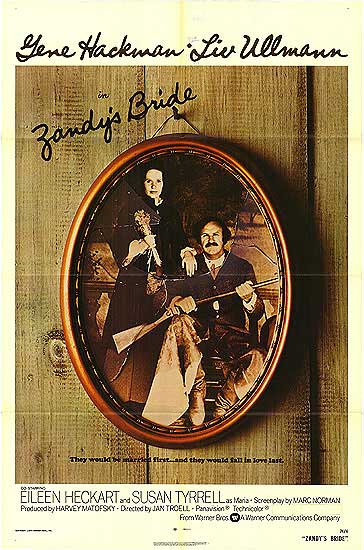
Zandy's Bride

From virtually the very beginning, in 1922 when, at the invitation of Mary Pickford, Ernst Lubitsch left his native Germany and moved to Southern California to make the film Rosita, successful foreign filmmakers have found the Hollywood pilgrimage irresistible. Lubitsch was followed, in no particular order, by F. W. Murnau, Victor Sjöström, Mauritz Stiller, Fritz Lang, Jean Renoir, Rene Clair, Max Ophüls, Michelangelo Antonioni, Milos Forman, Roman Polanski, Ivan Passer, Jan Kadar, Bill Forsythe, Louis Malle, Paul Verhoeven, Lina Wertmüller, Phillip Noyce, Peter Weir, Fred Schepisi, Lasse Hallström, Denis Villeneuve, Alfonso Cuarón, Guillermo del Toro, Alejandro G. Iñárritu ... the list is depressingly long. Lubitsch enjoyed a long and fruitful (in both commercial and creative terms) career in Hollywood. A majority of the others did not. For most, it gave their incomes a boost, but it took a significant toll on their art. Some of them managed to return to their native countries, with sad results. Their subsequent films failed to pick up the thread that they dropped upon going west.

The Swedish filmmaker Jan Troell (pronounced like Noël), who routinely directs, writes, photographs, and edits his films, is an exception to this dismal rule. The international success of his two-part epic film The Emigrants/The New Land (1972), about a Swedish family's migration to America in 1850 was noticed sufficiently by Warner Bros. that he was offered to direct a script based on the novel The Stranger: A Novel of the Big Sur by Lillian Bos Ross. Troell didn't like the script and turned it down, but on reading the novel, part of a Big Sur Trilogy, he was impressed enough by it that he found another writer, Marc Norman, to adapt it. Troell called the film Zandy's Bride (1974).

The "story" of the film is, despite the rewrite, unremarkable: Zandy Allan, a cattle rancher in Big Sur, needs help running things, but instead of looking to hire extra hands, he opts for a mail order bride from Minnesota. He finds an ad in a newspaper classified section:

RESPECTABLE spinster, American stock, wants life in the West. Wishes to marry. Reply P.O. Box 192, Minneapolis, Minnesota.

He puts on a clean, ill-fitting white shirt and rides all the way down to an incongruous outpost smack on the coast where the woman from Minnesota, Hannah Lund, has just arrived by stage. After sizing each other up, he chides her for lying (by 7 years) about her age, telling her she's "on the long side of child-bearing."

Immediately we are faced with incongruity. The leads are Liv Ullmann and Gene Hackman. Ullmann had shown up to act in the film, whereas Gene Hackman showed up to be Gene Hackman. In every film he's exactly the same, no matter how he's dressed or what he's saying. Ullmann is given so little to work with, but you can see her working with it, filling out her period costume like she's been dressed like that all her life, assured, responsive, engaged with her role and the "West" that Troell introduces to us. She makes us wonder what drove her to place that ad. Gene Hackman interests us only so far as his actions divulge, and his limitations are visited upon Zandy.

The two are married then and there, and after the long ride back up the mountain Zandy stables the horses and returns to the house to find Hannah passed out in bed in her traveling clothes. There follows a scene that makes it very hard for us to like Zandy much further. "I got the right!" he screams as he violently rapes her. The following morning he acts like what transpired either didn't happen or was unimportant. He spends the day with his cattle and returns to find some improvements to what Hannah calls his "pigsty." Gradually they wear each other down - she growing tougher, he growing gentler. The result is, of course, no surprise, but the progress to the film's anticlimax holds a few surprises. Some beautiful scenes unfold as Zandy becomes captivated by the beauty of Hannah, reminding me how, for about a decade, between Persona and The New Land, everyone seemed to be in love with Liv Ullmann. Jordan Cronenweth does capture some lovely images: of Zandy and Hannah at table, lit by the light coming off a basket of wildflowers on the table between them, or Zandy watching in admiration as Hannah brushes her long blonde hair by the firelight. Cronenweth certainly might have had some guidance from Troell, or indeed from George Oddner, who is listed in the end credits as "consultant to Jan Troell". Some things, however, don't work so well. Like the scene in which Zandy engages in hand to claw combat with a not very large black bear. The bear-mawling of Leo DiCaprio in The Revenant, albeit abetted by CGI, has set an impossibly high bar for any such scenes.

Troell was promised that he could also operate the camera, but the American cinematographers' union threatened to fine the appointed director of photography (Jordan Cronenweth) $500 every time Troell touched the camera. The result of depriving Troell of access to the camera, which introduced more cooks to the kitchen, is what really prevented Zandy's Bride from getting off the ground. “The biggest difference for me about working in America was the number of people around the camera. In the centre, it’s the same, the relationship between the director, the actors and the camera." (1) Troell started in film as a cinematographer, and he had operated the camera in his four feature films in Sweden. Forced to block only actors (deciding where they should stand in relation to the design that isn't his own), instead of his camera taking part in the blocking must have been crippling for Troell. The photography of his Swedish films is a marvelous voyage of discovery for the viewer.

Zandy's family - father, mother, and a brother - are introduced, only to give the viewer a good idea where Zandy learned about domestic violence. A Mexican woman, Maria Cordova (played by Susan Tyrrell, who was misidentified as "Maria Cordova" in The New York Times review of the film)(2), with whom Zandy has a history, gives the story - and Zandy - an excuse to go astray from Hannah's story, which is the reason the film exists. At least Tyrrell doesn't subject the viewer to her usual crazy lady schtick, for which she was nominated for an Oscar in John Huston's Fat City (1972).

Zandy's Bride gave me the feeling that what attracted Troell to the story's possibilities in direct human terms was precisely what turned critics away from it. You find yourself waiting for something to happen in the film and then you realize what happened went right on by without your noticing it: the gradual action of one force upon another, each resistant to the influence of the other, in which the trajectories of both are eventually altered. The notion that Zandy's Bride is somehow in the tradition of a Western is more than a little silly when you remember that Troell accomplished one of the greatest sequences on the theme of the West in The New Land, when Karl Oskar's brother Robert and his slow-witted friend Arvid trek all the way to California to strike gold, to encounter only death and disappointment. Troell's camera showed us no sweeping vistas, no Monument Valley horizons, no sense of immensities except what the face of Eddie Axberg, who plays Robert, discloses. It is all up close, through the mud and the dirt and the pain, with a bare minimum of dialogue and a handful of other actors. Yet it says so much more about the tragedy of the West than a thousand Westerns.

Zandy's Bride got some positive notices, but not enough with which to build a Hollywood career. Troell returned to Sweden none the worse for his experience. The most significant reason for Troell's failure in Hollywood was much more fundamental than his lack of control over the camera: a filmmaker's nationality is essential to his work. Remove him from his native soil and native language - his ethos - and he is more than simply uprooted. He has lost his frame of reference, his ability to navigate the strange new world around him. Troell returned to Sweden to make Bang! (1977), and finished Hurricane (1979), which Roman Polanski was hired to direct before his sexual predilections ended his own Hollywood career. While making Hurricane, Troell met the Swedish journalist, Agneta Ulfsater, who would become his wife. So Troell emerged the winner from his encounter with Hollywood.


(1) Troell to Michael Dwyer, "A Life Calling the Shots," The Irish Times, May 21, 2009.
(2) Howard Thompson, The New York Times, May 20, 1974.


Wednesday, January 6, 2010

Remastering the Film

When Charles Thomas Samuels (1936-1974) was writing his unfinished book, Mastering the Film, which was to be his overview of film from the perspective of its greatest directors, he arrived at a list of twelve filmmakers, each of whom had created at least two great films and had arrived at an individual style. The twelve filmmakers were Antonioni, Bergman, Bresson, Clair, De Sica, Fellini, Hitchcock, Olmi, Reed, Renoir, Truffaut, and Vigo.

The structure of Samuels' book appeared to force some of his choices upon him. His prejudices took care of the rest. For example, Samuels was honest enough to admit to feeling "deracinated" by the work of Asian filmmakers, and disqualified himself from passing judgement on them. Clearly, Jean Vigo did not live long enough to show us the full extent of his gifts. What remains is tantalizing but ultimately unsatisfying. I agree with Vernon Young's assessment of the work of René Clair, which he epitomized as "champagne on corn flakes." My own estimation of Bresson's work is common knowledge to readers of this blog. I would add that his hatred of actors is typical of filmmakers who insist on absolute control of every aspect of the creative process. Antonioni hated actors as much as Bresson, but at least he recognized that he needed their contribution to his work. The less said about Hitchcock, the better. His influence on the work of Truffaut was deleterious in the extreme.

Due perhaps to a lack of enthusiasm from publishers, the reception of his book of interviews with many of the his chosen filmmakers, Encountering Directors (1), and his own unforgiving self-criticism, ultimately resulting in his suicide, Samuels came nowhere near to finishing Mastering the Film. Tantalizing fragments were published posthumously both in his honor and to provide financial relief for his surviving wife and children.

I hang on to the memory of Samuels if only because film criticism on the level at which he was writing for publications like The American Scholar and The Hudson Review remains extremely rare, and because, knowing the lengths of his commitment to what he wrote and what he was writing about, I know that I will never be as good a critic as he was.

The following exchange between Samuels and Michelangelo Antonioni, included in Encountering Directors, reveals just how much Samuels expected of film, and one of the reasons that his splendid book was so slighted by journalistic reviewers:

Samuels: By the end of L'avventura, Sandro recognizes that his promiscuity is harmful to Claudia, with whom he has had the one intense relationship of his life, so far as we know. Do you mean us to believe that his ensuing guilt (inspiring him to tears) is an error because what makes him feel this guilt are conceptions of romantic love and personal responsibility that have become irrelevant burdens?

Antonioni: Sandro is a character from a film shot in 1960 and is therefore entirely immersed in such moral problems. He is an Italian, a Catholic, and so he is a victim of this morality. What I said awhile ago is that such moral dilemmas will have no right to exist in a future that will be different from the present. Today we are just beginning to glimpse that future, but in 1960 we lived in a country with the Pope and the Vatican, which have always been extremely important to all of us. There isn't a school in Italy still, not a law court without its crucifix. We have Christ in our houses, and hence the problem of conscience, a problem fed to us as children that afterward we have no end of trouble getting rid of. All the characters in my films are fighting these problems, needing freedom, trying to find a way to cut themselves loose, but failing to rid themselves of conscience, a sense of sin, the whole bag of tricks.

Samuels: I don't think you're proposing something that's only a matter of time. Would it indeed ever be good to dispense with the bag of tricks, as you call it? I wonder if we shouldn't be more proud of this tradition going back to Homer than of the trip to the moon. Speaking only for myself-no, I'm sure I speak for others, too-the ending of L'avventura is so powerful because Sandro has the conscience to regret what he has done. To feel such regret, one has to believe in the supreme importance of human responsibility, and I can't conceive of art without that belief.

I could not begin to write as comprehensive a study as Samuels devised. But if I were to come up with my own list of filmmakers to include in such a study, it would look like the following.

Gianni Amelio (b. 1945)
Michelangelo Antonioni (1912-2007)
Bruce Beresford (b. 1940)
Ingmar Bergman (1918-2007)
Jean-Pierre Dardenne (b. 1951) Luc Dardenne (b. 1954)
Federico Fellini (1920-1993)
Shohei Imamura (1926-2006)
Hirokazu Koreeda (b. 1962)
Akira Kurosawa (1910-1998)
Yasujiro Ozu (1903-1963)
Jean Renoir (1894-1979)
Vittorio De Sica (1901-1074)
Bertrand Tavernier (b. 1941)
Jan Troell (b. 1931)
Zhang Yimou (b. 1951)


Several filmmakers who did not make my list, for one or another reason, would make my list of Honorable Mentions: Claude Autant-Lara, Robert Bresson, Luis Buñuel, Claude Chabrol, Kon Ichikawa, Masaki Kobayashi, David Lean, Louis Malle, Ermanno Olmi, François Truffaut, Carol Reed, Andrzej Wajda, and Lina Wertmuller. I will expound on my choices next week.


(1) In his interview with Bresson, Samuels quoted a proverb that best explains the critical reception of Encountering Directors: "A jackass can look into a mirror, but a philosopher can't look back."