Reading the final volume of the Journals of Henry David Thoreau, that begins in December 1859, he mentions - though not by name - the fate of John Brown:
"His late career - these six weeks, I mean - has been meteor-like, flashing through the darkness in which we live. I know of nothing more miraculous in all history."
Brown, who had been a radical abolitionist, by the mid-1850s saw no other way to bring about an end to slavery except through violence. On the night of October 16, 1859, with a handful of men Brown staged a raid on Harper's Ferry federal armory in Virginia. He was planning to use the weapons he seized to arm slaves and incite a slave rebellion in the Appalachian region. The raid was a catastrophe and Brown was captured by Union marines, led by Colonel Robert E. Lee. On the 2nd of December, Brown, found guilty of "Treason against the state of Virginia; murder; conspiracy" was hanged. His trial and execution was one of the catalysts that brought about the secession of slave-owning states the following year and the start of the Civil War. A popular song sung by Union soldiers in the war was "John Brown's Body":
John Brown's body lies a-mouldering in the grave;
His soul's marching on!
I have often wondered why no one has made a film about John Brown. Thoreau himself pointed out "No theatrical manager could have arranged things so wisely to give effect to his behavior and words. And who, think you, was the Manager? Who placed the slave-woman and her child between his prison and the gallows?"
Since the end of the war, Brown's legacy has suffered huge swings of interpretation. As James W. Loewen, author of Lies My Teacher Told Me, a critical survey of the misrepresentation of American history in public school history textbooks, wrote: "The treatment of Brown, like the treatment of slavery and Reconstruction, has changed in American history textbooks. From 1890 to about 1970, John Brown was insane. Before 1890 he was perfectly sane, and after 1970 he regained his sanity. Since Brown himself did not change after his death, his sanity provides an inadvertent index of the level of white racism in our society."
Brown's last words to the tribunal that condemned him are rational, succinct, and noble. Hardly the words of a lunatic who knows he is condemned to die:
This Court acknowledges too, as I suppose, the validity of the LAW OF GOD. I saw a book kissed, which I suppose to be the BIBLE, or at least the NEW TESTAMENT, which teaches me that, "All things whatsoever I would that men should do to me, I should do even so to them." It teaches me further, to "Remember them that are in bonds, as bound with them." I endeavored to act up to that instruction. I say I am yet too young to understand that GOD is any respecter of persons. I believe that to have interfered as I have done, as I have always freely admitted I have done, in behalf of his despised poor, I have done no wrong, but RIGHT. Now, if it is deemed necessary that I should forfeit my life, for the furtherance of the ends of justice, and MINGLE MY BLOOD FURTHER WITH THE BLOOD OF MY CHILDREN, and with the blood of millions in this Slave country, whose rights are disregarded by wicked, cruel, and unjust enactments, – I say; LET IT BE DONE.
Given the schizophrenic representation of John Brown in the popular imagination that James Loewen describes, it's no wonder that, on the few occasions that American film depicted Brown, he was either an obvious madman or a blundering fool, from Abe Lincoln in Illinois (1940), Santa Fe Trail (1940), to Seven Angry Men (1955). All three films have Raymond Massey in common, playing Lincoln in the first and Brown in the other two.(1) I want to concentrate on Santa Fe Trail, which follows John Brown's career from Kansas to Virginia, interpolated with an invented and preposterous subplot involving Ronald Reagan as George Armstrong Custer. The film puts Custer at Harper's Ferry, which is fanciful history - Custer was 19 at the time and still at West Point.
Where do I start to attack this film? Evidently Robert Buckner, who wrote the script, saw the dramatic potential of John Brown's fateful final years. But then Warner Brothers told him that it needed more scenes of Jeb Stuart (Errol Flynn) and, just for the hell of it, George Custer, together at West Point in 1854, two years later in a competition to win the hand of a Kansas belle who never existed named "Kit Carson" Holliday (Olivia De Havilland, who just celebrated - if that is the word - her 103rd birthday), and participating in the military response to the Harper's Ferry raid. Along the way, Stuart battles Brown in Kansas and, at the film's climax, in Virginia. Tasmanian Errol Flynn is more wooden than the scaffold on which they hanged John Brown. Ronald Reagan, who was still a New Deal Democrat and had married Jane Wyman earlier in 1940, is miscast as Custer, but he is not nearly as out of place as Olivia De Havilland. After one of Brown's sons informs on him (another fabrication), De Havilland has this exchange with Flynn:
Kit: Oh, Jeb. I'm frightened. That boy is crippled for life. And that man on the train. He died for a principle. And a man killed him for a principle. One of them is wrong, but which one?
Stuart: Who knows the answer to that, Kit? Everybody in America is trying to decide.
Kit: Yes, by words in the East and by guns in the West. But one day the words will turn into guns. Oh, Jeb. Can't it be stopped now? Can't the slaves be freed before it's too late?
Stuart: It will be stopped when we hang John Brown. Then the South can settle our own problem without loss of pride by being forced into it by a bunch of fanatics.
Kit: Oh, Jeb. What does pride have to do with human lives?
Stuart: Kit, the two things kind of come together down South. Can't pry them apart, not even with guns.
Made the year following the sensational release of Gone With the Wind, a film whose distortions of history make it unwatchable today, Santa Fe Trail throws the deadly serious history of Brown's erratic but purposeful opposition to slavery under the wagon with the useless distraction of the subplot. Brown himself, played by Raymond Massey, is represented as a dangerous fanatic, and his cause, which resulted in a 4-year war, killing more than 600,000 Americans, is shown to have been tragically unnecessary. This horrible misreading of history was intended, we are assured, to dismiss the "hard feelings" between the North and the South when, in 1940, the nation was sitting out the war against fascism in Europe, knowing they would eventually be drawn into it. You see? We Americans can unite against a common cause if we can just overcome our differences.
If nothing else, Santa Fe Trail is a reminder of what a horrific place the United States was in in 1859, when the subject of slavery was one that politicians had to tiptoe around so as not to offend or alarm the slave states. In 1860, Abraham Lincoln, the candidate of the Republican Party, ran on a platform that was not overtly abolitionist, but that sought to limit the ownership of slaves to the South and prevent it from being established in the new territories in the West awaiting statehood. As conciliatory as Lincoln's position was, for he knew that he could not win the presidency if he alienated voters in the southern states, within a month of his inauguration in March 1861 South Carolina seceded from the Union, the outpost on the garrison of Fort Sumter was besieged, and the Civil War commenced.
As disgraceful as it is to distort the past (the Civil War was only dimly remembered in 1940), trying to subvert the lessons of the past is contemptible. Americans have never taken the Civil War seriously, so how can we be expected to learn anything from it? If George Santayana's famous warning about repeating the past were to come true, stupid and meretricious Hollywood movies like Santa Fe Trail can be used as evidence against us. Gone With the Wind remains one of the highest-grossing films of all time, so it's no surprise that Santa Fe Trail was one of Warner Bros. biggest hits of 1940.
The film omits Brown's speech at his trial, and instead inserts an absurd speech on the gallows in which he strikes a Messianic pose. Stuart sees Kit wiping a tear from her eye. "Don't, Kit," he tells her. "He was born for this." And Kit replies, "I'm not crying for him, Jeb. I see something else up there - something much more terrible than just one man." Sparing us the moment of Brown falling through the trap door, we see instead Robert E. Lee, who says, "So perish all such enemies of the Union, all such foes of the human race." But Lee was another such enemy of the Union, and he wasn't hanged.
(1) The director of Abe Lincoln in Illinois, John Cromwell, played John Brown.
Wednesday, July 31, 2019
Friday, July 26, 2019
Who Killed Colm Tóibín?
On July 22, The Irish Times published a short interview with the brilliant Irish novelist Colm Tóibín that conveyed a few specifics about his personal taste, what books he's been reading and what kind of writing he doesn't like to read. The title of the interview singled out one of Tóibín's remarks:
"‘I can’t do thrillers or spy novels or genre fiction. I just get bored'" His full comment was in response to the interviewer's question, "Which books do you feel are most overrated?" To which Tóbín replied, "I can’t do thrillers and I can’t do spy novels. I can’t do any genre-fiction books, really, none of them. I just get bored with the prose. I don’t find any rhythm in it. It’s blank, it’s nothing; it’s like watching TV."(1)
On the very same day that the interview appeared on The Irish Times website, less than five hours later, a second article appeared on the same website, "Literary author’s dismissal of genre fiction provokes backlash," that singled out Tóibín's comment about "genre fiction" in general - not "crime fiction" alone. "Tóibín’s criticism prompted an immediate backlash on social media from some high-profile fellow writers."(2) The writers included Marian Keyes, Liz Nugent, and Laura Lippman. Stephen Fry, who doesn't write fiction but is an authority on everything else under the sun, wrote: “I love you Colm, but really? Try @LeeChildReacher (and James Lee Burke as @PhilipPullman suggests). And John Le Carré, Len Deighton, Mick Herron and … Graham Greene? A major minor writer is usually so much more rewarding than a minor major one...” (Yes, but isn't the goal to read a major major writer [like Colm Tóibín]?)
The article's author even solicted reactions from several other Irish authors, whose responses were defensive, insulting, and/or threatening. And all because of a single remark in an otherwise skimpy interview. It wasn't as if Tóibín had written a treatise against crime fiction, as Edmund Wilson had done in 1944-45. In two famous essays, "Why Do People Read Detective Stories" and "Who Cares Who Killed Roger Ackroyd?", Wilson demolished the genre and its most famous practitioners. He even pointed out an unfair advantage that such writers enjoy: "Detective stories in general are able to profit by an unfair advantage in the code which forbids the reviewer to give away the secret to the public—a custom which results in the concealment of the pointlessness of a good deal of this fiction and affords a protection to the authors which no other department of writing enjoys."
While admitting that Arthur Conan Doyle established the genre at a high level of inventiveness, Wilson noticed what a falling off there was between Conan Doyle and Rex Stout ("the real secret that Author Rex Stout had been screening by his false scents and interminable divagations was a meagerness of imagination of which one only came to realize the full ghastliness when the last chapter had left one blank."), Agatha Christie ("Her writing is of a mawkishness and banality which seem to me literally impossible to read." "...you must first wonder who is going to be murdered, you must then wonder who is committing the murders, and you must finally be unable to foresee which of two men the heroine will marry."), Dashiell Hammett ("As a writer, he is surely almost as far below the rank of Rex Stout as Rex Stout is below that of James Cain."), Dorothy L. Sayers ("she does not write very well: it is simply that she is more consciously literary than most of the other detective-story writers and that she thus attracts attention in a field which is mostly on a sub-literary level. In any serious department of fiction, her writing would not appear to have any distinction at all."), and even Raymond Chandler ("he is a long way below Graham Greene.").
Just like Tóibín 75 years later, Wilson aroused ample outrage for his dismissal of detective fiction, and the advice he received sounds familiar: "Of the thirty-nine letters that have reached me, only seven approve my strictures. The writers of almost all the others seem deeply offended and shocked, and they all say almost exactly the same thing: that I had simply not read the right novels and that I would surely have a different opinion if I would only try this or that author recommended by the correspondent." Well, he tried some of them and found them equally lacking.
The exercise of personal taste isn't a science. However much some critics would like their opinions to be definitive, criticism remains utterly subjective. Every critical opinion starts out as an emotional response which then gets elaborated in objective terms. A good critic has the ability to not just express his opinion convincingly, but to demonstrate to the reader why a book or a film is good or bad. But it is still, and will always be, a purely subjective statement. Even when a critic appeals to an aesthetic standard, which is nothing more than an aggregate of subjectivities, the only real proof of the artistic worth of creative effort is its longevity - how long it will last. Over the centuries, some critical opinions have been confirmed and others repudiated. Just because we recognize Moby Dick, which sold only 500 copies in Herman Melville's lifetime, as one of the great American novels doesn't make us any more enlightened than 19th century readers. (But it does make us luckier.)
So why was the reaction to Colm Tóibín's expression of personal taste so disproportionate? He didn't express scepticism about climate change or the Holocaust. Those are inarguable facts. Dwight Macdonald once argued that the old Latin maxim, De gustibus non est disputandum was baloney - that, unlike facts, matters of taste are eminently disputable. So there is an accounting for taste after all. I think Colm Tóibín was expressing his impatience with a kind of writing that is only interested in presenting puzzles of varying degrees of intricacy and then solving them. Three dimensional characters with convincing motivations whose actions illuminate the bottoms of one another's souls is immaterial. As for television, I think Tóibín was expressing his distaste for the medium itself - not its programming. It is, indeed, a Golden Age for television writers and technicians and actors. But the great increase in the amount of work has shown no increase in the quality of the work.
(1) It's nothing.
(2) Backlash.
"‘I can’t do thrillers or spy novels or genre fiction. I just get bored'" His full comment was in response to the interviewer's question, "Which books do you feel are most overrated?" To which Tóbín replied, "I can’t do thrillers and I can’t do spy novels. I can’t do any genre-fiction books, really, none of them. I just get bored with the prose. I don’t find any rhythm in it. It’s blank, it’s nothing; it’s like watching TV."(1)
On the very same day that the interview appeared on The Irish Times website, less than five hours later, a second article appeared on the same website, "Literary author’s dismissal of genre fiction provokes backlash," that singled out Tóibín's comment about "genre fiction" in general - not "crime fiction" alone. "Tóibín’s criticism prompted an immediate backlash on social media from some high-profile fellow writers."(2) The writers included Marian Keyes, Liz Nugent, and Laura Lippman. Stephen Fry, who doesn't write fiction but is an authority on everything else under the sun, wrote: “I love you Colm, but really? Try @LeeChildReacher (and James Lee Burke as @PhilipPullman suggests). And John Le Carré, Len Deighton, Mick Herron and … Graham Greene? A major minor writer is usually so much more rewarding than a minor major one...” (Yes, but isn't the goal to read a major major writer [like Colm Tóibín]?)
The article's author even solicted reactions from several other Irish authors, whose responses were defensive, insulting, and/or threatening. And all because of a single remark in an otherwise skimpy interview. It wasn't as if Tóibín had written a treatise against crime fiction, as Edmund Wilson had done in 1944-45. In two famous essays, "Why Do People Read Detective Stories" and "Who Cares Who Killed Roger Ackroyd?", Wilson demolished the genre and its most famous practitioners. He even pointed out an unfair advantage that such writers enjoy: "Detective stories in general are able to profit by an unfair advantage in the code which forbids the reviewer to give away the secret to the public—a custom which results in the concealment of the pointlessness of a good deal of this fiction and affords a protection to the authors which no other department of writing enjoys."
While admitting that Arthur Conan Doyle established the genre at a high level of inventiveness, Wilson noticed what a falling off there was between Conan Doyle and Rex Stout ("the real secret that Author Rex Stout had been screening by his false scents and interminable divagations was a meagerness of imagination of which one only came to realize the full ghastliness when the last chapter had left one blank."), Agatha Christie ("Her writing is of a mawkishness and banality which seem to me literally impossible to read." "...you must first wonder who is going to be murdered, you must then wonder who is committing the murders, and you must finally be unable to foresee which of two men the heroine will marry."), Dashiell Hammett ("As a writer, he is surely almost as far below the rank of Rex Stout as Rex Stout is below that of James Cain."), Dorothy L. Sayers ("she does not write very well: it is simply that she is more consciously literary than most of the other detective-story writers and that she thus attracts attention in a field which is mostly on a sub-literary level. In any serious department of fiction, her writing would not appear to have any distinction at all."), and even Raymond Chandler ("he is a long way below Graham Greene.").
Just like Tóibín 75 years later, Wilson aroused ample outrage for his dismissal of detective fiction, and the advice he received sounds familiar: "Of the thirty-nine letters that have reached me, only seven approve my strictures. The writers of almost all the others seem deeply offended and shocked, and they all say almost exactly the same thing: that I had simply not read the right novels and that I would surely have a different opinion if I would only try this or that author recommended by the correspondent." Well, he tried some of them and found them equally lacking.
The exercise of personal taste isn't a science. However much some critics would like their opinions to be definitive, criticism remains utterly subjective. Every critical opinion starts out as an emotional response which then gets elaborated in objective terms. A good critic has the ability to not just express his opinion convincingly, but to demonstrate to the reader why a book or a film is good or bad. But it is still, and will always be, a purely subjective statement. Even when a critic appeals to an aesthetic standard, which is nothing more than an aggregate of subjectivities, the only real proof of the artistic worth of creative effort is its longevity - how long it will last. Over the centuries, some critical opinions have been confirmed and others repudiated. Just because we recognize Moby Dick, which sold only 500 copies in Herman Melville's lifetime, as one of the great American novels doesn't make us any more enlightened than 19th century readers. (But it does make us luckier.)
So why was the reaction to Colm Tóibín's expression of personal taste so disproportionate? He didn't express scepticism about climate change or the Holocaust. Those are inarguable facts. Dwight Macdonald once argued that the old Latin maxim, De gustibus non est disputandum was baloney - that, unlike facts, matters of taste are eminently disputable. So there is an accounting for taste after all. I think Colm Tóibín was expressing his impatience with a kind of writing that is only interested in presenting puzzles of varying degrees of intricacy and then solving them. Three dimensional characters with convincing motivations whose actions illuminate the bottoms of one another's souls is immaterial. As for television, I think Tóibín was expressing his distaste for the medium itself - not its programming. It is, indeed, a Golden Age for television writers and technicians and actors. But the great increase in the amount of work has shown no increase in the quality of the work.
(1) It's nothing.
(2) Backlash.
Saturday, July 13, 2019
The Boy from Ipanema
João Gilberto, whose death was announced on July 6, was a guitar player and singer who came along at precisely the right moment, in exactly the right place. In 1959 he recorded an album called "Chega de Saudade," based on some songs by Antonio Carlos Jobim and Vinicius de Moraes. That same year, French filmmaker Marcel Camus made Orfeu Negro, (Black Orpheus) an Eastmancolor film adapted from a play by De Moraes, shot in and around Rio de Janeiro. It incorporated music composed by Jobim and Luiz Bonfa, including the songs "A felicidade" and "Morning of the Carnival." The film won awards, including the Best Foreign Film Oscar in 1960, but the soundtrack album is what really attracted attention. The music was a combination of Brazilian samba rhythms, which, like every other Latin American rhythm (salsa, merengué, mambo) was African in origin, and American jazz chord progressions.
There was a moment - that lasted a few years - in the 1960s when it seemed that every major and minor American jazz musician, arranger and singer was recording a "Brazil" album. It started with guitarist Donald Byrd in February 1962. He had gone to Brazil to hear the music first hand and brought back some of the musicians he met there to record "Jazz Samba," which also featured saxophonist Stan Getz. Within a few years, songs and albums were recorded by Frank Sinatra, Miles Davis, Dizzy Gillespie, Stanley Turrentine, Quincy Jones, Herbie Mann, Ella Fitzgerald, Cannonball Adderley, Dave Brubeck, Oscar Peterson, Louis Armstrong, Vince Guaraldi, Count Basie, Lalo Schifrin, Gerry Mulligan, Gil Evans, Nelson Riddle, Clare Fischer, and Paul Desmond (to name only the most well-known) who either dabbled with the Bossa Nova sound or plunged in up to their gills. Jobim laid down recordings of his beautiful melodies, and played either guitar or piano (or flute) on them. He played piano with Gilberto, since no one had mastered the rhythmic complexities of his guitar, which learned all it could from Brazil's Samba-canção singers, like Dorival Caymmi about how to incorporate the samba rhythm in strumming the strings - something street performers had to learn simply because they had to perform without a drummer or rhythm section.
That sound has travelled the world and has been ill-served by its popularity. To most listeners nowadays, there is no sound more banal than Bossa Nova. When the Blues Brothers (Dan Ackroyd and John Belushi) finally make it to the bank to pay the school mortgage, pursued by an army of cops, on their way up to the bank office, the muzak you hear on the elevator is the Eumir Deodato arrangement of "The Girl from Ipanema" - Bossa Nova consigned to the thankless duty of elevator music. This is by no means the fault of the music. No songs are more sensual and captivating than those Gilberto recorded. When Albert Camus attended a party in Rio in 1949, a singer performed whose name he spelled "Kaïmi" in his journal. Camus was moved to write, "Of all songs, these are the most beautiful, songs of love and the sea." The singer was Dorival Caymmi, one of the first and the greatest of the Samba-canção singers.
Like Caymmi (as well as the novelist Jorge Amado), Gilberto was from Bahia, a region of Brazil with its own distinctive culture, characterized by its celebration of a mixed-race society. Gilberto wasn't the father of Bossa Nova, as some have mistakenly claimed. That title belongs to Jobim. But Gilberto was the voice of Bossa Nova, the first voice you ever heard singing "The Girl from Ipanema" - "Garota de Ipanema" in Portuguese. Norman Gimbel had written the song's English lyrics, and when the song was recorded in 1964 on the Getz/Gilberto album, Stan Getz suggested that Gilberto's pretty wife, named Astrud, should sing the English lyrics. The recording became not only a huge hit, it launched a singing career for Astrud, who had never sung professionally before. Astrud and João divorced a short time later. He left Brazil to live in North America for a long period and returned to Brazil to discover that a whole new generation of performers like Caetano Veloso and Gilberto Gil venerated him. My favorite of his albums is "Amoroso," recorded in 1976, a selection of songs by Jobim (and one by Gershwin) accompanied by orchestrations by Claus Ogerman. And my favorite song from the album is "Camiños Cruzados" ("Crossed Paths"). The lyrics, in Paul Sonnenberg's translation, close with:
I am such a fool to try in vain
And think this through
I know love will not be bound
By anybody’s rules
Here we are, willing now to try
To build a new love
And leave our sadness behind.
You can hear Gilberto's version here.
There was a moment - that lasted a few years - in the 1960s when it seemed that every major and minor American jazz musician, arranger and singer was recording a "Brazil" album. It started with guitarist Donald Byrd in February 1962. He had gone to Brazil to hear the music first hand and brought back some of the musicians he met there to record "Jazz Samba," which also featured saxophonist Stan Getz. Within a few years, songs and albums were recorded by Frank Sinatra, Miles Davis, Dizzy Gillespie, Stanley Turrentine, Quincy Jones, Herbie Mann, Ella Fitzgerald, Cannonball Adderley, Dave Brubeck, Oscar Peterson, Louis Armstrong, Vince Guaraldi, Count Basie, Lalo Schifrin, Gerry Mulligan, Gil Evans, Nelson Riddle, Clare Fischer, and Paul Desmond (to name only the most well-known) who either dabbled with the Bossa Nova sound or plunged in up to their gills. Jobim laid down recordings of his beautiful melodies, and played either guitar or piano (or flute) on them. He played piano with Gilberto, since no one had mastered the rhythmic complexities of his guitar, which learned all it could from Brazil's Samba-canção singers, like Dorival Caymmi about how to incorporate the samba rhythm in strumming the strings - something street performers had to learn simply because they had to perform without a drummer or rhythm section.
That sound has travelled the world and has been ill-served by its popularity. To most listeners nowadays, there is no sound more banal than Bossa Nova. When the Blues Brothers (Dan Ackroyd and John Belushi) finally make it to the bank to pay the school mortgage, pursued by an army of cops, on their way up to the bank office, the muzak you hear on the elevator is the Eumir Deodato arrangement of "The Girl from Ipanema" - Bossa Nova consigned to the thankless duty of elevator music. This is by no means the fault of the music. No songs are more sensual and captivating than those Gilberto recorded. When Albert Camus attended a party in Rio in 1949, a singer performed whose name he spelled "Kaïmi" in his journal. Camus was moved to write, "Of all songs, these are the most beautiful, songs of love and the sea." The singer was Dorival Caymmi, one of the first and the greatest of the Samba-canção singers.
Like Caymmi (as well as the novelist Jorge Amado), Gilberto was from Bahia, a region of Brazil with its own distinctive culture, characterized by its celebration of a mixed-race society. Gilberto wasn't the father of Bossa Nova, as some have mistakenly claimed. That title belongs to Jobim. But Gilberto was the voice of Bossa Nova, the first voice you ever heard singing "The Girl from Ipanema" - "Garota de Ipanema" in Portuguese. Norman Gimbel had written the song's English lyrics, and when the song was recorded in 1964 on the Getz/Gilberto album, Stan Getz suggested that Gilberto's pretty wife, named Astrud, should sing the English lyrics. The recording became not only a huge hit, it launched a singing career for Astrud, who had never sung professionally before. Astrud and João divorced a short time later. He left Brazil to live in North America for a long period and returned to Brazil to discover that a whole new generation of performers like Caetano Veloso and Gilberto Gil venerated him. My favorite of his albums is "Amoroso," recorded in 1976, a selection of songs by Jobim (and one by Gershwin) accompanied by orchestrations by Claus Ogerman. And my favorite song from the album is "Camiños Cruzados" ("Crossed Paths"). The lyrics, in Paul Sonnenberg's translation, close with:
I am such a fool to try in vain
And think this through
I know love will not be bound
By anybody’s rules
Here we are, willing now to try
To build a new love
And leave our sadness behind.
You can hear Gilberto's version here.
Labels:
Albert Camus,
Antonio Carlos Jobim,
Frank SInatra
Thursday, July 11, 2019
Mr. Hulot's Holiday
For some inexplicable reason, I decided yesterday to watch the 1953 debut of Jacques Tati's screen character Monsieur Hulot, Les Vacances de Monsieur Hulot, known to English-speaking audiences as Mr. Hulot's Holiday.(1) I haven't seen it since I wrote about it ten years ago on this blog in a post I called "A Brief Vacation." But I remember the experience of watching it for the first time in a theater almost forty years ago. I felt then that it was charming - sufficiently delightful to justify its reputation. It is a bonafide classic - which means that most people accept it unquestioningly as an untouchable masterpiece, to place proudly alongside Chaplin's City Lights or Keaton's Sherlock, Jr. But what, then, is a "classic"? In his 1975 piece, "Jan Troell: A Portrait," Vernon Young makes an oh-so-necessary point: "If the word classic has any value left (after being attributed to movies which are merely old and, if truth be said, often inhumanly tedious), Here Is Your Life and the brace of Emigrant films are classics; they define with unique richness the material of which they are composed."(1)
In his 2004 essay for Criterion, David Ehrenstein called Mr. Hulot's Holiday, "One of the most original—and hilarious—comedies ever made."(2) Really? Even Roger Ebert had reservations. "The first time I saw Jacques Tati's 'Mr. Hulot's Holiday,'" Ebert wrote in 1996, "I didn't laugh as much as I thought I was supposed to. But I didn't forget the film, and I saw it again in a film class, and then bought the laserdisc and saw it a third and fourth time, and by then it had become part of my treasure. But I still didn't laugh as much as I thought I was supposed to, and now I think I understand why. It is not a comedy of hilarity but a comedy of memory, nostalgia, fondness and good cheer. There are some real laughs in it, but 'Mr. Hulot's Holiday' gives us something rarer, an amused affection for human nature--so odd, so valuable, so particular."(3)
In my experience of Tati's film, the trajectory was reversed: the film has shrunk with each subsequent viewing. I get Ebert's point about the film's evocation of "memory, nostalgia, fondness and good cheer." The film is dripping with the mood of summer vacations - even of the strange compulsion to have them once a year, along with everyone else in the Western world. The crazy rush to the train station, the panic and congestion and the long journey off the been track to arrive - at last - at the beach. I am there completely. And the wistfulness of the end - it hurts a little every time I see it.
But after seeing it again on home video in the '80s, then on laserdisc, and DVD (every new medium gives us an excuse to watch all these old films again), it got smaller, thinner, less substantial each time. The word "charming" continues to rise to my fingertips. But I feel less obliged than ever to call the film great. Sixty-six years after it was made, if the word classic still has a meaning, Mr. Hulot's Holiday is not one.
(1) But why the Anglicism "Holiday" when Vacation is closer to "Vacance"?
(1) Vernon Young, "Jan Troell: A Portrait," reprinted by permission from Jan Troell, edited by Lars-Olof Lothwall (Stockholm: The Swedish Film Institute, 1975).
(2) "Mr. Hulot's Holiday," David Ehrenstein
(3) "Great Movie: Mr. Hulot's Holiday," November 6, 1996.
Labels:
Buster Keaton,
Chaplin,
Jacques Tati,
Jan Troell,
Roger Ebert,
Vernon Young
Saturday, July 6, 2019
Analogous Agonies
![]() |
| Japanese Internment Camp Manzanar, California |
“What therefore is truth? A mobile army of metaphors, metonymies, anthropomorphisms: in short a sum of human relations which become poetically and rhetorically intensified, metamorphosed, adorned, and after long usage seem to a nation fixed, canonic and binding.” —Nietzsche
What distinguishes a good metaphor from a bad one is its effectiveness. An abstract concept can be likened to a concrete fact, and if the metaphor works, one's understanding of the concept will deepen. Some metaphors are strong and others are weak. A weak metaphor leaves an abstraction where it was found - remote, hard to grasp or beyond the reach even of imagination.
The OED defines the word "analogous" as "1. Comparable in certain respects, typically in a way which makes clearer the nature of the things compared." In the past few weeks, we have become acquainted with a strange and implacable term: "Holocaust analogy." Newly-elected American Congresswoman Alexandria Ocasio-Cortez called the refugee detention centers at the U.S./Mexican border "concentration camps," and then invoked the words "never again" - intended as a rebuke to the Trump administration which has, she wants us to infer, resurrected the horrors once carried out by the Nazis on Jews, communists, homosexuals, gypsies, on everyone they defined as "social undesirables."
There were backlashes to Ocasio-Cortez's appropriation of those words from political opponents on the Right, accusing her of "misappropriating" the words in a false comparison of the (mis)treatment of refugees in overcrowded border patrol facilities to the Holocaust. A few days later, there was another response that attracted much greater attention, which came from the director of the U.S. Holocaust Museum that stated (in part):
The United States Holocaust Memorial Museum unequivocally rejects efforts to create analogies between the Holocaust and other events, whether historical or contemporary. . . . The Museum further reiterates that a statement ascribed to a Museum staff historian regarding recent attempts to analogize the situation on the United States southern border to concentration camps in Europe during the 1930s and 1940s does not reflect the position of the Museum. The Museum deeply regrets any offense to Holocaust survivors and others that may have been engendered by any statement ascribed to a Museum historian in a personal capacity. (1)
The position taken by the USHMM wasn't surprising. In fact, it was consistent with the historical position of many Jewish historians, artists, and cultural critics since 1945 - that the Holocaust was an event (historical/political/cultural) whose provenance, consequence, and sheer scale, was unprecedented in human affairs that simply cannot be likened, to the extent of any human language, to any other event. What is more, its representation by aesthetic means, in metaphoric and mimetic form, is unacceptable and to be strongly discouraged. In other words, the Holocaust should not - since it can not - be represented in any other but the terms of memorials both historical and personal.
However consistent the statement of the USHMM was with past positions on the subject of "Holocaust analogies," it was met with a surprising rebuttal on July 1 in an open letter published in the New York Review of Books from a long list of scholars. Directed to the Museum's director, Sara J. Bloomfield, the statement reads:
By “unequivocally rejecting efforts to create analogies between the Holocaust and other events, whether historical or contemporary,” the United States Holocaust Memorial Museum is taking a radical position that is far removed from mainstream scholarship on the Holocaust and genocide. And it makes learning from the past almost impossible ... The Museum’s decision to completely reject drawing any possible analogies to the Holocaust, or to the events leading up to it, is fundamentally ahistorical. It has the potential to inflict severe damage on the Museum’s ability to continue its role as a credible, leading global institution dedicated to Holocaust memory, Holocaust education, and research in the field of Holocaust and genocide studies. The very core of Holocaust education is to alert the public to dangerous developments that facilitate human rights violations and pain and suffering; pointing to similarities across time and space is essential for this task ... Looking beyond the academic context, we are well aware of the many distortions and inaccuracies, intentional or not, that frame contemporary discussions of the Holocaust. We are not only scholars. We are global citizens who participate in public discourse, as does the Museum as an institution, and its staff. We therefore consider it essential that the United States Holocaust Memorial Museum reverse its position on careful historical analysis and comparison. We hope the Museum continues to help scholars establish the Holocaust’s significance as an event from which the world must continue to learn.(2)
The position taken by the scholars who signed the letter to Bloomfield, while it is quite a welcome one, came as something of a surprise to someone who has dedicated some time to the subject of the various treatments of Holocaust in print and on film. While there are many examples of how the subject has been mishandled, there have been a few that, however controversially, have invited discussion and that have expanded, tenuously, our understanding of the Holocaust, both its victims (mostly) as well as its perpetrators. But there are some people, including filmmakers, who insist that films like Steven Spielberg's Schindler's List, whatever its qualities as a film, should never have been made because, they claim, it applies some sort of resolution, a moral uplift, to the implacable story of the Holocaust.
Last December, Edna Friedberg wrote on the USHMM's website about "Why Holocaust Analogies Are Dangerous":
This oversimplified approach to complex history is dangerous. When conducted with integrity and rigor, the study of history raises more questions than answers. And as the most extensively documented crime the world has ever seen, the Holocaust offers an unmatched case study in how societies fall apart, in the immutability of human nature, in the dangers of unchecked state power. It is more than European or Jewish history. It is human history.
But Dr. Friedberg denies the right of just anyone to invoke whatever lesson the Holocaust might teach us and use it as a "rhetorical cudgel". The Holocaust defined our understanding of the depths of human depravity, but also words like "genocide." That term has certainly come in for its share of abuse since 1945. Representative Ocasio-Cortez may not have given sufficient thought to her use of the words "concentration camp," but she must certainly have known how people would respond to them. How exactly U.S. customs and border protection agencies are supposed to deal with the refugee crisis is a matter of controversy today only because of the Trump administration's irresponsible exaggeration of the immigration problem. Their plan is apparently to have no plan, to make the crisis worse by not giving it the attention it deserves - in other words, they are deliberately worsening the crisis by their refusal to find a reasonable and humane solution to it. Whether or not the detention centers are analogous to concentration camps may be arguable, but the total lack of concern about the seriousness of the situation has exacerbated it. Trump evidently wants conditions at the border to be as terrible as possible to reinforce his insistence on the issue of illegal immigration and the building of a wall that is supposed to solve it.
(1) Statement Regarding the United States Holocaust Memorial Museum’s Position on Holocaust Analogies, June 24, 2019.
(2) Open Letter
(3) Edna Friedberg, December 12, 2018.
Sunday, June 30, 2019
Detour
I have somehow managed, until the age of sixty-one, to avoid the subject of the film noir. At the outset, I feel obliged to say that I am not a fan. The origin of the term and its elaborate definition is, of course, entirely French. They were discovered and applied by American critics long after the genre had disappeared. I don't want to go into what defines film noir, as codified by Raymond Borde and Étienne Chaumeton in their "seminal" book Panorama du film noir Américain 1941–1953, but over my lifetime I've seen a good number of films now classified as film noir, whether I knew it or not. The problem with such classifications (which is really what "auteurism" is all about) is that they fail to make the films to which they are applied any better than they were before the concept was invented. The films were unremarkable - and unpretentious -, cheaply-made B-movies when they were first released, and no amount of puffery has made them any better.
One could argue that there are better examples of film noir, made with more money, bigger stars and higher production values, but that is beside the point. Detour (1945) is cited as one of the most perfect examples of the genre precisely because it was made cheaply and in a hurry, with a no-name cast, by an Austrian-born director who arrived in Hollywood with F. W. Murnau and who refused to leave. Edgar G. Ulmer's career as a director went on a lengthy detour of its own because of his dalliance with another director's wife. That director was the nephew of Carl Laemmle, the head of Universal, and they blackballed Ulmer's chances of ever taking part in a major production. By the time Detour was made, he had become a fixture of skidrow production companies, one of which was called Producer's Releasing Corporation, whose acronym became better known as Pretty Rotten Crap.
Prior to watching my copy of Detour, I watched the introduction to the film that aired on TCM's Noir Alley, hosted by Eddie Muller. Believe me, such an introduction, while attempting to entice viewers who aren't fans of such a film, was almost enough to talk me out of watching it at all. Muller spoke about the film's schlock elements like they were cardinal virtues and how, once he had first heard about Detour when he was a teenager, he eagerly awaited seeing it, before home video or cable channels existed, on some late night TV broadcast. This kind of obsessive fandom was harmless as long as it wasn't taken too seriously. But then postwar French film critics, who were doing everything they could to trash the generation of French film directors who might have had any connection whatever to the defeat of France in 1940 and the four year German occupation, and who alternatively attempted - unsuccessfully, I believe - to elevate American pulp literature and movies to a level of High Seriousness, seized on the deceptively more adult, and more cynical crime melodramas of the Forties and Fifties. By now, thanks to the intervention of French film criticism (which includes the auteur dogma), American university students can write a PhD thesis on some of the worst Hollywood melodramas of the film noir era that turns them into profound cultural documents like Winesburg, Ohio or The Great Gatsby.
Al (Tom Neal) is a hitchhiker who stops at a greasy spoon in Reno. When a trucker puts a nickel in a jukebox and it plays the song, "I Can't Believe That You're in Love With Me" (played by Artie Shaw), Al lapses into reverie of when he was a piano player in a New York club where he and a singer named Sue (Claudia Drake) were in love and planned to get married. Out of nowhere, Sue announces she's going to California, leaving poor Al to play solo at the club. Again out of nowhere (the film has an unhealthy disrespect for plot), Al decides to hitchhike across the country to be closer to Sue. He makes it as far as the Arizona desert where he's given a ride by a well-dressed guy named Haskell (Edmund MacDonald) in a convertible. Haskell tells him about a woman he gave a ride to not long before who left bloody scratches on his hand. And he keeps having to pop little pills every now and then. After stopping at a roadside diner, Al takes over the driving while Haskell sleeps. When it begins to rain, Al needs some help putting up the convertible top, but Haskell doesn't respond. Because he's dead. So, in the driving rain, Al does what anyone else would do - he takes Haskell's wallet and his driver's licence in case he gets stopped by a cop (licences didn't have photos on them in those days), changes clothes with the corpse, hides it in the brush by the side of the road and keeps on driving to LA. Just as his plan to take his masquerade only as far as San Bernardino is underway, enter Vera (Ann Savage) - the same she-devil who scratched Haskell's hand. Al gives her a lift and within minutes she recognizes the car as Haskell's. Al confesses to robbing him when he found out he was dead, and Vera decides to blackmail him all the way to LA. After a few utterly predictable twists, the movie returns us to poor Al in the Reno diner, whose voice-over narration takes us up to the abrupt conclusion to this mercifully short (68 minutes!) thriller.
Once, when François Truffaut adapted the David Goodis pulp thriller Down There in 1960, a trash novel was transformed into a refreshingly personal, idiosyncratic work of film art. When Truffaut was asked by Charles Thomas Samuels "[Why do] you usually adapt trash novels to the screen?" his response was clever in a Cahiers du Cinema way: "I have never used a trash novel or a book I did not admire. Writers like David Goodis and William Irish have special value, and they have no counterparts in France. Here detective story writers are rotten, whereas in America writers as great as Hemingway work in that field ... So you see, I don't film trash." The fact is, Truffaut used trash as a jumping off point for a brilliant film.
Truffaut, as the originator of the auteur policy, insisted that a film's underlying material was less important than its treatment in the hands of a true film auteur. So, ostensibly, they can create something that demonstrates, in Truffaut's words, "a personal vision of life or of cinema." Detour poses the question: did Edgar G. Ulmer triumph over the severe limitations of his material or was he defeated by them? Detour has cheapness stamped all over it. About 80% of it was shot in a studio, including the many "process shots" of the actors in a car driving down a highway that's projected onto a screen from behind (so that what's in front of the screen doesn't cast a shadow on it). Among Detour's many gaffes is seeing two actors, both wearing big hats (de riguer in 1945) breezing down a highway in a convertible with its top down. (In one scene, Tom Neal is driving at night, struggling to stay awake, while Edmund Macdonald sleeps with his hat resting over his face.) Or Neal hitchhiking and then climbing into the driver's side of a truck or riding beside a driver with the wheel on the right side of the car. The film had to be reversed to maintain continuity and make it look like Al was going in the right direction - right to left (west), according to the superimposed map. All of the elements of the film that were already formulaic in 1945 seem especially tired under Edgar G. Ulmer's direction. So, how could something so cut-rate as Detour wind up with such a following of devoted fans?
In his negative review of Sydney Pollock's film version of Horace McCoy's They Shoot Horses Don't They?, Stanley Kauffmann examined the curious history of the novel's publication history:
"When the book was published, it had a fair sale, but when it was subsequently published in France, it was a critical and commercial sensation, and Horace McCoy not very well known here became an outstanding American writer there. My own impression is that his French success was one more example of old-style inverse anti-Americanism. To praise what was second-rate and brutal about America, like facile gangster films, was a way of patronizing." (1)
I recall a college professor in the late 1970s trying to explain how Jerry Lewis, generally regarded as the worst sort of movie fool, was revered by French critics. He said that, to the French, Lewis's bumbling idiot character was seen as the quintessential American: uncouth, uncoordinated, incoherent - always smashing into things and screaming. That was how the French saw Americans.
In his beautiful memoir, My Last Sigh, Luis Buñuel wrote:
"While we're making the list of bêtes noires, I must state my hatred of pedantry and jargon. Sometimes I weep with laughter when I read certain articles in the Cahiers du Cinema, for example. As the honorary president of the Centre de Capacitación Cinematografica in Mexico City, I once went to visit the school and was introduced to several professors, including a young man in a suit and tie who blushed a good deal. When I asked him what he taught, he replied, 'The Semiology of the Clonic Image.' I could have murdered him on the spot. By the way, when this kind of jargon (a typically Parisian phenomenon) works its way into the educational system, it wreaks absolute havoc in underdeveloped countries. It's the clearest sign, in my opinion, of cultural colonialism."
If a movie could be made by a machine, it would look something like Detour. Everything is perfunctory, from Tom Neal's painted-on five o'clock shadow to the impenetrable Manhattan fog outside the Break O' Dawn club to Ann Savage mugging hysterically to live up to her made-up name. Nothing reminds me more that Hollywood was a movie assembly line - what D. W. Griffith, without a trace of irony, once called "a Detroit of the mind." In this respect, Detour is rather terrifying. Remove every element of original thought or conscientious craft from filmmaking and you'll wind up with something like it. It is industrial grade entertainment, made for an audience that, by 1945, would go to the movies no matter what was playing. Producers knew it. Detour is the result. What perplexes me is the awful obviousness of this. I've heard the phrase "it's so bad it's good" used in connection with many things over the years, always to things that have no practical use. Because who would buy a bad television, a bad washing machine, or a bad automobile unless it was a defective lemon advertised as a good one? In that case people would get their money back or call the police. Not so with innumerable bad movies like Detour now being held up as masterpieces. It was Pretty Rotten Crap in 1945, and now it's a Pretty Rotten Classic. In 1992, Detour was selected as one of 100 American films for preservation in the United States National Film Registry by the Library of Congress as being "culturally, historically, or aesthetically significant". A 4K restoration by the Academy of Motion Picture Arts & Sciences premiered in Los Angeles at the TCM Festival in April 2018, and a Blu-Ray and DVD of the film was released in March 2019 from the Criterion Collection. The French are having a good laugh.
(1) Stanley Kauffman, Figures of Light (New York: Harper & Row, 1971).
(2) Luis Buñuel, My Last Sigh, translated by Abigail Israel (New York: Alfred A. Knopf, 1983).
One could argue that there are better examples of film noir, made with more money, bigger stars and higher production values, but that is beside the point. Detour (1945) is cited as one of the most perfect examples of the genre precisely because it was made cheaply and in a hurry, with a no-name cast, by an Austrian-born director who arrived in Hollywood with F. W. Murnau and who refused to leave. Edgar G. Ulmer's career as a director went on a lengthy detour of its own because of his dalliance with another director's wife. That director was the nephew of Carl Laemmle, the head of Universal, and they blackballed Ulmer's chances of ever taking part in a major production. By the time Detour was made, he had become a fixture of skidrow production companies, one of which was called Producer's Releasing Corporation, whose acronym became better known as Pretty Rotten Crap.
Prior to watching my copy of Detour, I watched the introduction to the film that aired on TCM's Noir Alley, hosted by Eddie Muller. Believe me, such an introduction, while attempting to entice viewers who aren't fans of such a film, was almost enough to talk me out of watching it at all. Muller spoke about the film's schlock elements like they were cardinal virtues and how, once he had first heard about Detour when he was a teenager, he eagerly awaited seeing it, before home video or cable channels existed, on some late night TV broadcast. This kind of obsessive fandom was harmless as long as it wasn't taken too seriously. But then postwar French film critics, who were doing everything they could to trash the generation of French film directors who might have had any connection whatever to the defeat of France in 1940 and the four year German occupation, and who alternatively attempted - unsuccessfully, I believe - to elevate American pulp literature and movies to a level of High Seriousness, seized on the deceptively more adult, and more cynical crime melodramas of the Forties and Fifties. By now, thanks to the intervention of French film criticism (which includes the auteur dogma), American university students can write a PhD thesis on some of the worst Hollywood melodramas of the film noir era that turns them into profound cultural documents like Winesburg, Ohio or The Great Gatsby.
Al (Tom Neal) is a hitchhiker who stops at a greasy spoon in Reno. When a trucker puts a nickel in a jukebox and it plays the song, "I Can't Believe That You're in Love With Me" (played by Artie Shaw), Al lapses into reverie of when he was a piano player in a New York club where he and a singer named Sue (Claudia Drake) were in love and planned to get married. Out of nowhere, Sue announces she's going to California, leaving poor Al to play solo at the club. Again out of nowhere (the film has an unhealthy disrespect for plot), Al decides to hitchhike across the country to be closer to Sue. He makes it as far as the Arizona desert where he's given a ride by a well-dressed guy named Haskell (Edmund MacDonald) in a convertible. Haskell tells him about a woman he gave a ride to not long before who left bloody scratches on his hand. And he keeps having to pop little pills every now and then. After stopping at a roadside diner, Al takes over the driving while Haskell sleeps. When it begins to rain, Al needs some help putting up the convertible top, but Haskell doesn't respond. Because he's dead. So, in the driving rain, Al does what anyone else would do - he takes Haskell's wallet and his driver's licence in case he gets stopped by a cop (licences didn't have photos on them in those days), changes clothes with the corpse, hides it in the brush by the side of the road and keeps on driving to LA. Just as his plan to take his masquerade only as far as San Bernardino is underway, enter Vera (Ann Savage) - the same she-devil who scratched Haskell's hand. Al gives her a lift and within minutes she recognizes the car as Haskell's. Al confesses to robbing him when he found out he was dead, and Vera decides to blackmail him all the way to LA. After a few utterly predictable twists, the movie returns us to poor Al in the Reno diner, whose voice-over narration takes us up to the abrupt conclusion to this mercifully short (68 minutes!) thriller.
Once, when François Truffaut adapted the David Goodis pulp thriller Down There in 1960, a trash novel was transformed into a refreshingly personal, idiosyncratic work of film art. When Truffaut was asked by Charles Thomas Samuels "[Why do] you usually adapt trash novels to the screen?" his response was clever in a Cahiers du Cinema way: "I have never used a trash novel or a book I did not admire. Writers like David Goodis and William Irish have special value, and they have no counterparts in France. Here detective story writers are rotten, whereas in America writers as great as Hemingway work in that field ... So you see, I don't film trash." The fact is, Truffaut used trash as a jumping off point for a brilliant film.
Truffaut, as the originator of the auteur policy, insisted that a film's underlying material was less important than its treatment in the hands of a true film auteur. So, ostensibly, they can create something that demonstrates, in Truffaut's words, "a personal vision of life or of cinema." Detour poses the question: did Edgar G. Ulmer triumph over the severe limitations of his material or was he defeated by them? Detour has cheapness stamped all over it. About 80% of it was shot in a studio, including the many "process shots" of the actors in a car driving down a highway that's projected onto a screen from behind (so that what's in front of the screen doesn't cast a shadow on it). Among Detour's many gaffes is seeing two actors, both wearing big hats (de riguer in 1945) breezing down a highway in a convertible with its top down. (In one scene, Tom Neal is driving at night, struggling to stay awake, while Edmund Macdonald sleeps with his hat resting over his face.) Or Neal hitchhiking and then climbing into the driver's side of a truck or riding beside a driver with the wheel on the right side of the car. The film had to be reversed to maintain continuity and make it look like Al was going in the right direction - right to left (west), according to the superimposed map. All of the elements of the film that were already formulaic in 1945 seem especially tired under Edgar G. Ulmer's direction. So, how could something so cut-rate as Detour wind up with such a following of devoted fans?
In his negative review of Sydney Pollock's film version of Horace McCoy's They Shoot Horses Don't They?, Stanley Kauffmann examined the curious history of the novel's publication history:
"When the book was published, it had a fair sale, but when it was subsequently published in France, it was a critical and commercial sensation, and Horace McCoy not very well known here became an outstanding American writer there. My own impression is that his French success was one more example of old-style inverse anti-Americanism. To praise what was second-rate and brutal about America, like facile gangster films, was a way of patronizing." (1)
I recall a college professor in the late 1970s trying to explain how Jerry Lewis, generally regarded as the worst sort of movie fool, was revered by French critics. He said that, to the French, Lewis's bumbling idiot character was seen as the quintessential American: uncouth, uncoordinated, incoherent - always smashing into things and screaming. That was how the French saw Americans.
In his beautiful memoir, My Last Sigh, Luis Buñuel wrote:
"While we're making the list of bêtes noires, I must state my hatred of pedantry and jargon. Sometimes I weep with laughter when I read certain articles in the Cahiers du Cinema, for example. As the honorary president of the Centre de Capacitación Cinematografica in Mexico City, I once went to visit the school and was introduced to several professors, including a young man in a suit and tie who blushed a good deal. When I asked him what he taught, he replied, 'The Semiology of the Clonic Image.' I could have murdered him on the spot. By the way, when this kind of jargon (a typically Parisian phenomenon) works its way into the educational system, it wreaks absolute havoc in underdeveloped countries. It's the clearest sign, in my opinion, of cultural colonialism."
If a movie could be made by a machine, it would look something like Detour. Everything is perfunctory, from Tom Neal's painted-on five o'clock shadow to the impenetrable Manhattan fog outside the Break O' Dawn club to Ann Savage mugging hysterically to live up to her made-up name. Nothing reminds me more that Hollywood was a movie assembly line - what D. W. Griffith, without a trace of irony, once called "a Detroit of the mind." In this respect, Detour is rather terrifying. Remove every element of original thought or conscientious craft from filmmaking and you'll wind up with something like it. It is industrial grade entertainment, made for an audience that, by 1945, would go to the movies no matter what was playing. Producers knew it. Detour is the result. What perplexes me is the awful obviousness of this. I've heard the phrase "it's so bad it's good" used in connection with many things over the years, always to things that have no practical use. Because who would buy a bad television, a bad washing machine, or a bad automobile unless it was a defective lemon advertised as a good one? In that case people would get their money back or call the police. Not so with innumerable bad movies like Detour now being held up as masterpieces. It was Pretty Rotten Crap in 1945, and now it's a Pretty Rotten Classic. In 1992, Detour was selected as one of 100 American films for preservation in the United States National Film Registry by the Library of Congress as being "culturally, historically, or aesthetically significant". A 4K restoration by the Academy of Motion Picture Arts & Sciences premiered in Los Angeles at the TCM Festival in April 2018, and a Blu-Ray and DVD of the film was released in March 2019 from the Criterion Collection. The French are having a good laugh.
(1) Stanley Kauffman, Figures of Light (New York: Harper & Row, 1971).
(2) Luis Buñuel, My Last Sigh, translated by Abigail Israel (New York: Alfred A. Knopf, 1983).
Tuesday, June 25, 2019
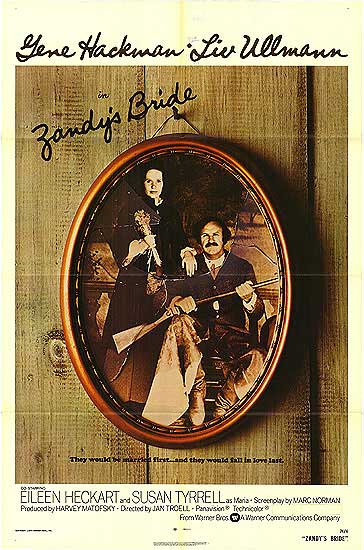
Zandy's Bride
From virtually the very beginning, in 1922 when, at the invitation of Mary Pickford, Ernst Lubitsch left his native Germany and moved to Southern California to make the film Rosita, successful foreign filmmakers have found the Hollywood pilgrimage irresistible. Lubitsch was followed, in no particular order, by F. W. Murnau, Victor Sjöström, Mauritz Stiller, Fritz Lang, Jean Renoir, Rene Clair, Max Ophüls, Michelangelo Antonioni, Milos Forman, Roman Polanski, Ivan Passer, Jan Kadar, Bill Forsythe, Louis Malle, Paul Verhoeven, Lina Wertmüller, Phillip Noyce, Peter Weir, Fred Schepisi, Lasse Hallström, Denis Villeneuve, Alfonso Cuarón, Guillermo del Toro, Alejandro G. Iñárritu ... the list is depressingly long. Lubitsch enjoyed a long and fruitful (in both commercial and creative terms) career in Hollywood. A majority of the others did not. For most, it gave their incomes a boost, but it took a significant toll on their art. Some of them managed to return to their native countries, with sad results. Their subsequent films failed to pick up the thread that they dropped upon going west.
The Swedish filmmaker Jan Troell (pronounced like Noël), who routinely directs, writes, photographs, and edits his films, is an exception to this dismal rule. The international success of his two-part epic film The Emigrants/The New Land (1972), about a Swedish family's migration to America in 1850 was noticed sufficiently by Warner Bros. that he was offered to direct a script based on the novel The Stranger: A Novel of the Big Sur by Lillian Bos Ross. Troell didn't like the script and turned it down, but on reading the novel, part of a Big Sur Trilogy, he was impressed enough by it that he found another writer, Marc Norman, to adapt it. Troell called the film Zandy's Bride (1974).
The "story" of the film is, despite the rewrite, unremarkable: Zandy Allan, a cattle rancher in Big Sur, needs help running things, but instead of looking to hire extra hands, he opts for a mail order bride from Minnesota. He finds an ad in a newspaper classified section:
RESPECTABLE spinster, American stock, wants life in the West. Wishes to marry. Reply P.O. Box 192, Minneapolis, Minnesota.
He puts on a clean, ill-fitting white shirt and rides all the way down to an incongruous outpost smack on the coast where the woman from Minnesota, Hannah Lund, has just arrived by stage. After sizing each other up, he chides her for lying (by 7 years) about her age, telling her she's "on the long side of child-bearing."
Immediately we are faced with incongruity. The leads are Liv Ullmann and Gene Hackman. Ullmann had shown up to act in the film, whereas Gene Hackman showed up to be Gene Hackman. In every film he's exactly the same, no matter how he's dressed or what he's saying. Ullmann is given so little to work with, but you can see her working with it, filling out her period costume like she's been dressed like that all her life, assured, responsive, engaged with her role and the "West" that Troell introduces to us. She makes us wonder what drove her to place that ad. Gene Hackman interests us only so far as his actions divulge, and his limitations are visited upon Zandy.
The two are married then and there, and after the long ride back up the mountain Zandy stables the horses and returns to the house to find Hannah passed out in bed in her traveling clothes. There follows a scene that makes it very hard for us to like Zandy much further. "I got the right!" he screams as he violently rapes her. The following morning he acts like what transpired either didn't happen or was unimportant. He spends the day with his cattle and returns to find some improvements to what Hannah calls his "pigsty." Gradually they wear each other down - she growing tougher, he growing gentler. The result is, of course, no surprise, but the progress to the film's anticlimax holds a few surprises. Some beautiful scenes unfold as Zandy becomes captivated by the beauty of Hannah, reminding me how, for about a decade, between Persona and The New Land, everyone seemed to be in love with Liv Ullmann. Jordan Cronenweth does capture some lovely images: of Zandy and Hannah at table, lit by the light coming off a basket of wildflowers on the table between them, or Zandy watching in admiration as Hannah brushes her long blonde hair by the firelight. Cronenweth certainly might have had some guidance from Troell, or indeed from George Oddner, who is listed in the end credits as "consultant to Jan Troell". Some things, however, don't work so well. Like the scene in which Zandy engages in hand to claw combat with a not very large black bear. The bear-mawling of Leo DiCaprio in The Revenant, albeit abetted by CGI, has set an impossibly high bar for any such scenes.
Troell was promised that he could also operate the camera, but the American cinematographers' union threatened to fine the appointed director of photography (Jordan Cronenweth) $500 every time Troell touched the camera. The result of depriving Troell of access to the camera, which introduced more cooks to the kitchen, is what really prevented Zandy's Bride from getting off the ground. “The biggest difference for me about working in America was the number of people around the camera. In the centre, it’s the same, the relationship between the director, the actors and the camera." (1) Troell started in film as a cinematographer, and he had operated the camera in his four feature films in Sweden. Forced to block only actors (deciding where they should stand in relation to the design that isn't his own), instead of his camera taking part in the blocking must have been crippling for Troell. The photography of his Swedish films is a marvelous voyage of discovery for the viewer.
Zandy's family - father, mother, and a brother - are introduced, only to give the viewer a good idea where Zandy learned about domestic violence. A Mexican woman, Maria Cordova (played by Susan Tyrrell, who was misidentified as "Maria Cordova" in The New York Times review of the film)(2), with whom Zandy has a history, gives the story - and Zandy - an excuse to go astray from Hannah's story, which is the reason the film exists. At least Tyrrell doesn't subject the viewer to her usual crazy lady schtick, for which she was nominated for an Oscar in John Huston's Fat City (1972).
Zandy's Bride gave me the feeling that what attracted Troell to the story's possibilities in direct human terms was precisely what turned critics away from it. You find yourself waiting for something to happen in the film and then you realize what happened went right on by without your noticing it: the gradual action of one force upon another, each resistant to the influence of the other, in which the trajectories of both are eventually altered. The notion that Zandy's Bride is somehow in the tradition of a Western is more than a little silly when you remember that Troell accomplished one of the greatest sequences on the theme of the West in The New Land, when Karl Oskar's brother Robert and his slow-witted friend Arvid trek all the way to California to strike gold, to encounter only death and disappointment. Troell's camera showed us no sweeping vistas, no Monument Valley horizons, no sense of immensities except what the face of Eddie Axberg, who plays Robert, discloses. It is all up close, through the mud and the dirt and the pain, with a bare minimum of dialogue and a handful of other actors. Yet it says so much more about the tragedy of the West than a thousand Westerns.
Zandy's Bride got some positive notices, but not enough with which to build a Hollywood career. Troell returned to Sweden none the worse for his experience. The most significant reason for Troell's failure in Hollywood was much more fundamental than his lack of control over the camera: a filmmaker's nationality is essential to his work. Remove him from his native soil and native language - his ethos - and he is more than simply uprooted. He has lost his frame of reference, his ability to navigate the strange new world around him. Troell returned to Sweden to make Bang! (1977), and finished Hurricane (1979), which Roman Polanski was hired to direct before his sexual predilections ended his own Hollywood career. While making Hurricane, Troell met the Swedish journalist, Agneta Ulfsater, who would become his wife. So Troell emerged the winner from his encounter with Hollywood.
(1) Troell to Michael Dwyer, "A Life Calling the Shots," The Irish Times, May 21, 2009.
(2) Howard Thompson, The New York Times, May 20, 1974.
The Swedish filmmaker Jan Troell (pronounced like Noël), who routinely directs, writes, photographs, and edits his films, is an exception to this dismal rule. The international success of his two-part epic film The Emigrants/The New Land (1972), about a Swedish family's migration to America in 1850 was noticed sufficiently by Warner Bros. that he was offered to direct a script based on the novel The Stranger: A Novel of the Big Sur by Lillian Bos Ross. Troell didn't like the script and turned it down, but on reading the novel, part of a Big Sur Trilogy, he was impressed enough by it that he found another writer, Marc Norman, to adapt it. Troell called the film Zandy's Bride (1974).
The "story" of the film is, despite the rewrite, unremarkable: Zandy Allan, a cattle rancher in Big Sur, needs help running things, but instead of looking to hire extra hands, he opts for a mail order bride from Minnesota. He finds an ad in a newspaper classified section:
RESPECTABLE spinster, American stock, wants life in the West. Wishes to marry. Reply P.O. Box 192, Minneapolis, Minnesota.
He puts on a clean, ill-fitting white shirt and rides all the way down to an incongruous outpost smack on the coast where the woman from Minnesota, Hannah Lund, has just arrived by stage. After sizing each other up, he chides her for lying (by 7 years) about her age, telling her she's "on the long side of child-bearing."
Immediately we are faced with incongruity. The leads are Liv Ullmann and Gene Hackman. Ullmann had shown up to act in the film, whereas Gene Hackman showed up to be Gene Hackman. In every film he's exactly the same, no matter how he's dressed or what he's saying. Ullmann is given so little to work with, but you can see her working with it, filling out her period costume like she's been dressed like that all her life, assured, responsive, engaged with her role and the "West" that Troell introduces to us. She makes us wonder what drove her to place that ad. Gene Hackman interests us only so far as his actions divulge, and his limitations are visited upon Zandy.
The two are married then and there, and after the long ride back up the mountain Zandy stables the horses and returns to the house to find Hannah passed out in bed in her traveling clothes. There follows a scene that makes it very hard for us to like Zandy much further. "I got the right!" he screams as he violently rapes her. The following morning he acts like what transpired either didn't happen or was unimportant. He spends the day with his cattle and returns to find some improvements to what Hannah calls his "pigsty." Gradually they wear each other down - she growing tougher, he growing gentler. The result is, of course, no surprise, but the progress to the film's anticlimax holds a few surprises. Some beautiful scenes unfold as Zandy becomes captivated by the beauty of Hannah, reminding me how, for about a decade, between Persona and The New Land, everyone seemed to be in love with Liv Ullmann. Jordan Cronenweth does capture some lovely images: of Zandy and Hannah at table, lit by the light coming off a basket of wildflowers on the table between them, or Zandy watching in admiration as Hannah brushes her long blonde hair by the firelight. Cronenweth certainly might have had some guidance from Troell, or indeed from George Oddner, who is listed in the end credits as "consultant to Jan Troell". Some things, however, don't work so well. Like the scene in which Zandy engages in hand to claw combat with a not very large black bear. The bear-mawling of Leo DiCaprio in The Revenant, albeit abetted by CGI, has set an impossibly high bar for any such scenes.
Troell was promised that he could also operate the camera, but the American cinematographers' union threatened to fine the appointed director of photography (Jordan Cronenweth) $500 every time Troell touched the camera. The result of depriving Troell of access to the camera, which introduced more cooks to the kitchen, is what really prevented Zandy's Bride from getting off the ground. “The biggest difference for me about working in America was the number of people around the camera. In the centre, it’s the same, the relationship between the director, the actors and the camera." (1) Troell started in film as a cinematographer, and he had operated the camera in his four feature films in Sweden. Forced to block only actors (deciding where they should stand in relation to the design that isn't his own), instead of his camera taking part in the blocking must have been crippling for Troell. The photography of his Swedish films is a marvelous voyage of discovery for the viewer.
Zandy's family - father, mother, and a brother - are introduced, only to give the viewer a good idea where Zandy learned about domestic violence. A Mexican woman, Maria Cordova (played by Susan Tyrrell, who was misidentified as "Maria Cordova" in The New York Times review of the film)(2), with whom Zandy has a history, gives the story - and Zandy - an excuse to go astray from Hannah's story, which is the reason the film exists. At least Tyrrell doesn't subject the viewer to her usual crazy lady schtick, for which she was nominated for an Oscar in John Huston's Fat City (1972).
Zandy's Bride gave me the feeling that what attracted Troell to the story's possibilities in direct human terms was precisely what turned critics away from it. You find yourself waiting for something to happen in the film and then you realize what happened went right on by without your noticing it: the gradual action of one force upon another, each resistant to the influence of the other, in which the trajectories of both are eventually altered. The notion that Zandy's Bride is somehow in the tradition of a Western is more than a little silly when you remember that Troell accomplished one of the greatest sequences on the theme of the West in The New Land, when Karl Oskar's brother Robert and his slow-witted friend Arvid trek all the way to California to strike gold, to encounter only death and disappointment. Troell's camera showed us no sweeping vistas, no Monument Valley horizons, no sense of immensities except what the face of Eddie Axberg, who plays Robert, discloses. It is all up close, through the mud and the dirt and the pain, with a bare minimum of dialogue and a handful of other actors. Yet it says so much more about the tragedy of the West than a thousand Westerns.
Zandy's Bride got some positive notices, but not enough with which to build a Hollywood career. Troell returned to Sweden none the worse for his experience. The most significant reason for Troell's failure in Hollywood was much more fundamental than his lack of control over the camera: a filmmaker's nationality is essential to his work. Remove him from his native soil and native language - his ethos - and he is more than simply uprooted. He has lost his frame of reference, his ability to navigate the strange new world around him. Troell returned to Sweden to make Bang! (1977), and finished Hurricane (1979), which Roman Polanski was hired to direct before his sexual predilections ended his own Hollywood career. While making Hurricane, Troell met the Swedish journalist, Agneta Ulfsater, who would become his wife. So Troell emerged the winner from his encounter with Hollywood.
(1) Troell to Michael Dwyer, "A Life Calling the Shots," The Irish Times, May 21, 2009.
(2) Howard Thompson, The New York Times, May 20, 1974.
Subscribe to:
Posts (Atom)