Saturday, June 29, 2013

Restricted Viewing

The Motion Picture Association of America (MPAA) is a powerful and much-maligned organization that practices "voluntary" censorship on movies made and released in the United States. Of course, it continually denies that it is involved in censorship and claims only that it is performing a service to moviegoers - particularly those with children. It provides guidance to parents about a movie's content that is supposed to help them choose which ones are suitable for exposure to their children. A rating caveat is assigned to every movie, from G for "General" audiences, "all ages admitted", to NC-17 for "no one 17 and under admitted".

Nowadays, movie producers tolerate such blatant censorship for liability reasons: if a parent tries to bring legal action against them because the content of a movie was unsuitable for a child, a producer can always use the MPAA rating caveat in his defense. The sheer paucity of films designed for adults cries out for a revamp of this necklace of skeletons that hangs around the industry's neck.

Over the years, as violence and sexuality have grown increasingly graphic in their representation in movies, the MPAA has reserved its hardest ratings, "R" and "NC-17" for movies that are - supposedly - off limits to under-17-year-olds. While the majority of movies manage to land a PG or a PG-13 rating, even when, in some cases, they are extremely violent, many adults - moviegoers and critics - have sought out movie material that is suitable for grown-ups, that don't cater to a juvenile audience or to a juvenile mentality or morality. Since most Hollywood products have the combined intelligence quotient of a flea, this has often been a lonely hunt for grown-up moviegoers.

Since the majority of the blockbuster movies in release are derived from comic books or their euphemistic equivalent, "graphic novels," movie producers have tried to tailor them to teenage audiences (even when so many comic book fans are old enough to have teenaged children of their own), and have to persuade the MPAA to refrain from applying a rating stronger than a PG-13. As anyone who watched the mass shooting in Aurora, Colorado unfold on TV (I was able to do it from the opposite side of the earth), The Dark Knight Rises, which was having a midnight showing, was rated PG-13. It was so violent that, when James Holmes entered the theater - filled with children and teenagers - firing his weapons, most audience members believed it was a stunt staged for the special screening.

Since I am not a parent and I don't have to worry about finding anything but stupidity objectionable, the ratings are pointless to me. If they are going to persist, however, why not have one that cuts both ways, that serves families with children that need protection from sexuality and violence as well as adults who want protection from infantilism? I would like the MPAA to do me small favor. If a movie is tailored to appeal to children, like the Harry Potters and Hobbits that stink up the multiplexes, they could put some teeth in the rating system by restricting the audience to people under 17. No adults should be admitted without the accompaniment of a child. If nothing else, such a rating system would remind some people that they're too old to bother with such childish things any more. And it might even give them an appetite for more "adult" fare at the movies. Wishful think, I know.

Saturday, June 22, 2013

Death of a Character Actor


The things people say about you after you're dead are forgivable only to an extent. On the negative side, Baudelaire once asked, apropos the hysterically hostile obituaries of Edgar Allen Poe, "Is there no by-law in America to prevent dogs from entering cemeteries?"

On the positive side, excessive praise can sometimes invoke eternal damnation for its intended beneficiary. Think of Ronald Reagan or the recently deceased Margaret Thatcher. Ultimately, what does it matter what people say about you when you're dead?

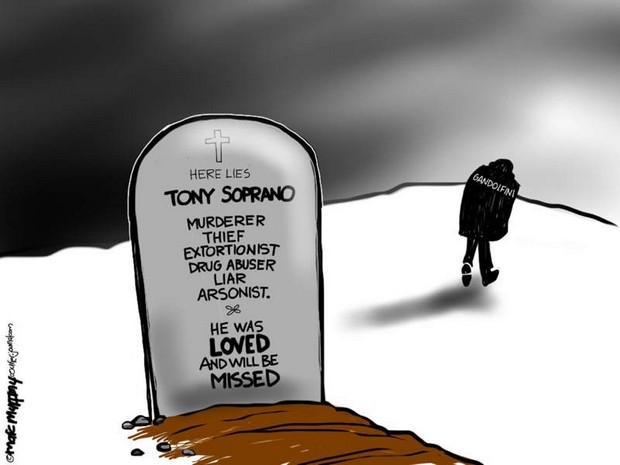
At the death of James Gandolfini this week, which wasn't altogether a surprise considering his size, I found that the sheer volume of praise expressed day after day was getting tiresome. And virtually all of it was for one role - Tony Soprano - which I never liked. How hard was it, really, for a big Italian man from New Jersey to play a mafioso?

I first noticed Gandolfini in Tony Scott's True Romance (1993). With a script by Quentin Tarantino, could the subject of facile violence have been avoided? Gandolfini played Virgil, a hit man (he claimed he was inspired by a friend who was a hit man) whose longest scene called for him to beat Patricia Arquette all over her cheap hotel room. When he finds her defiant to the last, he opens his shirt and tells her to give him her best shot. She drives a corkscrew into his foot, which inspires an even more brutal beating. (Arquette eventually kills him with a toilet tank lid.)

Gandolfini didn't get my attention again until Get Shorty (1995), in which he played a bodyguard known as Bear. Once a stuntman, Bear dreams - like everyone else in the Get Shorty - of making it big in movies. Since he gets beaten up every time he goes up against Chili Palmer (John Travolta), Bear's incipient humanity has a chance to show itself. Though it was the usual sort of role for a man his size, Gandolfini brought to his performance just enough truth to make me believe in him.

Listening to all the praise for Gandolfini was too often quite silly. They all managed to say pretty much the same thing - that he made audiences care deeply for Tony Soprano, who is a professional murderer. Did anyone in the series have the nerve to inform Tony that the real reason he was depressed and needed therapy was because he was a blood-thirsty murderer?

Post-Sopranos, which was an example of immorality masquerading as amorality ("Shakespeare didn't balk at writing about murderers, did he?" Yes, but Shakespeare never expected anyone to feel sorry for Macbeth.), Gandolfini's performance in the otherwise useless The Mexican (2001) stole the show away from its putative stars, Brad Pitt and Julia Roberts. He played a hit man again in that film, with the preposterous name of Winston Baldry, but we learn some time after he kidnaps Samantha (Roberts) that he is gay, and the film slows down considerably to indulge Winston in a fling with another man he meets in a truck stop. It was a surprisingly off-beat role for the redoubtable Tony Soprano. Gandolfini was clearly trying to stretch his image.

I next noticed him in Tony Scott's remake of The Taking of Pelham 123 (2009), playing the mayor of New York City. His last scene with Denzel Washington, thanking him for his acts of heroism during the movie's long hostage ordeal, was touching. Gandolfini next played a voice role in Spike Jonze's Where the Wild Things Are (2009). I found the film disappointing, since Jonze reduced Maurice Sendak's book, which I loved since I was a boy, to a rather dimly-realized shadow of itself. But Gandolfini's unmistakable voice for the wild thing Carol was a surprising presence, and the rock bottom gentleness of the big man shone through - even if Carol is little more than a more animate muppet in Jonze's sorry movie.

The last thing I saw him in was Killing Them Softly (2012), but neither the movie nor Gandolfini's small part in it - yet another hood, this time named Mickey - were otherwise mentionable.

James Gandolfini had a great deal going for him as an actor, and being deprived of his future performances, in which we would have seen more of his talent in a wider range of roles, is a true loss for everyone. His size was, as he knew too well, a shortcoming to be surmounted. It seemed to me that his physical presence, just like Shaquille O'Neal's on the basketball court, probably accounted for a large portion of his success as an actor. But he had a tough time convincing producers that he could do something more than beat the crap out of Patricia Arquette, even if he did it with so much aplomb and panache. But he wasn't, alas, the Great Actor everyone said he was this week. He was just getting started when his heart stopped.

Thursday, June 6, 2013

The Grey

There is a TV commercial currently airing here in Asia for the luxury Shangri-la Hotel chain that is like a gripping mini-movie. In the commercial, a man is alone in a forbidding snowbound landscape, apparently fighting to stay alive. The snow is deep and wolves are stalking him. His flashlight flickers out and he is overcome with fatigue and lies down in the snow. When the wolves approach him, they do something astonishing - they snuggle up around him, and when the man awakes he finds he is surrounded by warm sleeping wolves. Then a caption appears on the screen: "To embrace a stranger as one's own. It's in our nature."

What the commercial is supposed to mean, and how on earth it's supposed to represent Shangri-La Hotels, is subject to interpretation. But, in a powerful way, Joe Carnahan's 2011 movie, The Grey, is a perfect antidote to such unnatural nature.

The movie, with its uninspired title, is more exactly reminiscent of the world of Jack London's most elemental stories of man in extremis than any other film I've seen, especially the miserably lame movie adaptations of White Fang (1991) and The Call of the Wild (2009). Because they are narrowly regarded as "animal stories," I first encountered those books when I was in my teens in the "juvenile" section of a public library. This stupid categorization has resulted in a general underestimation of London's writing and its appeal to more than just juveniles. He was an uneven but an often serious writer whose work, inspired by an uncompromising view of the cruelties of life, is overdue for reconsideration.

The Grey is the story of seven survivors of a plane crash in the wintry Alaskan wilderness, led by John Ottway (played by Liam Neeson), a man who works for an oil pipeline company, protecting its workers from the large predators they inevitably encounter in Alaska. I lived in Anchorage for a few years. It's the largest city in the state, but if one were to take a secondary road north, south or east of the city for ten miles, especially in winter (October to April), one would be in a place remarkably similar to the one in which the seven men found themselves.

The plane crash is easily one of the most frightening of such scenes ever filmed, with unrestrained passengers depicted being thrown violently around the cabin, and the fuselage breaking off, exposing Ottway and others to the cold blast of air outside, as the plane descends. Ottway awakes, still secured to his seat, now sitting by itself in a snowy field, his face dusted with blowing snow. He finds and rescues as many men as he can find, but all but seven passengers are scattered, with the fuselage, over a large area, and wolves begin to turn up to devour their remains. Ottway takes charge, despite some resistance, and the men spend their first night taking turns watching out for the wolves. One of them, dropping his guard to urinate during the night, is found torn to pieces the following morning. Ottway determines that the group of survivors must walk to a distant forest if they are to escape the wolves.

There is an altogether unnerving moment when the men hear a wolf's growl in the dark, and Ottway grabs a flaming torch to find out where it is. All that the men can see, staring at them from the darkness, is a pair of illumined eyes, then another, and then a multitude of them, lit by the light of Ottway's torch.

From that moment, until the end of the movie, the filmmakers pursue, with commendable honesty, the grim fates of the men. The movie's lack of critical and commercial success was probably due to its very determination to be truthful to - if nothing else - the odds of survival under such circumstances. The final confrontation between Ottway and the "Alpha" wolf ends - for those who sit through the end credits - ambiguously.

There is a scene near the end of the movie that Catholic groups found objectionable in which Ottway, who has just watched the last of his companions drown, sits on the riverbank and shouts at the blank sky, "Do something! I'm calling on you!" It is Ottway's pathetic, desperate appeal for divine intervention. "Fuck faith! Earn it!" he shouts. He swears to God that, if He saves him, he'll believe in Him for the rest of his life. There were also complaints, believe it or not, about the portrayal of grey wolves in the movie. I found that the use of prosthetic wolves in some scenes was a little obvious. But at least the filmmakers avoided the horribly dishonest portrayal of the dogs in the two Jack London adaptations mentioned above.

The nearly exclusive cast of men (0ne woman and a little girl appear in flashbacks) reveals a degree of intimacy on the part of the director and script writers (1) of such places as a remote industrial outpost. Much of my experience in the military was similarly remote from the opposite sex. While not entirely like prison (it lacked only the interminability of prison), such societies suffer in many ways from the absence of women and their humanizing influence. In The Grey, the scenes in the makeshift after-hours club - the chaotic brawling, the sheer desperate exclusivity of it - comes across tellingly. The machismo among the crash survivors is chastened, but enough of it remains to create conflict. Besides Liam Neeson, still imposing at 59 when the film was made, some other notable performers, like Frank Grillo and Dermot Mulroney, turn up in surprising guises.

When the wolf pack shows up with its imperious hierarchy, the filmmakers obviously meant for us to notice the parallel with the hierarchy among the men. Ottway assumes leadership because he is the strongest and the ablest of the group. The strongest compete for leadership of the group, while the weakest, one after another, are killed, die of hypoxia, or just give up and, in a painfully moving scene, explain how they can't - and don't want - to go any farther.

I can't say to what extent the raw power of the movie is derived from the story, "Ghost Walker," by Ian MacKenzie Jeffers, on which it is based. The movie is reminiscent of another story, by Jack London, called "Love of Life," (2) in which a man becomes separated from his companion in the wilderness because of an injured ankle. He has a rifle, but no ammunition, and can only manage to survive the following days on some ptarmigan eggs, a few minnows, and the pink bones of a dead caribou calf. As snow begins to fall and he realizes he is starving, the man discovers that an old, sick wolf (what Ottway would've called an "Omega") is following him. He is entering a delirium brought on by starvation, and his hallucinations are hard for him to distinguish from reality.

He is finally reduced to crawling on his hands and knees. He finds more bones, and realizes they are the remains of his companion, attacked and eaten by wolves. The sick wolf continues to stalk him, approaching when he seems to fall asleep, but the wolf's wheezing breath and cough awakes the man. Finally, half-alive, the man and the wolf engage in a life-or-death struggle, with the man succeeding in biting the wolf's throat so deeply that he drinks its blood. The man is later discovered by a scientific expedition:

"From the deck they remarked a strange object on the shore. It was moving down the beach toward the water. They were unable to classify it, and, being scientific men, they climbed into the whale-boat alongside and went ashore to see. And they saw something that was alive but which could hardly be called a man. It was blind, unconscious. It squirmed along the ground like some monstrous worm. Most of its efforts were ineffectual, but it was persistent, and it writhed and twisted and went ahead perhaps a score of feet an hour."

They take the man aboard their ship, and he slowly recovers his senses and his health. He returns to civilization, but the savagery of nature that was London's subject, and the subject of Joe Carnahan's movie, is unforgettable.


(1) Joe Carnahan and Ian MacKenzie Jeffers.
(2) Both the film and the story utilize remarkably similar poems that capture their grimness. In The Grey, Ottway recites, on two occasions, a poem he believes was written by his father: "Once more into the fray. Into the last good fight I'll ever know. Live and die on this day. Live and die on this day." The story, "Love of Life" begins with a stanza from the poem "The Gold-Seekers" by Hamlin Garland:

This out of all will remain--
They have lived and have tossed:
So much of the game will be gain,
Though the gold of the dice has been lost.

Thursday, May 30, 2013

Saying 'I love you'

I used to be leery of I love yous. Having heard the endearment used too many times, backed up with little or no feeling, I used to avoid the words whenever possible - even with my family, whose love is supposed to be unconditional. But as I've grown older, I've changed my mind.

Nearly everyone would agree that, as the saying goes, life is too short, that there is never enough time to do all of the things we want to do, or mean to do. And yet we pass through life with no apparent sense of urgency, as if there were an unlimited supply of tomorrows, as if so many of the things we feel that we need to do, all the places we feel a need to visit, can wait until later. If life is so short, and nearly everyone assures us of this, then why do we always postpone saying the few right words to the right people that we know we need to say? And when we arrive at what we perceive to be our last moments, if we can see them coming, those words become uppermost in our hearts, and the people we would say them to with them.

There is a true story that deserves repeating. Clive Wearing is a British musicologist, instrumentalist, and orchestra conductor who, in 1985, came home feeling unwell. With a noticeable fever, he went to bed. In the morning he couldn't remember his wife Deborah's name. A doctor visited [this is England!] and found his temperature was 104. The doctor gave Clive enough sleeping pills to make him sleep all day and told Deborah to go off to work. When she got home later that day, Clive wasn't there. As Deborah wrote in her book, Forever Today, "His pyjamas lay crumpled in the middle of the bare sheet. I screamed his name. Running the length of the flat, I already knew something bad had happened."

A taxi-driver found him wandering the streets, and the police traced his name from the credit cards in his wallet. He was hospitalized, where doctors learned that he had contracted a common virus that had gone to his brain, the high fever eventually destroying crucial areas that stored his short-term memory. When he recovered, he was unable to look at something and, looking away for a second, remember what it was he looked at. He was also stricken with "retrograde amnesia," which effectively robbed him of most of his memories. He could speak and read, and he remembered his wife, his first and only love. As Deborah recounts it,

"Clive was constantly surrounded by strangers in a strange place, with no knowledge of where he was or what had happened to him. To catch sight of me was always a massive relief - to know that he was not alone, that I still cared, that I loved him, that I was there. Every time he saw me, he would run to me, fall on me, sobbing, clinging. It was a fierce reunion."

I saw a documentary about him made by Jonathan Miller, and Deborah performed for the camera what seemed at first to be a cruel trick. She would leave Clive's side and step out the hospital room. After only a few moments, she turned around and went back inside to Clive. He reacted like she'd been away for days or weeks, overjoyed, throwing his arms around her and kissing her.

In his essay on Wearing's condition, "The Abyss," Oliver Sacks wrote of him: "The only times of feeling alive were when Deborah visited him. But the moment she left, he was desperate once again, and by the time she got home, ten or fifteen minutes later, she would find repeated messages from him on her answering machine: 'Please come and see me, darling—it’s been ages since I’ve seen you. Please fly here at the speed of light.'"(1)

Many contemporaries of Sigmund Freud commented on how his clinical discoveries in psychology had "confirmed the poets." As we have learned since then, the importance of Freud as an imaginative thinker eclipsed his importance as a scientist. When I made my first tentative steps into Freud's writings, I started where he left off, with his late, speculative metempsychological works, The Future of an Illusion and Civilization and Its Discontents. I remember how moved I was reading the words, in the latter book, in which Freud announces his great theme:

"Life, as we find it, is too hard for us; it brings us too many pains, disappointments and impossible tasks. In order to bear it we cannot dispense with palliative measures."

Freud then examines the various "palliative measures" in detail, before arriving at the passage I still find so moving:

"One procedure I have not yet mentioned. And how could one possibly forget, of all others, this technique in the art of living? It is conspicuous for a most remarkable combination of characteristic features. It, too, aims of course at making the subject independent of Fate (as it is best to call it), and to that end it locates satisfaction in internal mental processes, making use, in so doing, of the displaceability of the libido of which we have already spoken. But it does not turn away from the external world; on the contrary, it clings to the objects belonging to that world and obtains happiness from an emotional relationship to them. Nor is it content to aim at an avoidance of unpleasure - a goal, as we might call it, of weary resignation; it passes this by without heed and holds fast to the original, passionate striving for a positive fulfilment of happiness. And perhaps it does in fact come nearer to this goal than any other method. I am, of course, speaking of the way of life which makes love the centre of everything, which looks for all satisfaction in loving and being loved . . . The weak side of this technique of living is easy to see; otherwise no human being would have thought of abandoning this path to happiness for any other. It is that we are never so defenceless against suffering as when we love, never so helplessly unhappy as when we have lost our loved object or its love. But this does not dispose of the technique of living based on the value of love as a means to happiness."

Reading these words again, I think of Clive Wearing, who must endure the finding and the losing of love over and over every day, his life in suspense between total fulfillment and total despair.


This past weekend, the monster tornado in Oklahoma reminded us of what is on people's minds in what they consider to be their last moments. Jimmy Breslin learned the same thing when he examined the phone messages left by people or sent to people who were in the Twin Towers on September 11. He spoke about the overwhelming emotion behind nearly every message:

"You know something, all of those messages that I listened to, from people who knew they were going to die, they all said the same three things: I love you, I love you, and I love you. There was nothing about racial hatred or wanting vengeance or even anger. Just love. There's something comforting in that. We now know that when death is imminent, our only regret will be not saying I love you enough."(2)


Why should we wait for a natural or man-made disaster to remind us of what we know already? Today, even if you think it's trite, or if they complain that you said it five minutes ago, and even if you suspect you don't feel it (even though you know you do), say it. Say it again and again. It's the single human expression that can never get old, that can never be cheapened by overuse.


(1) Wearing, whose musical talent remains intact, is now living a more sedate life in a more genteel institution, still beset with his life in an inescapable NOW, which is at least tempered for him by his constantly-renewed love for Deborah.
(2) Jimmy Breslin American Lives: The Stories of the Men and Women Lost on September 11.

Friday, May 24, 2013

The Boy


We always knew that Alfred Hitchcock was a pervert. It was simply a difference of degree, not of kind. So many of his movies are about perverts - who also happen to be murderers - that it became obvious as he got older that he identified more closely with them instead of with the James Stewart/Cary Grant/Henry Fonda heroes. Perversion was his true métier.

So the HBO movie The Girl (2012), based on the account of a witness to and a victim of old Tubby's more unseemly advances came as no surprise. It is, nonetheless, irresistible for any cinephile anxious to see Hitchcock's completely overwrought edifice chipped away: a personal account of the behind-the-scenes/behind-the-camera drooling of the Master of Suspenders over pretty Tippi Hedren, whom he made the star of two of his last highly-regarded movies.

Hitchcock prided himself on his knowledge of his audience. He was famous for calling actors "cattle," and infamous for regarding his audience as a flock of sheep. He knew exactly how to make an audience squirm, jump, bite their nails, and - crucially - grab their genitals. No other filmmaker had such a talent for making crime sexy. He knew that a suave, debonair criminal had a much greater chance of success than a creepy, uncouth one. I get the feeling that Rebecca was probably the favorite of his Hollywood movies because we aren't sure that Cary Grant isn't trying to murder Joan Fontaine until the last reel.

We never had to consult a psychologist to guess that his obesity gave Hitchcock a complex. His love of camera tricks - crane shots, impossible angles, action scenes in which people dangle from the heights of the Statue of Liberty or Mount Rushmore - not to mention his fixation on studio shooting, leaving the location shooting to second units and using rear-screen projection almost obsessively - clearly was liberating for a man who didn't care to move about much. Rear Window, in which the hero (James Stewart) is incapacitated by a broken leg, is a fat man's fantasy. The spying into his neighbor's private lives was borderline criminal, but great fun for Hitchcock.

But for all the leering going on behind the camera, Hitchcock actually succeeded in eliciting an excellent performance from Tippi Hedren. She never acted before The Birds (1963) and went on a long hiatus after Marnie (1965). Hedren claimed it was Hitchcock's exclusive contract that sabotaged her career, but in her two movies for him, she was one of the few things worth watching.

The Girl has Toby Jones playing Hitchcock and Sienna Miller playing Hedren. At first, I found Jones to be too small for the role (Hitchcock once claimed he was 5 ft 8, but he was really a fraction shy of 5 ft 7). But Jones actually does a better job of impersonation than Anthony Hopkins did in the movie Hitchcock. Jones got the voice especially right.

The real casting mistake was Sienna Miller, who is pretty enough, but whose prettiness is of a different sort than Tippi Hedren's. Hitchcock certainly would never have looked twice at her. She doesn't suggest depths to her femininity or her sexuality. With Miller, it is all right there on the surface, "on the plate" as Hitchcock puts it, enticing but entirely lacking in mystery.

Hitchcock's long-suffering (an educated guess) wife, Alma comes off as something of a cipher in The Girl. Played by Imelda Staunton, she isn't given the credit due her for being Hitchcock's close collaborator up until her death two years before him. Only her unexplained departure in the movie, which apparently causes Hitchcock some concern, suggests the dimensions of their relationship. Much more room is given the woman in Helen Mirren's performance in Hitchcock. But then, Mirren is a scene-stealer even in the presence of Anthony Hopkins.

The Girl shows what a god Hitchcock was in Sixties Hollywood. Psycho had revitalized
his sagging career, and raised the bar for bloodiness (and bloodymindedness). He never learned how to drive a car (he was terrified of policemen), so in The Girl we see Toby Jones riding in the back of a chauffeur-driven Rolls. Hitchcock was 62 when principal photography started for The Birds. I watched it again recently and found it a sometimes excruciatingly methodical stylistic exercise. Like Psycho, it spends at least half its length reeling in a whopping red herring, dawdling over plots that are jettisoned as soon - or as late - as the action commences. There is a kind of elegance to the first halves of Psycho and The Birds that turns preposterously ugly the moment when Mother and the birds enter stabbing and biting. Hedren was traumatized by a week of shooting live birds being flung at her face on a soundstage, just so Hitch could get his sadistic kicks.

Glancing at Hitchcock's filmography, it's surprising to see how many misses there were, like The Paradine Case, Rope, Under Capricorn, and Stage Fright, before arriving at the hits like Shadow of a Doubt, Strangers on a Train, North by Northwest, or the movie recently voted by a consortium of critics (who hadn't been introduced to one another) the "greatest film of all time", Vertigo. The only ones I would like to see again are The 39 Steps and The Wrong Man. Claude Chabrol and François Truffaut notwithstanding, Hitchcock was one of the best commercial film directors. Study his movies if you must, but don't come away from them talking about art. Such talk hasn't done anyone - least of all Hitchcock - a damn bit of good.

Monday, May 20, 2013

Words To Live By

Four years ago on this blog, I collected a number of quotes from the essays of George Orwell in a post I called George Orwell's Ready Reckoner. It was the first of what I intended to be a series. But, as way led on to way, I never got around to a second installment. I hope this makes up for my negligence.

As the following quotes demonstrate, he was, aside from a superb prose stylist, a sensitive literary critic, a political thinker of genius, and a fearless observer of the world around him. As Orwell wrote of Shakespeare, "If one has once read [him] with attention, it is not easy to go a day without quoting him, because there are not many subjects of major importance that he does not discuss or at least mention somewhere or other, in his unsystematic but illuminating way." Orwell could have said as much of himself.

Here is the latest batch, in no particular order.


It is difficult to think of any politician who has lived to be eighty and still been regarded as a success. What we call a 'great' statesman normally means one who dies before his policy has had time to take effect. If Cromwell had lived a few years longer he would probably have fallen from power, in which case we should now regard him as a failure. If Pétain had died in 1930, France would have venerated him as a hero and patriot. Napoleon remarked once that if only a cannon ball had happened to hit him when he was riding into Moscow, he would have gone down in history as the greatest man who ever lived. (James Burnham and the Managerial Revolution, 1946)


When one thinks of the cruelty, squalor, and futility of war - and in this particular case of the intrigues, the persecutions, the lies and the misunderstandings - there is always the temptation to say: "One side is as bad as the other. I am neutral." In practice, however, one cannot be neutral, and there is hardly such a thing as a war in which it makes no difference who wins. (Looking Back on the Spanish War, 1942)


You cannot hold an imaginary conversation with a Dickens character as you can with, say, Peter Bezukhov. And this is not merely because of Tolstoy's greater seriousness, for there are also comic characters that you can imagine yourself talking to - Bloom, for instance, or Pécuchet, or even Wells's Mr Polly. It is because Dickens's characters have no mental life. (Charles Dickens, 1940)


There is always a temptation to claim that any book whose tendency one disagrees with must be a bad book from a literary point of view. (Notes on Nationalism, 1945)


"Raffles" is a good book, and so is "The Island of Dr. Moreau," and so is "La Chartreuse de Parme,: and so is "Macbeth"; but they are "good" at very different levels. Similarly, "If Winter Comes" and "The Well-Beloved" and "An Unsocial Socialist" and "Sir Lancelot Greaves" are all bad books, but at different levels of "badness." This is the fact that the hack-reviewer has made it his special business to obscure. (In Defense of the Novel, 1936)


Shall the common man be pushed back into the mud, or shall he not? I myself believe, perhaps on insufficient grounds, that the common man will win his fight sooner or later, but I want it to be sooner and not later - some time within the next hundred years, say, and not some time within the next ten thousand years. (Looking Back on the Spanish War, 1942)


Philosophers, writers, artists, even scientists, not only need encouragement and an audience, they need constant stimulation from other people. It is almost impossible to think without talking. If Defoe had really lived on a desert island he could not have written Robinson Crusoe, nor would he have wanted to. (As I Please 22, 1944)


What is the special quality in modern life that makes a major human motive out of the impulse to bully others? (As I Please 63, 1946)


A joke worth laughing at always has an idea behind it, and usually a subversive idea. (Charles Dickens, 1940)


When we gorge ourselves this Christmas, if we do get the chance to gorge ourselves, it is worth giving a thought to the thousand million human beings, or thereabouts, who will be doing no such thing. For in the long run our Christmas dinners would be safer if we could make sure that everyone else had a Christmas dinner as well. (As I Please 66, 1946)


... the ancient boneheap of Europe, where every grain of soil has passed through innumerable human bodies. (Inside the Whale, 1940)


The great enemy of clear language is insincerity. When there is a gap between one's real and one's declared aims, one turns as it were instinctively to long words and exhausted idioms, like a cuttlefish squirting out ink. (Politics and the English Language, 1946)


Art and propaganda are never quite separable, and ... what are supposed to be purely aesthetic judgements are always corrupted to some extent by moral or political or religious loyalties. (Tolstoy and Shakespeare, 1941)


If the intellectual liberty which without a doubt has been one of the distinguishing marks of western civilisation means anything at all, it means that everyone shall have the right to say and to print what he believes to be the truth, provided only that it does not harm the rest of the community in some quite unmistakable way. (The Freedom of the Press, 1946)


The theory that civilisation moves in recurring cycles is one way out for people who hate the concept of human equality. (Review of The Development of William Butler Yeats by V.K. Narayana Menon, 1943))


All writers are vain, selfish and lazy, and at the very bottom of their motives there lies a mystery. Writing a book is a horrible, exhausting struggle, like a long bout of some painful illness. One would never undertake such a thing if one were not driven on by some demon whom one can neither resist or understand. (Why I Write, 1946)


Much of the literature that comes to us out of the past is permeated by and in fact founded on beliefs (the belief in the immortality of the soul, for example) which now seem to us false and in some cases contemptibly silly. (Inside the Whale, 1940)


What people always demand of a popular novelist is that he shall write the same book over and over again, forgetting that a man who would write the same book twice could not even write it once. Any writer who not is utterly lifeless moves upon a kind of parabola, and the downward curve is implied in the upward one. (Charles Dickens, 1940)


Nearly all Western thought since the last war, certainly all "progressive" thought, has assumed tacitly that human beings desire nothing beyond ease, security and avoidance of pain. In such a view of life there is no room, for instance, for patriotism and the military virtues. (Review of Mein Kampf, by Adolf Hitler, 1940)


Every piece of writing has its propaganda aspect, and yet in any book or play or poem or what-not that is to endure there has to be a residuum of something we can only call art. (Tolstoy and Shakespeare, 1941)


Nourished for hundreds of years on a literature in which Right invariably triumphs in the last chapter, we believe half-instinctively that evil always defeats itself in the long run. Pacifism, for instance, is founded largely on this belief. Don't resist evil, and it will somehow destroy itself. But why should it? What evidence is there that it does? And what instance is there of a modern industrialized state collapsing unless conquered from the outside by military force? (Looking Back on the Spanish War, 1942)


War is of its nature barbarous, it is better to admit that. If we see ourselves as the savages we are, some improvement is possible, or at least thinkable. (As I Please 25, 1944)


All revolutions are failures, but they are not all the same failure. (Arthur Koestler, 1944)


The worst crimes are not always the punishable ones. (Benefit of Clergy: Some Notes on Salvador Dali, 1944)


The quickest way of ending a war is to lose it, and if one finds the prospect of a long war intolerable, it is natural to disbelieve in the possibility of victory. (James Burnham and the Managerial Revolution, 1946)


The creative impulse seems to last for about 15 years: in a prose writer these 15 years would probably be between the ages of 30 and 45, or thereabouts ... Many writers, perhaps most, ought simply to stop writing when they reach middle age. Unfortunately our society will not let them stop. Most of them know no other way of earning a living, and writing, with all that goes with it - quarrels, rivalries, flattery, the sense of being a semi-public figure - is habit-forming. (As I Please 64, 1946)


It is obvious that any economic system would work equitably if men could be trusted to behave themselves but long experience has shown that in matters of property only a tiny minority of men will behave any better than they are compelled to do. (Review of Communism and Man by F.J. Sheed, 1939)


All through the Christian ages, and especially since the French Revolution, the Western world has been haunted by the idea of freedom and equality; it is only an idea, but it has penetrated to all ranks of society ... Nearly everyone, whatever his actual conduct may be, responds emotionally to the idea of human brotherhood. (Charles Dickens, 1940)


The art of writing is in fact largely the perversion of words, and I would even say that the less obvious this perversion is, the more thoroughly it has been done. For a writer who seems to twist words out of their meanings (e.g. Gerard Manley Hopkins) is really, if one looks closely, making a desperate attempt to use them straightforwardly. (New Words, 1940)


When sexual frankness ceased to be possible, picaresque literature was robbed of perhaps half of its subject matter. The eighteenth-century inn where it was almost abnormal to go into the right bedroom was a lost dominion. (Tobias Smollett: Scotland's Best Novelist, 1944)  

Thursday, May 16, 2013

A Question and an Answer

In great poetry, one can always look for resemblances, echoed themes. Ideas central to life are central to poetry: where can one find meaning to the perplexities of existence? Two poets, W.H. Auden and Mary Oliver, wrote poems about journeys, lives and worlds apart. Without looking into the backgrounds of each poem, the personal circumstances that inspired them (which can contribute to, but never detract from, our appreciation of them), the first poem poses a troubling question that the second confidently answers.

W.H. Auden's cycle, "A Voyage," begins with the poem "Whither?":


A Voyage

I. WHITHER?

Where does this journey look which the watcher upon the quay,
Standing under his evil star, so bitterly envies,
As the mountains swim away with slow calm strokes
And the gulls abandon their vow? Does it promise a juster life?

Alone with his heart at last, does the fortunate traveller find
In the vague touch of a breeze, the fickle flash of a wave,
Proofs that somewhere exists, really, the Good Place,
Convincing as those that children find in stones and holes?

No, he discovers nothing: he does not want to arrive.
His journey is false, his unreal excitement really an illness
On a false island where the heart cannot act and will not suffer:
He condones his fever; he is weaker than he thought; his weakness is real.

But at moments, as when real dolphins with leap and panache
Cajole for recognition or, far away, a real island
Gets up to catch his eye, his trance is broken: he remembers
Times and places where he was well; he believes in joy,

That, maybe, his fever shall find a cure, the true journey an end
Where hearts meet and are really true, and crossed this ocean, that parts
Hearts which alter but is the same always, that goes
Everywhere, as truth and falsehood go, but cannot suffer.


As Auden found, the suspense of his journey, the pause between departure and arrival, held questions and answers in equipoise. As long as his journey lasts (and they lasted so much longer in the Forties), his tremulous questions can find neither affirmation nor negation. Like him, they can only wait. But, until the journey's end, there are wondrous distractions, passing scenery and the indifference of nature, but also its strange complicity, that provide him with escape from his suspense.

Mary Oliver's poem, "The Journey" offers a lonely colloquy on the same subject. But she seems so much more anxious that her journey should begin, caught in that irresistible hurry that travel instills in us, that the time for reflection or regret would have to wait. Motion is the only truth now:


The Journey

One day you finally knew
what you had to do, and began,
though the voices around you
kept shouting
their bad advice--
though the whole house
began to tremble
and you felt the old tug
at your ankles.
"Mend my life!"
each voice cried.
But you didn't stop.
You knew what you had to do,
though the wind pried
with its stiff fingers
at the very foundations,
though their melancholy
was terrible.
It was already late
enough, and a wild night,
and the road full of fallen
branches and stones.
But little by little,
as you left their voices behind,
the stars began to burn
through the sheets of clouds,
and there was a new voice
which you slowly
recognized as your own,
that kept you company
as you strode deeper and deeper
into the world,
determined to do
the only thing you could do--
determined to save
the only life you could save.


Oliver is as melancholy as Auden, but her loneliness is populated by voices, as Auden's were only by memories. Kafka's parable, "My Destination," makes it explicit (Kafka explicit?):


I gave orders for my horse to be brought round from the stables. The servant did not understand me. I myself went to the stable, saddled my horse and mounted. In the distance I heard a bugle call, I asked him what this meant. He knew nothing and had heard nothing. At the gate he stopped me, asking: "Where are you riding to, master?" "I don't know," I said, "only away from here, away from here. Always away from here, only by doing so can I reach my destination." "And so you know your destination?" he asked. "Yes," I answered, "didn't I say so? Away-From-Here, that is my destination." "You have no provisions with you," he said. "I need none," I said, "the journey is so long that I must die of hunger if I don't get anything on the way. No provisions can save me. For it is, fortunately, a truly immense journey."


Here on my Philippine island for another birthday, I know that destinations are only as certain as one's intentions at departure. Where I was going isn't always where I have arrived. The journey is the only answer.