Monday, January 30, 2012

To the Max


"There's an enigmatic relationship between Max and myself. He has meant a tremendous amount to me....As an actor, Max is sound through and through. Robust. Technically durable. If I'd had a psychopath to present these deeply psychopathic roles, it would have been unbearable. It's a question of acting the part of a broken man, not of being him. The sort of exhibitionism in this respect which is all the rage just now will pass over, I think. By and by people will regain their feeling for the subtle detachment which often exists between Max and my madmen." - Ingmar Bergman, Bergman on Bergman (1968)


The man I consider to be the greatest living actor, Max von Sydow, is now 82. His film performances - many, but not most, of which I am privileged to have seen - are rivalled in greatness by his stage performances, of which I have heard great things. The names of the characters he has played in the 144 films in which he has appeared provide us with a guide to the diversity of his brilliance. He is famous for his great kings, his devout priests, and his compassionate doctors: Antonius Blok, Albert Emanuel Vogler, Töre, Jesus, Andreas Winkelman, Smålands-Pelle, Johan Borg, Jan Rosenberg, Karl Oskar, Andreas Vergerus, Father Merrin, The Emperor Ming, King Osric, Salomon August Andrée, Ernst Stavro Blofeld, The Devil, Fridtjof Nansen, The Apostle Peter, August Strindberg, Lassefar, Pope Clement VII, Johan Åkerblom, Eugene O'Neill, Knut Hamsun, Cardinal Von Waldberg, Sir Walter Loxley.

Besides the thirteen films he has made with Ingmar Bergman, he made five films with Jan Troell, who remains one of the greatest living filmmakers. He was nominated last week for a Best Supporting Actor Oscar, the second time he's been nominated (the first was for Pelle the Conqueror, 1987). I first saw him playing Jesus in George Stevens' beautiful but silly The Greatest Story Ever Told (1964). I was six years old, and by the time I saw him in Bergman's The Seventh Seal (1957), his was a familiar face.


Obviously, Hollywood never knew what to do with him, even if he knew what to do with Hollywood. Of the many films he appeared in, speaking English with a noticeable but not a heavy accent, only a handful are worthy of him. He was so well-known to Americans as Jesus, and as the exorcist Father Merrin, that the makers of Needful Things had fun casting him as Satan. I'm sure he relished the small roles he was offered in Hollywood, and never expected much except a good living. Although now a citizen of France, he still has an address in California.

But if the quality of the films (in a foreign language) were the first consideration, only Marcello Mastroianni appeared in as many equally impressive films. Max will be remembered because so many of the films he acted in were indelible: The Seventh Seal, The Magician, The Virgin Spring, Through a Glass Darkly, Winter Light,
A Stopover in the Marshlands, The Emigrants, The New Land, The Flight of the Eagle, Pelle the Conqueror, Hamsun.

Friday, January 27, 2012

Writing is Wonderful


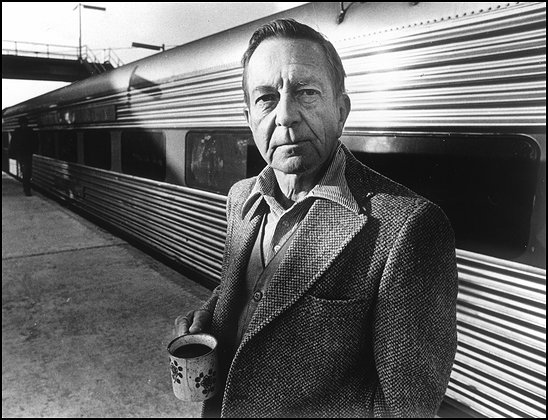
Reading again the Paris Review interview with John Cheever, first published in the Fall 1976 issue, what a relief to find oneself in his company again, saying so much about writing - and, by extension, living - that is so replenishing. For instance, he quickly dispels the notion, popularized by mostly bad writers, that writing is a torment.

"When I write a story that I really like, it's ... why, wonderful. That's what I can do, and I love it while I'm doing it. I can feel that it's good ... The sense is of one's total usefulness. We all have a power of control, it's part of our lives: we have it in love, in work that we love doing. It's a sense of ecstasy, as simple as that. The sense is that 'this is my usefulness, and I can do it all the way through.' It always leaves you feeling great. In short, you've made sense of your life."

His advice to his readers, and to other writers, is as free from cant as anyone could want. He calls writing "our most intimate and acute means of communication." When asked his feelings about "truth" and "reality", he replies that

"For one thing the words “truth” and “reality” have no meaning at all unless they are fixed in a comprehensible frame of reference. There are no stubborn truths ... What I’ve always wanted of verisimilitude is probability, which is very much the way I live.

When he finishes writing a book, he says, "there is some dislodgment of the imagination. I wouldn’t say derangement. But finishing a novel, assuming it’s something you want to do and that you take very seriously, is invariably something of a psychological shock."

Pursuing this admission, the interviewer asks "How long does it take the psychological shock to wear off? Is there any treatment?"

"I don’t quite know what you mean by treatment. To diminish shock I throw high dice, get sauced, go to Egypt, scythe a field, screw. Dive into a cold pool."

He mentions how important memory is for a writer a few times: "... any estimable exercise of the imagination draws upon such a complex richness of memory that it truly enjoys the expansiveness—the surprising turns, the response to light and darkness—of any living thing."

So many of the interviewers questions seem like the standard questions asked of any writer, like "Do you feel drawn to experiment in fiction." But Cheever takes them in his stride:

"Fiction is experimentation; when it ceases to be that, it ceases to be fiction. One never puts down a sentence without the feeling that it has never been put down before in such a way, and that perhaps even the substance of the sentence has never been felt. Every sentence is an innovation."

Cheever spoke about his affection for Scott Fitzgerald, "it is such a sad story." But he could as easily have been speaking of himself ("Everyone keeps saying that about my stories, 'Oh, they're so sad.'"):

"All the estimates of him bring in his descriptions of the '29 crash, the excessive prosperity, the clothes, the music, and by doing so, his work is described as being heavily dated . . . sort of period pieces. This all greatly diminishes Fitzgerald at his best. One always knows reading Fitzgerald what time it is, precisely where you are, the kind of country. No writer has ever been so true in placing the scene. But I feel that this isn't pseudohistory, but his sense of being alive. All great men are scrupulously true to their times."

Then, in response to a silly quote about novelists by William Golding, Cheever expands on his belief that writing is a more mysteriously psychic experience than we may think:

"Cocteau said that writing is a force of memory that is not understood. I agree with this. Raymond Chandler described it as a direct line to the subconscious. The books that you really love give the sense, when you first open them, of having been there. It is a creation, almost like a chamber in the memory. Places that one has never been to, things that one has never seen or heard, but their fitness is so sound that you’ve been there somehow."

Writing is "a question of making sense of ones experience ... Fiction is meant to illuminate, to explode, to refresh ... Acuteness of feeling and velocity have always seemed to me terribly important ... The proper function of writing is to enlarge people. To give them their risk, if possible to give them their divinity."

In his 1991 review of Cheever's Journals, John Updike wrote of his "memories of the sprightly, debonair, gracious man, often seen on the arm of his pretty, witty wife."

I saw his interview with Dick Cavett in 1981, just a few months before his death. Cavett wrote in a recent New York Times Opinionater column of his last meeting with Cheever, outside a "40-room mansion on Gramercy Park" where the National Arts Club had invited them to speak:

"Out front afterwards, on the dark sidewalk as people were leaving, I thanked and said goodbye to John for the last time. He started away and then came back, reached inside his jacket, and handed me his typed copy of the wonderful and witty remarks he had just made about me. As I recall, I tucked them inside my blazer pocket, making a mental note to take good care of that sheet of paper. A cleaner may have been the last to see it."

Tuesday, January 24, 2012

Contagion


Every few years, it seems, some new strain of virus appears out of nowhere that threatens to go pandemic and kill millions of us. Each new viral scare is both a product of a shrinking planet and a vindication of it. The "medical thriller disaster film" Contagion illustrates these strengths and vulnerabilities.

Two men, John Sayles and Steven Soderbergh, represent the two main problems with American "independent" film. (If only they could somehow be merged into one filmmaker, the resulting films would be something like Pontecorvo's Battle of Algiers.) Sayles has never been short of things to say (Matewan, Eight Men Out, Lone Star, Men With Guns, Casa de los Babys). He's the closest we have to an American Ken Loach. What Sayles lacks is an original or compelling way of saying them. Soderbergh, on the other hand, has acquired a superb technique that is too often confused with art and is lavished on trivial material or on movie star vehicles.

Soderbergh's film Contagion has almost everything that a film dealing with such a subject requires: intelligence, truthfulness, and a plot driven by a genuinely frightening eventuality. What it doesn't have, strangely, is what Sayles would've given it at the expense of suspense: a point of view. Soderbergh takes a dim view of humanity when he shows us a handful of experts who know what to do and who get to it, a bureaucracy that does pretty much whatever the experts tell them, and the rest of humanity that does nothing but wait on enough luck to survive. The everyday sort of selfless heroism that was evident in Japan after the earthquake and tsunami is omitted. Western observers spoke often of the apparent stoicism with which the Japanese public endured their daily hardships. But some of them also speculated that Americans might not be so stoical, if and when they are faced with such a national calamity. Soderbergh shows them on their worst behavior as the disease spreads, stampeding pharmacies, looting grocery stores, and vandalizing everything else. The only cool heads in the movie are, of course, played by the stars.

Probably the most despicable character in the movie is played by Jude Law - a blogger who contributes to and exploits the hysteria. At one point, he tells a scientist (played by Elliott Gould) that he's a writer and has his own blog. "Blogging is not writing," Gould tells him. "It's graffiti with punctuation." Law is dubious of everything that established institutions do to fight the virus. Even when they develop a vaccine, he says "This thing's side effects will be like the credits at the end of a movie."

Contagion, which is immeasurably better than the last film on the subject, Outbreak, has a current of fear that is, er, infectious. When we first see Gwyneth Paltrow, she coughs, and we follow her home from Chicago, after a business trip to Macao. Our clinical interest in her fate is softened by the helplessness in which her illness leaves her, and by Matt Damon's stunned reaction to the news of her sudden death.

I suppose that such a film, which must cover vast distances (Atlanta, Chicago, Minneapolis, San Francisco, Dubai, Japan, Switzerland, the United Kingdom, Brazil, Russia, Malaysia, and Hong Kong) couldn't avoid the many ellipses and musical segues to which Soderbergh so often resorts. A throbbing, monotonous music score underpins these scenes, that manage to be dramatically effective while basically saying very little.

The star-studded cast is headed by an excellent Laurence Fishburne as the director of the CDC - for which Contagion is an extended endorsement. Kate Winslet manages to turn her small role as CDC field investigator into a memorable vignette. And Matt Damon is once again convincing as a regular Joe - in this case a hapless man who is immune to the virus that kills his wife and young son.

What the film tells us about human beings isn't very surprising or edifying. Camus' great novel, The Plague, is something of a model for all such stories, even if it is about much more than just the progression and containment of a bubonic plague outbreak in a 1940s Algerian city. The last paragraph of the novel (in Stuart Gilbert's translation) reads:

"...as he listened to the cries of joy rising from the town, Rieux remembered that such joy is always imperiled. He knew what those jubilant crows did not know but could have learned from books: that the plague bacillus never dies or disappears for good; that it can lie dormant for years and years in furniture and linen-chests, that it bides its time in bedrooms, cellars, trunks, and bookshelves; and that perhaps the day would come when, for the bane and enlightening of men, it would rouse up its rats again and send them forth to die in a happy city."

Needless to say, Camus' chronicle is incalculably more moving as a human drama, and a towering work of art. Soderbergh has announced his upcoming retirement from directing. I can't think of too many other directors who could've made Contagion run its 106 minutes as smoothly as Soderbergh. Smoothness may not count for much, but in American film, perhaps it's the most we have a right to expect.

Saturday, January 21, 2012

Language Barrier


Last November, when an unscrupulous landlady of mine decided to raise my rent 60%, I did a little research into Philippine rent laws and discovered one - conveniently published in English - that prohibited landlords from raising their tenants' rent more that 7% per year. Known as the "Rent Control Act of 2009", the law included, in section 14, a provision for "a continuing information drive" that called for it to be "translated and be made available in major regional dialects and ... posted in conspicuous public places, including barangay halls."

I printed a copy of the Act and handed it to my landlady the next time she showed up to collect my rent. Since I had heard she was college educated, I made the honest mistake of expecting her to be able to read the English in which the Act had been written. The look on her face when she looked at the first page and then looked up at me made me realize my mistake. She would probably need a lawyer, I thought, to make sense of it for her.

Filipinos are taught English from grade one through their fourth year of high school. This is actually typical of many countries, including Japan, where I had lived for three years in the 1990s. But, like everything else in a person's education that has no practical application in their lives (like algebra) , even the best students have few opportunities in their lives to use the English that they spent ten years learning. One of the reasons why the Filipino Department of Education makes the instruction of English mandatory in public schools is because of the many dialects spoken throughout the Philippine archipelago - Ilocano, Pampangan, Waray, Visayan, Cebuano. For the same reason, DepEd has directed the schools to teach Tagalog, which is the official language of the country, a common dialect that can be used and understood all over the country. National television broadcasts and all Filipino movies use Tagalog. This guarantees that the greatest number of people who watch TV and movies can follow what is being spoken.

English is reserved - inexplicably - as the language of national government and of higher education. When I visited my local barangay hall and asked, in Tagalog of course, if a copy of the Rent Control Act had been posted there, translated into the local dialect, I was told that they had heard of neither the Act nor the information drive for its dissemination.

This week I watched on national TV the Senate impeachment trial of the standing Chief Justice of the Supreme Court, conducted exclusively in English, and I wondered how many Filipinos could follow what was going on. And then it occurred to me that, perhaps, this was the whole point. The exclusive use of English in government proceedings meant that a majority of Filipinos would understand nothing of what was going on. Just as it didn't matter that the Philippine government had passed the Rent Control Act, when few Filipinos would know of its existence or it meaning as long as it was drafted in English. As long as the Philippines is ruled in this way, with a majority of the people having no knowledge of the substance of laws enacted, a government could rule with impunity.

Recently, when a question regarding the "constitutionality" of a particular measure under debate in the Philippine Senate was raised, a certain senator noted for her outrageous remarks announced that no one who was not a law school graduate like her was qualified to interpret the Philippine constitution. When I heard this, I was flummoxed. If an American senator had made such a remark, he would've been pilloried. If what she said were true, I thought, then such a constitution should immediately be burned. (Incidentally, this same Philippine senator - Miriam Defensor-Santiago - has been elected as a judge at the International Criminal Court in The Hague.)

Wednesday, January 18, 2012

Tough Mercies

Once again a poor contemporary film - Crazy Heart (2009) - propels me back to the film that ostensibly inspired it - Bruce Beresford's Tender Mercies (1983). Crazy Heart is so lamely executed, made by people who have as little feeling for life as they have for film, that the characters emerge as pathetic rather than sympathetic. In fact, Crazy Heart, which some critics called "Tender Mercies Lite", is a practical demonstration of how to escape from life, how to misrepresent the truth, and how to avoid art. 

Jeff Bridges won an Oscar for his performance as Bad Blake, a country singer on what he seems determined will be his last legs. As played by Bridges, he is a messy human being, with failed marriages and responsibilities left behind. He spends at least half the film drunk, with his pants hanging open, travelling from town to town at his manager's direction. The film commits a quite glaring mistake when Bridges steps onstage, whether in a small town lodge or an arena, and he and his band play brilliantly - until Blake falls over and has to run backstage to throw up. T-Bone Burnett supervised the songs Bridges sings throughout the film. So instead of a broken down old country singer no one wants to hear any more, Crazy Heart gives us an award-winning soundtrack album. Bridges has even taken a year off (which must be nice) to take his new-found guitar-playing and singing talents on the road. 

The biggest mistake Crazy Heart makes is that Jeff Bridges' performing sounds far too polished. He's supposed to be playing with pick-up bands in saloons and bowling alleys. Anthony Quinn liked to tell a story of his days of shooting with Fellini for La Strada. Fellini arranged for Quinn to arrive in a small Italian town and perform his Zampano strongman act in front of whatever crowd showed up, shooting the scene with discreetly-placed cameras. On Fellini's signal, Quinn rode up in his wagon and prepared for his act. A crowd gathered and Quinn launched into his performance. He was brilliant and a huge crowd showed their appreciation for this apparently unknown performer with a hatful of cash. Quinn packed up his motorcycle and rode out of the town square. Later at night, Fellini phoned Quinn and told him they would have to re-shoot the whole scene. "But why?" asked Quinn. "I thought it was perfect?" "Because," Fellini replied, "you played the scene just like Anthony Quinn, the great actor. And of course the crowd loved it. But you're not Anthony Quinn. You're Zampano. You're supposed to be lousy." 

Before Tender Mercies began shooting, Robert Duvall drove all over West Texas, listening to the people's speech and singing with local bands in preparation for his performance as Mac Sledge, a former country singer who finds himself one morning broke in a motel four miles from the nearest town. He asks the motel owner, Rosa Lee (played beautifully by Tess Harper) if he can work off what he owes her. She eventually gives him a steady job, pumping gas and doing odd jobs around the property. Twelve minutes into the film, there is a scene between Mac and Rosa Lee in the backyard garden. Mac comes straight out with "I guess it's no secret how I feel about you. A blind man could see that. Would you think about marrying me?" This is precisely the point at which Pauline Kael, an occasionally sensitive critic, decided that the film had failed her. "I kept waiting for Tender Mercies to get started - to get into something. I was still waiting when it was over and I was back out on the street...[It is] proof that a movie doesn't have to be long to be ponderous." (1) 

I can only guess that Kael was disappointed that the film, in her estimate, hadn't earned the sudden access of emotion between Mac and Rosa Lee. I think the point that Horton Foote, who wrote the script, and Beresford were making was how little their characters are capable of expressing their feelings. Mac has to do it through the platitudes of a country song. Duvall himself wrote the song that he sings at the film's climax, "If You'll Hold the Ladder (I'll Climb to the Top)". The song's clumsy poetry is typical of country songs, which give people, who are, evidently, in their millions, an outlet for their deepest feelings. 

Duvall is so perfect as Mac Sledge that he sounds (to my ears) dreadful when we finally hear him sing, his voice (intentionally) a collection of vocal mannerisms learned from a lifetime of singing in honkytonks - just the sort of twangy cowboy music I've tried to avoid all my life. He isn't catapulted, as in Crazy Heart, back into fame after his recovery from drink. He is simply redeemed by love and by a profound faith, but sadly mystified by the workings of God. After a reunion with his daughter Sue Ann, she is killed in a road accident that leaves Mac at a loss: 

"I was almost killed once in a car accident. I was drunk and I ran off the side of the road and I turned over four times. And they took me out of that car for dead. But I lived. And I prayed last night to know why I lived and she died. But I got no answer to my prayers. I still don't know why she died and I lived. I don't know the answer to nothin'. Not a blessed thing." 

Bad Blake gets into a remarkably similar accident and survives with a broken leg. In fact, the similarities between Crazy Heart and Tender Mercies are many - too many to avoid comparing the two films. Blake has a son he hasn't seen in years. Instead of an ex-wife country singer, he has Tommy Sweet (Colin Farrell), who has managed to remain successful and not lose everything. Instead of Rosa Lee, Blake gets AA. In fact, Robert Duvall appears in Crazy Heart as an old friend of Blake's who helps him recover from alcohol. Bridges' film could've done without Duvall's imprimatur, but I suppose they believed that genuflecting at Tender Mercies wouldn't hurt. Boy were they wrong. (1) Pauline Kael, Taking It All In.

Sunday, January 15, 2012

When Nature Calls


Is there a Geneva Convention statute giving instructions for the disposition of the dead in war? At a bare minimum, there must certainly be one that requires for a proper burial. And it probably condemns the sort of treatment that a group of U.S. marines gave to the dead bodies of Taliban in a video recently "leaked" on YouTube. It gives us a rather lurid glimpse into the mentality of these men, and should give us pause about what war can do to perfectly civilized people.

Nobody seems to want to any more, but the only way we are ever going to understand why American fighting men do such things is by thinking about why one of them decided to record it and share it with others. They knew that it was wrong, but they had to have believed that they would get away with it and that there would be support for their actions among fellow marines. They believed, I think, that they were demonstrating to one another their absolute mastery over their enemy. Their act of desecration proved that their Taliban adversaries, although dead, could be useful.

A few people, who also expressed disgust for the incident, hinted at some understanding for its context. Evidently, there had been a firefight, and the enemy dead had been placed in a pile. No one who hasn't been under fire and fought off the assault to live another day can possibly imagine what the experience is like. There is no other experience even remotely like it. It can be explained in physiological terms, when the adrenaline those marines were affected by, the exhilaration of coming close to death and surviving, was probably extraordinary. It's at precisely such moments that ideas like "professionalism" and "decorum" become especially meaningless. While combat is the single event for which all of a marine's or a soldier's training has prepared him, nothing can prepare him for the gamut of emotions or the velocity of their arrival and departure. It is in all the minutes, hours, and days after the event that the marine or soldier shows his true mettle. And the majority of those fighting men, the junior enlisted men, are 19 or 20 years old. Their high school buddies back home are getting high, partying, and doing all the things that 19 and 20 year olds normally do.

While on deployment in Afghanistan, each deployment lasting for 365 days, these young men earn what's known as "certain places pay" (i.e., combat pay) and their base pay isn't taxed. If their units weren't tightly knit prior to its deployment, the ever-present fear of being on patrol and the constant tension and relaxation of being in or out of garrison, produces a fellowship among them that is unprecedented and irreplaceable. For many of them, the thought of separating from the service, when their unit faces the likelihood of further deployments, is unthinkable. Ask any of those young men what they are fighting for and they will tell you, unequivocally, that it is for one another. Their mission may include everything from "peace-keeping" to "nation-building", but such concepts have meaning only for the people who have the time to think about them. These young men have a clear and direct understanding of brotherhood, of being more than an individual, of being a part of something bigger than themselves.

In order to overcome their basic reluctance to kill another human being, these young men have to be de-sensitized - i.e., brutalized - to the point at which the human beings whom they are called on to kill are deprived of their humanity. It happens in all wars. But it is especially prevalent when there are racial or cultural differences separating them from their enemies.

Sending these young men to do our dirty work and then criticizing the manner in which they do it is exceptionally hypocritical. What those marines did wasn't a disgrace to the U.S. Marine Corps. It was an embarrassment to the military mission in Afghanistan, which is trying to convince ordinary Afghans that they are there to help them achieve a pluralistic, secular state. Doubtless, the marines will have to be provided with further instruction in the proper handling of all those who oppose such a state, once they have been properly killed, that is.

Our notions of "limited war", of a "low-intensity conflict" have been severely tested by the estimates of somewhere between 12,000 and 14,000 civilian dead in ten years. 95% of the world's supply of opium comes from Afghan poppy farmers. If the Taliban want to terrorize the world, they could do worse than to simply rely on the heroin that supplies the estimated 15 to 16 million addicts worldwide, tens of thousands of whom die early deaths every year.

Saturday, January 14, 2012

Calamity Prone


Philippine president Benigno Aquino III declared a state of "national calamity" after heavy rains from tropical storm "Sendong" left more than a thousand people dead and at least as many missing just a few days before Christmas. He declared that the state of calamity was to last for sixty days, but if he wanted to tell the truth about his beleaguered country (1), he should've extended it "in perpetuity".

Experts try to explain such disasters by pointing out that the Philippines endures an average of ten big tropical storms and cyclones every year. But that doesn't account for the routinely catastrophic scale of the damage the storms inflict on the Philippines, since the U.S. east coast sees several large storms as well, but the cost of lives and property damage is comparably minimal.

In the days after the flash floods in Mindanao, I heard pundits on Filipino TV talking about the "disaster-prone" areas in the country, suggesting that there are actually specific areas, such as river basins, that are prone to disasters like floods and landslides. But there are places like that everywhere in the world. Many major cities are situated on river basins. The Thai capitol, Bangkok, recently experienced its worst flooding in more than fifty years. The floods weren't restricted to one region, nor were they, despite extremely heavy rainfall, what caused the calamity in Mindanao.

When a major flood hits the U.S. or Europe, there is much property loss but comparably little loss of life. The huge flash floods in Mindanao took place in the middle of the night when people were asleep in their beds. The Philippine agency responsible for alerting citizens of impending disasters insisted that they provided sufficient warning to the residents of the region. What they didn't point out was what the warning consisted of and what form it took. Living in a remote province myself, in which there is only one radio station and where the two national TV networks are off the air at night, I wonder what, if any, warning would arrive here in time to save people's lives in a disaster.

Communications is just one part of a country's infrastructure. After the disaster, local officials were blaming "illegal logging" for the severity of the floods. But these disasters are practically self-inflicted, since infrastructure development in the poorer provinces of the Philippines is notoriously neglected. Where there is highway or bridge construction, corruption ensures that the money initially provided for the construction gets siphoned off: contractors pass the job on to sub-contractors, and the resulting roads and bridges are washed away every few years. Nothing gets fixed here until it breaks.

As I wrote in May 2010, Filipinos seem to have a special relationship with their surroundings. A road sign can be found everywhere, at particular places along a highway, that reads "Accident Prone Area". At first glance, one's first reaction to the sign is that it isn't areas that are accident prone - it's people. But Filipinos evidently don't see it that way. If accidents occur in certain places more often than elsewhere, the places themselves are partly responsible. The sign is a warning to everyone who drives into the area to be careful, lest they fall prey to whatever is causing all the accidents. It reminds me of an insurance law in Japan that states when your car is rear-ended, you are partially responsible (I think 15% was the percentage), since the accident wouldn't have occurred if your car hadn't been there.

I wouldn't be surprised if soon there will be signs posted in special areas in these islands that read Disaster Prone Area. They won't save lives, but they will give the local governments an excuse not to spend another peso on infrastructure.


(1) One example of the lack of truth-telling is the official unemployment rate of 6.4% (as of October 2011). Forgetting that 11 million Filipinos are working overseas, and that most of the women are too busy caring for their children to even consider getting a job, no one who has visited this country for a few days could possibly estimate unemployment at anything less than 30%.