“His films are interesting. He upsets the official cinema, which cares only for profits. He taught films how to use disorder.” Robert Bresson (1)
Saturday, April 24, 2021
Alphaville: A Strange Adventure of Lemmy Caution
“His films are interesting. He upsets the official cinema, which cares only for profits. He taught films how to use disorder.” Robert Bresson (1)
Thursday, April 15, 2021
The Friends of Eddie Coyle
Saturday, April 10, 2021
Round Midnight
Monday, April 5, 2021
A Sunday in the Country
Wednesday, March 31, 2021
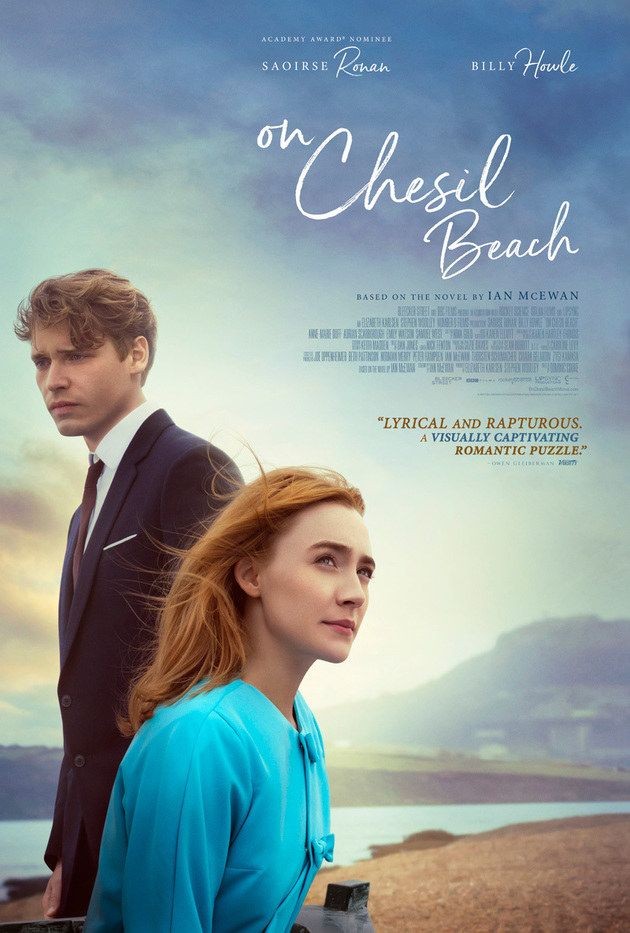
On Chesil Beach
“This is how the entire course of a life can be changed - by doing nothing.”
Nothing demonstrates what a cumbersome and ultimately fragile
medium the motion picture is more than an adaptation of a good novel – in this
case Ian McEwan’s On Chesil Beach (2017). It was the last of three projects to
adapt the novel to film, starting in 2010 with Sam Mendes, who had bigger fish
to fry (Skyfall), then it was passed on to Mike Newell, until the
backers backed out. Finally, in 2016, Dominic Cooke, who is an experienced
theater director, took it on as his first film.
McEwan wrote the script for the film, the first time since he
adapted The Innocent in 1993. At just 166 pages (40,000 words), On Chesil
Beach is a slight novel, so its fleshing out presented McEwan with an
opportunity to revisit his material and even make some additions. A great deal
more is made, for instance, of Edward’s mother (Anne-Marie Duff) in the film,
and Florence’s therapeutic effect on her. And I liked how Florence gets Edward
to admit, as he's moving his hand up her skirt, that he’s a virgin, too. Trouble is, it probably made her even more
afraid of what was coming.
If anything, the horrible anti-climax that occupies the
center of McEwan’s novel is all the more ghastly in the film. Watching two people,
Edward Mayhew and Florence Ponting (Billy Howle
and Saoirse Ronan), who are hopelessly ill-prepared on their wedding
night, doing – or attempting to do – what is expected of them should’ve seemed
a much more crushing attack on English society of 1962, and a punishing
reminder of its failure to prepare two impeccably educated 22-year-olds for the
facts of life. McEwan supplied us with what was going on inside their heads,
and it definitely helped to explain the somewhat predictable disaster that
ensues (for her sake he had refrained from masturbating a few weeks prior, but
then she takes his penis in her hand to guide it and - -!). But to watch it
unfold without knowing how much she is repulsed by everything about it, which
partly explains her hysterical revulsion at being covered in his ejaculate
(well, only her thigh in the film – in the novel it reaches her chin), is both
shocking and outrageous.
McEwan sets up the tragic moment beautifully. Edward:
For over a year, Edward had been mesmerised by the
prospect that on the evening of a given date in July the most sensitive portion
of himself would reside, however briefly, within a naturally formed cavity
inside this cheerful, pretty, formidably intelligent woman.
Then Florence:
Where he merely suffered conventional first-night
nerves, she experienced a visceral dread, a helpless disgust as palpable as
seasickness. For much of the time, through all the months of merry wedding
preparation, she managed to ignore this stain on her happiness, but whenever
her thoughts turned towards a close embrace - she preferred no other term -her
stomach tightened dryly, she was nauseous at the back of her throat. In a
modern, forward-looking handbook that was supposed to be helpful to young
brides, with its cheery tones and exclamation marks and numbered illustrations,
she came across certain phrases or words that almost made her gag: mucous
membrane, and the sinister and glistening glans. Other phrases offended her
intelligence, particularly those concerning entrances: Not long before he
enters her . . . or, now at last he enters her, and, happily, soon after he has
entered her . . . Was she obliged on the night to transform herself for Edward
into a kind of portal or drawing room through which he might process? Almost as
frequent was a word that suggested to her nothing but pain, flesh parted before
a knife: penetration.
In the novel, time shifts are handled deftly and carry the
reader back and forth from the wedding night scene to Edward’s and Florence’s
childhoods and courtship. In the film the transitions are, if anything, too resplendent: one comes
away convinced these two brilliant people deserved so much more than what they got.
Both McEwan and Dominic Cooke, who was a novice at film
directing, complained about the loss of control. While McEwan, writing the
screenplay, knew that film was collaborative, he missed “playing God” and
controlling everything himself. Cooke, who came from the theater, disliked
having to contend with the input of so many others – mostly producers, who were
eager to suggest ways of simplifying what he wanted to be complex.
Finally, where the film spoils the novel, not to mention
Edward and Florence’s wedding night, is in the sex itself, fleeting though it
is. (And the trouble starts with Edward’s tongue-kisses, which – evidently –
neither actor was up to.) While McEwan could present to us the physical details
without fear of obscenity: “She found his testicles first and, not at all
afraid now, she curled her fingers softly round this extraordinary bristling
item she had seen in different forms on dogs and horses, but had never quite
believed could fit comfortably on adult humans. Drawing her fingers across its
underside, she arrived at the base of his penis, which she held with extreme
care, for she had no idea how sensitive or robust it was. She trailed her
fingers along its length, noting with interest its silky texture, right to the
tip, which she lightly stroked; and then, amazed by her own boldness, she moved
back down a little, to take his penis firmly, about halfway along, and pulled
it downwards, a slight adjustment, until she felt it just touching her labia”,
the only thing that Dominic Cooke or his two actors could give us is a
pantomime, and some other whitish substance standing in for Edward’s spilled
seed on Florence’s inner thigh. As written, the scene presented difficulties
for a 21st century filmmaker because it all takes place in the
cramped space between Edward and Florence’s genitals. But leaving the crucial
moment to our imaginations, when everything else in the film is strenuously
explicit, was, I think, a mistake. It even reinforces the enforced ignorance
about sex that got McEwan’s honeymooners in such a mess. Maybe Michael
Winterbottom might’ve been up for the challenge. Or maybe not. And you can’t
blame the literalness of film. As Charles Thomas Samuels wrote ages ago, “Sex
needs words in order to be creative.”
As for the rest of the film, which is a long denouement in the
novel, it was fine all the way up to the concert scene at the end in which
Florence receives an ovation in her cherished Wigmore Hall and looks directly at Edward, who
sits there and weeps. Movie makeup has made considerable advances in a hundred
years, but they didn’t prepare me for the aged masks of Florence and Edward in
that final shot, which were embarrassingly bad. They wanted a more conclusive
conclusion than McEwan’s (in the novel, they never see each other again after
the scene at night on Chesil Beach), but I could’ve done without it. (I especially could've done without learning that Florence had married that fucking cellist!) I prefer to
remember them as Edward does:
Occasionally, he would come to a forking of the
paths deep in a beech wood and idly think that this was when she must have
paused to consult her map that morning in August, and he would imagine her
vividly, only a few feet and forty years away, intent on finding him.
McEwan was echoing Philip Larkin, and not just “Annus Mirabilis”. Dominic Cooke told an interviewer that, if there is a lesson to be learned from the story, it is to never look back.
Truly, though our element is time,
We are not suited to the long
perspectives
Open at each instant of our lives.
They link us to our losses:
worse,
They show us what we have as it
once was,
Blindingly undiminished, just as
though
By acting differently we could
have kept it so.
(“Reference Back” by Philip Larkin)
Saturday, March 27, 2021
The Other Browning Version
“God from afar looks graciously upon a gentle master.”
Ten years ago on this
blog I compared the two film adaptations of Terence Rattigan’s play The
Browning Version, Anthony Asquith’s from 1951 and Mike Figgis’s from 1994.(1)
While Asquith’s film has the distinction of preserving for the ages the
magisterial performance of Michael Redgrave as Andrew Crocker-Harris, Figgis’s film
rehabilitates the role of Crocker-Harris’s wife, Millie (Figgis renamed her
Laura).
Looking for a
streaming source for the Mike Figgis version, I chanced upon yet another Browning
Version, aired on the BBC in 1985, with Ian Holm playing Crocker-Harris and
Judi Dench playing Millie.(2) While it isn’t quite a film, but much more of a filmed
play (the script is attributed to Rattigan, who in ‘85 had been dead for eight
years), it has the advantage of getting us much closer to the actors – and getting
close to Ian Holm and Judi Dench is always rewarding.
I am indebted to PBS, America’s
public television, for honing my television tastes throughout the 1970s. Much
of the programming was imported from the UK and presented weekly on shows like Masterpiece
Theater. What I wrote about that show six years ago on this blog bears
repeating:
Long
ago critics started using the words "masterpiece theater" as a
pejorative term, implying that certain films had been subjected to such
high-minded treatment that they were stuffy, plodding, or - to use the ultimate
dirty word - literary. I wondered how many of those critics had ever actually
watched Masterpiece Theater or ever watched PBS for that matter? If
they had, they might have discovered just how dangerous it was to use such a
term, since the show, which aired out of WGBH Boston, could be some of the most
challenging television around.
Once
the action of this BBC Browning Version was underway, my initial response
was surprise at seeing a strapping young man (Stephen Mackintosh) playing the
schoolboy John Taplow. In the better-known film versions he was played by pubescent
– and rather inadequate – boys. Stephen Mackintosh was 18 when the BBC filmed the
program, set entirely in the Crocker-Harris’s drawing room. To some, Mackintosh
may seem rather old for a boy in the Lower 5th form, but in English
boarding schools the 6th form is the senior year, so Taplow’s age
would’ve been about 16.
The one-act play is quite familiar to me now: Andrew Crocker-Harris is a boarding school schoolmaster at what the British call public school, but which is exclusively private, teaching Greek and Latin. He is so unpopular among his students, past and present, that he has been called by them the “Croc” and the “Himmler of the Lower 5th.” The reason for such “soulless petty tyranny” becomes clear when we meet his wife, Millie, who treats him with open disdain and is carrying on an affair with Frank Hunter, the science master of the Upper 5th form. One of Crocker-Harris’s students, named John Taplow, confesses to Frank that he feels sympathy for the Croc. His sympathy inspires him to buy the Croc a parting gift – a copy of Robert Browning’s verse translation of the Agamemnon. Inside it he writes, in Greek, “God from afar looks graciously upon a gentle master.” The gift of the book and the inscription is so unexpected that Crocker-Harris is overcome with emotion. It is the climax of the play and the three actors I’ve seen perform the role of Crocker-Harris make it exceptionally moving.
The
only thing that prevented Ian Holm, who died last June at 88, from being as famous
a stage and screen presence as, for instance, Anthony Hopkins, was his size. He
was just shy of 5’5”. He was consigned to supporting roles for decades, yet in
film after film his presence is unforgettable: The Return of the Soldier,
Dreamchild, The Madness of King George, The Sweet Hereafter,
Joe Gould’s Secret. As Crocker-Harris, Holm is refreshingly steady
rather than doddering. Michael Redgrave portrayed him as a kind of cipher – a
walking shadow, to which his nightmare marriage had reduced him. Albert Finney tried
to make him more sensitive (more sympathetic), but his performance lacked a cohesive
center. This may have been due to the transformation of Millie (renamed Laura)
into a more sympathetic, if complex, unfaithful wife. The drama becomes more
nuanced because of this shift in the balance, and it makes for a more
satisfying conclusion. For the Asquith film Rattigan wrote a climactic scene in
which Crocker-Harris apologizes to the assembled student body for “having let
[them] down.” Figgis includes the scene as well, but since the play is presented
intact in the BBC production, the climax lacks the sheer spectacle of the film
versions, but is more subtle and quite consistent with the rest of the play. Crocker-Harris
simply tells Millie, “I don’t think either of us has the right to expect
anything further from the other.” I could almost hear the slamming of a door.
This is
where the three Browning Versions stand or fall – on the character of
Crocker-Harris’s wife. Rattigan made her into a monster who not only cheats on
her husband but who informs him of the progress of her cheating. She throws
herself at another schoolmaster (not the first, we discover), whose response to
her has cooled when the film opens. It was Rattigan’s way of exposing the
rotten core of middle class English respectability, and that cruelty lies just
beneath its smooth surface. Millie may have had her reasons for going astray,
but Rattigan clearly wanted us to believe that it is Andrew who is more sinned
against than sinned. Millie witnessed the erosion of Andrew’s spirit. When
Hunter mentions the “soul-destroying Lower Fifth,” Andrew insists that his soul
wasn’t destroyed. The generous gesture of Taplow, the copy of Browning’s
translation of the Agamemnon, arouses him from what turned out to be a
hibernation of the soul.
Ian
Holm doesn’t fill his performance with “business” the way Redgrave did. He
isn’t fidgety or subject to nervous tics. Nor is he dodgy with his accent, as
Finney was. Finney spoke in an affected, refined accent. Holm is at home
with his attuned, enunciated lines
because a classics teacher would be pedantic about such things.
Enter Judi
Dench, who is a tigress. She not only fills out the role of Millie,
contributing depths to the character previously unseen, but also – at last –
believability for her cruelty to Crocker-Harris. In her first scene with
Michael Kitchen, who plays Upper Fifth master Frank Hunter, she practically
chases him around the room. What she doesn’t know is that he’s suffering an attack
of conscience and is planning to use Crocker-Harris’s – and Millie’s – imminent
departure from the school as a good excuse to break things off with her.
Everything
about the production is as near to perfection as it could get. The settings, costumes,
and the direction are superb. The director, Michael Simpson, had extensive experience
in the theater, and he handles the pacing splendidly. But what we are left with
at the play’s conclusion is the image of Millie serving Crocker-Harris his dinner,
a domestic scene between a Clytemnestra who has failed to destroy her Agamemnon,
reduced to a housewife offering a dinner plate to her husband.
(2) There is one more Browning Version, made for American television in 1959, with John Gielgud as Crocker-Harris and a young Robert Stephens playing Taplow. It was directed by John Frankenheimer.
Wednesday, March 17, 2021
The End of the Record
[If there is a single element that I look forward to in an Irish story, besides the marvelous language, I would call it magic. Sean O'Faolain was one of the first great Irish writers who didn't become an exile from Ireland. I first encountered his stories in my twenties and I read every one I could find. This one, "The End of the Record," is especially short and especially strange. And with it I wish you all a Happy St. Patrick’s Day.]
The
news went around the poorhouse that there was a man with a recording van in the
grounds. He was picking up old stories and songs.
‘And they say that he would give you a five-shilling
piece into your hand for two verses of an old song,’ said Thomas Hunter, an old
man from Coomacoppal, in West Kerry, forgetting that five-shilling pieces were
no longer in fashion. ‘Or for a story, if you have a good one.’
‘What sort of stories would them be?’ Michael Kivlehan
asked sceptically. He was from the barony of Forth and Bargy, in County
Wexford, and had been in the poorhouse for eleven years.
‘Any story at all only it is to be an old story and a
good story. A story about the fairies, or about ghosts, or about the way people
lived long ago.’
‘And what do he do with ‘um when he have ‘um?’
‘Hasn’t he a phonograph? And doesn’t he give them out
over the wireless? And doesn’t everyone in Ireland be listening to them?’
‘I wonder now,’ said
Michael Kivlehan, ‘would he give me five shillings for the “Headless
Horseman and the Coacha Bowr”?’
Thomas Hunter sighed.
‘One time I had a grand story about Finn MacCool and
the Scotch giant. But it is gone from me. And I’d be getting my fine
five-shilling piece into my fist this minute if I could only announce it to
him.’
The two old men sat on the sides of their beds and
tried to remember stories. But it was other things they remembered and they
forgot all about the man outside who had set them thinking of their childhood.
The doctor had taken the collector into the women’s ward
to meet Mary Creegan. She was sitting up in bed, alone in the long room; all
the other women were out in the warm sun. As the two men walked up the bare
floor the collector was trailing a long black cable from a microphone in his
hand, and the doctor was telling him that she came from a place called
Faill-a-ghleanna in West Cork.
‘She should have lots of stories because her husband
was famous for them. After he died she went a bit airy so they had to bring her
to us. ‘Twas a bit tough on her at first. Sixty years in the one cottage – and then
to finish up here.’ They stood beside her bed. ‘I brought a visitor to see you,
Mary,’ he said in a loud voice.
She did not appear to see them. She was humming
happily to herself. Her bony fingers were wound about an ancient rosary beads.
Her white hair floated up above a face as tiny and as wrinkled as a forgotten
crab apple. All her teeth were gone so that her face was as broad as it was
long: it was as if the midwife had pressed the baby’s chin and forehead
betweeen thumb and forefinger. The doctor gently laid his hand under the tiny
chin and turned her face towards him. She smiled.
‘Put down the kettle and wet the tay,’ she ordered.
The doctor sat on the bed; so did the collector.
‘‘Tis down, Mary and two eggs in the pot. This poor
man here is after coming a long way to talk to you. He’s tired out.’
She turned and looked at the stranger. Encouraged by a
brightening spark in the depths of her eyes he turned aside and murmured
quietly into the microphone. ‘Reggy? Recording ten seconds from . . . now.’
‘It’s a bad road,’ she said. ‘Ask Jamesy is he keeping
that divil of a cow out of the cabbage.’
‘She’s all right,’ the doctor cried into her ear.
‘Jamesy is watching her. Be talking to us while we’re waiting for the tay. You
told me one time you saw a ghost. Is that true?’
She looked out of the window and her eyes opened and
narrowed like a fish’s gills as if they were sucking something in from the blue
sky outside. The collector stealthily approached her chin with the microphone.
‘Ghosts? Ayeh! Ha! My ould divil of a tailor is
forever and always talkin’ about ‘um. But, sure, I wouldn’t heed him. Bummin’
and boashtin’ he is from morning to night and never a needle to be shtuck in
the shtuff. Where is he? Why don’t you ask him to be talking to you about ghoshts?’
The doctor looked across the bed at the collector and
raised his eyebrows.
‘Maybe you don’t believe in them yourself?’ he mocked.
‘I do not believe in ‘um. But they’re there. Didn’t
I hear tell of ‘um from them that saw ‘um? Aye, and often. And often! Aye’ –
still collecting her thoughts from the sky above the bakehouse chimney – ‘wasn’t
it that way the night Father Regan died? Huh! They called him Father Regan, but
he was not a right priest. He was silenced for some wrong thing he did when he
was a young priest, and they sent him to Faill-a-ghleanna to be doing penance
for it. When his time came to die it was a bad, shtormy night. And when he sent
for the parish priest to hear his confession the priest said he could not come.
And that was a hard thing to do, for no man should refuse the dying. And they
sent another messenger for the priest, and still the priest could not come. “Oh,”
said Father Regan, “I’m lost now.” So they sent a third messenger. And for the
third time the priest could not come. And on his way back wasn’t the messenger
shtopped on the road by a woman? It was Father Regan’s own mother. “Go back,”
says she, “and if the candles by his bed light up,” says she, “of their own
accord,” says she, “he is saved.” And the messenger went back, and Father Regan
gave wan look at him and he closed his eyes for the last time. With that all
the people went on their knees. And they began to pray. If they did, there were
three candles at the head of the dead priest. And didn’t the one beside the
window light up? And after a little while the candle beside the fire clevy lit
up. And they went on praying. And the wind and the shtorm screaming about the
house, and they watching the wick of the last candle. And, bit by bit, the way
you’d blow up a fire with a bellows, didn’t the candle over the priest’s head
light up until the whole room was like broad day light?’
The old woman’s voice suddenly became bright and hard.
‘Isn’t that tay ready a-yet? Domn and blosht it, ye’ll
have them eggs like bullets.’ She looked alertly at the two men. ‘Where am I? Where’s
Jamesy? What are ye doing to me?’
The doctor held her wrist. Her eyes faded. She sank
back heavily.
‘I thought,’ she wailed, ‘that it was how I saw a great
brightness.’
The collector spoke one word into the microphone. The
old woman had fainted. Overcome with regrets he began to apologize, but the doctor waved
his hand at him.
‘Excited. I’ll send up the sister to give her an
injection. Sometimes she loves to talk about old times. It does her good.’
They went out of the empty ward, the cable trailing
softly. They passed the male ward. Michael Kivlehan and Thomas Hunter were
sitting on their beds. As the doctor led the way downstairs, he said, ‘When
that generation goes it will be all over. Wait for me outside. There are a
couple more. You might get bits and scraps from them.’
The engineer put his head out of the van and said, in
the gloomy voice of all engineers, ‘That might come through all right.’
When the doctor came out again they sat with a
middle-aged man from Wicklow, named Fenelon. He had been on the roads until
arthritis crippled him. When he counted the years he spoke in Urdu. He had
scraps of the tinkers’ language which is called Shelta. He said:
‘I often walked from Dublin to Puck, and that’s a
hundred miles, without ever disturbing anything but a hare or a snipe. I’d make
for Ross, and then cross to Callan, and by Shevenamon west to the Galtees.’
He did not see the microphone; he did not see his visitors;
as the needle softly cut the disc he was seeing only the mountainy sheep that
looked at him with slitted eyes, a thing as shaggy as themselves.
They moved on to an old woman, who sang a love song
for them in a cracked voice. She said she had learned it in Chicago. She gave
them a poem of twelve verses about a voyage to the South Seas. They were
finishing a disc with a very old man from Carlow when the sister came out and
hastily beckoned to the doctor. As they folded up the cable he came back. He said,
with a slow shake of the head:
‘It’s old Mary. I must leave ye. But ye have the best
of them. The rest is only the shaking of the bag.
When they had thanked him and were driving away, the
collector said, eagerly :
‘Pull up when we’re out of town. I want to play back
those discs.
They circled up and out of the town until its murmur
was so faint that they could hear only the loudest cries of the playing
children. There they played back the discs, and as they leaned towards the
loud-speaker and the black record circled smoothly they could see sideways
through the window, the smoke of the hollow town. The last voice was Mary
Creegan’s.
‘and after a little while the candle beside the fire
clevy lit up. And they went on praying. And the wind and the shtorm screaming
about the house, and they watching the wick of the last candle. And, bit by
bit, the way you’d blow up a fire with a bellows, didn’t the candle over the
priest’s head light up until the whole room was like broad day light. . .
. Isn’t that tay ready a-yet? Domn and
blosht it, ye’ll have them eggs like bullets. . . . Where am I? Where’s Jamesy? What are ye doing
to me? . . . I thought that it was how I
saw a great brightness.’
The listeners relaxed. Then from the record came a
low, lonely cry. It was the fluting of a bittern over moorland. It fluted sadly
once again, farther away, and for a third time, almost too faint to be heard. Many
times the men played back those last few inches of disc. Every time they heard
the bittern wailing over the mountains.
It was dusk. They laid the voices in a black box and
drove away. Then they topped the hill, and the antennae of their headlamps began
to probe the winding descent to the next valley.