Friday, March 17, 2017

Union or Reunion?

INTO THE TWILIGHT

OUT-WORN heart, in a time out-worn,
Come clear of the nets of wrong and right;
Laugh, heart, again in the grey twilight,
Sigh, heart, again in the dew of the morn.
Your mother Eire is aways young,
Dew ever shining and twilight grey;
Though hope fall from you and love decay,
Burning in fires of a slanderous tongue.

(W. B. Yeats)


I think I have devoted more than enough space on this blog to a subject that is not exactly near and dear to my heart -- my Irish-Americanness. To me, there is no subject hoarier than the centuries-old story of Ireland's struggle for independence from England. Yet every year I have devoted a post on this date - St. Patrick's Day - to some matter touching on Ireland or Northern Ireland, whether it is a film (The Quiet Man, The Luck of the Irish, Omagh) or an item from the news. This time last year I commented on Gerry Adams, former IRA chief and current head of the Irish political party Sinn Fein (pronounced "Shin Fain"[1]) being denied entry to the White House St. Patrick's Day celebration. I don't recall that there was any follow-up to the story. Was it just an oversight? Or was Adams's name deliberately left off the guest list? I'd like to think it was the latter. But Gerry Adams is once again in the news, just in time for another St. Patrick's Day post.

Last summer I watched the referendum over Great Britain's membership in the European Union with disbelief. Like the Scottish Independence referendum before it, the outcome seemed to me utterly counterintuitive. No to gaining self-rule for the first time since 1707? And No to being a part of the same body that has managed to keep Europe at peace for seventy years?

But when Brexit became a reality the following day, and not a bad dream caused by an undigested "bit of beef, a blot of mustard, a crumb of cheese, a fragment of an underdone potato", some people who were part of Great Britain, like the same Scotsmen who voted to remain in it, as well as the Northern Irish who suddenly realized it was no longer such a good thing not to belong in the Irish Republic (which, as a state independent of Great Britain since 1921, shall remain in the EU), began to visit - or re-visit - the advantages of breaking away from Great Britain. Who knows, but that Queen Elizabeth, who last year became the longest-reigning monarch in British history, might live to see not just the cross of St. Andrew struck from the Union Jack, but Orangemen of the six counties of Ulster making quite sure that the exit door doesn't hit them in the arse?

It appears that there is a slight chance that Irish nationalists may finally get through plebecite what they once thought could only be realized through violence: the reunion of Northern Ireland with the Republic of Ireland, with one government in Dublin. Avoidance of the economic downturn forecast for a Britain standing alone again outside of the EU may be incentive enough to persuade the Protestant Unionists in the North to exit Britain and remain in the EU. Unlike Scotland, who would have to apply for EU membership should they decide on independence, Ireland is already a member.

On Monday, Reuters reported the following: 

'Northern Ireland's largest Irish nationalist party Sinn Fein on Monday said it wanted a referendum on splitting from the United Kingdom "as soon as possible", hours after Scottish First Minister Nicola Sturgeon demanded a new independence vote. Sinn Fein has been regularly calling for a vote for Northern Ireland to leave the UK and unite with the Republic of Ireland since Britain voted to leave the European Union last June while most voters in Northern Ireland voted to remain. 

Under a 1998 peace deal that ended 30 years of sectarian violence in the province, the British government can call a referendum if it appears likely a majority of those voting would seek to form part of a united Ireland. 

But Northern Ireland's Secretary of State James Brokenshire said in July last year that he did not believe the conditions for calling a referendum had been met. Opinion polls in the past have shown a majority of people in Northern Ireland want to remain part of the United Kingdom - in an IPSOS-MORI poll in September, only 22 percent of 1,000 voters questioned said they would support a united Ireland while 63 percent said they would prefer to remain part of the UK. 

However, there has been no poll in recent months and Sinn Fein saw a surge in its support at assembly elections a week ago. 

"Brexit will be a disaster for the economy, and a disaster for the people of Ireland. A referendum on Irish unity has to happen as soon a possible," Sinn Fein's leader in Northern Ireland Michelle O'Neill told reporters in Belfast ... Fifty-six percent of voters in Northern Ireland voted to remain in the European Union in June last year, but 52 percent of the United Kingdom as a whole voted to leave. The British government "are continuing to refuse to listen to the majority view and they are refusing to honour their commitments and agreements," O'Neill said ... O'Neill's comments come as British Prime Minister Theresa May is poised to launch the Brexit process, which is expected to have major implications for the economy of Northern Ireland which has close trade links to the Irish Republic, an EU member.'(2)

Could this possibly be the end of the long and (mostly) tedious history of British interference/influence in Ireland? Like most national struggles that have gone on for centuries, in which the goal has become indistinct, exhaustion may well be the deciding factor for the future of a united Ireland.


(1) Why are Irish names - that is, names written in the Irish language (a language I do not speak), like the writer Sean O'Faolain (pronounced O-Fay-lawn), transliterated into English so unsatisfactorily?
(2) "Sinn Fein wants vote on Northern Ireland leaving UK 'as soon as
possible'," by Ian Graham and Conor Humphries, Reuters March 13, 2017.

Monday, March 13, 2017

Twenty Seventeen


Last week, after one of the latest false claims from Donald Trump, Nebraska Republican senator Ben Sasse remarked, “We are in the midst of a civilization-warping crisis of public trust." Why is it that, at the very moment when the public are starving for facts, President Trump is challenging the importance of science in establishing those facts? And when the truth is becoming harder to find, why is he calling the press the enemy of the people?

In a recent Guardian article, Jill Abramson writes: "Fake news has morphed into something far more egregious, fake history." Abramson used as examples of the Trump administration's falsification of history Ben Carson's calling Africans brought to America as slaves "immigrants," Betsy DeVos's assertion that black colleges, which were until fifty or sixty years ago the only places where blacks could get college educations, were examples of the importance of students having the freedom to choose where they are schooled, and Stephen Bannon's claims that Joseph McCarthy was an American hero.(1)

In another article from Politifact, Joshua Gillin reported on "James McDaniel, a 28-year-old Clearwater native, said he created a fake news website last month as a joke to see just how naive Internet readers could be." In less than two weeks, his website received got one million views.(2)

It appears that the very consumption habits of the public contributes to the loss of historical memory. In the Authors' Note to their splendid book, The Long Week-End: A Social History of Great Britain 1918-1939, Robert Graves and Alan Hodge wrote about a quite strange phenomenon:

"We have done what we could to verify the facts contained in this short history. A number of errors must still remain, if only because the sources that we chiefly rely on - memoirs and contemporary newspapers - are themselves far from trustworthy. For example, we have lately been interested to find widespread disagreement in the Press about even so recent and important an event as the German re-occupation of the Rhineland: according to a large body of opinion it took place in March 1934, not 1936. We cannot explain this."

Further into their book, Graves and Hodge suggest that "The more newspapers people read, the shorter grows their historical memory; yet most people read little else. Any sudden overwhelming public event - such as the outbreak of war, the coming of peace, a general election, a large-scale strike, a ruinous financial crisis - that engrosses the headlines for days or weeks, is a sponge for all that immediately preceded it."(3)

Unfortunately, this sort of thing - the deliberate lying of political demagogues - is nothing new. As long ago as 1942, George Orwell, who had witnessed how nearly all the accounts of the Spanish Civil War in the British press were distortions of the facts, worried that unbiased historical accounts were becoming a thing of the past: 


"This kind of thing is frightening to me, because it often gives me the  feeling that the very concept of objective truth is fading out of the world. After all, the chances are that those lies, or at any rate similar lies, will pass into history. How will the history of the Spanish war be written? If Franco remains in power his nominees will write the history books. But suppose Fascism is finally defeated and some kind of democratic government restored in Spain in the fairly near future; even then, how is the history of the war to be written? What kind of records will Franco have left behind him?  Suppose even that the records kept on the Government side are recoverable — even so, how is a true history of the war to be written? For, as I have pointed out already, the Government also dealt extensively in lies. From the anti-Fascist angle one could write a broadly truthful history of the war, but it would be a partisan history, unreliable on every minor point. Yet, after all, some kind of history will be written, and after those who actually remember the war are dead, it will be universally accepted. So for all practical purposes the lie will have become truth. 

I know it is the fashion to say that most of recorded history is lies anyway. I am willing to believe that history is for the most part inaccurate and biased, but what is  peculiar to our own age is the abandonment of the idea that history could be truthfully written. In the past people deliberately lied, or they unconsciously coloured what they wrote, or they struggled after the truth, well knowing that they must make many mistakes; but in each case they believed that ‘facts’ existed  and were more or less discoverable. And in practice there was always a considerable body of fact which would have been agreed to by almost everyone. If you look up the history of the [First World] war in, for instance, the Encyclopedia Britannica, you will find  that a respectable amount of the material is drawn from German sources. A British and a German historian would disagree deeply on many things, even on fundamentals, but there would still be that body of, as it were, neutral fact on which neither would seriously challenge the other. It is just this common basis of agreement, with its implication that human beings are all one species of animal, that totalitarianism destroys. Nazi theory indeed specifically denies that such a thing as ‘the truth’ exists. There is, for instance, no such thing as ‘Science’. There is only ‘German Science’, ‘Jewish Science’, etc. The implied objective of this line of thought is a nightmare world in which the Leader, or some  ruling clique, controls not only the future but the past. If the Leader says of such and such an event, ‘It never happened’ — well, it never happened. If he says that two and two are five — well, two and two are five. This prospect frightens me much more than bombs — and after our experiences of the last few years that is not a frivolous statement."(4)

Two years later, Orwell observed: 


"A certain degree of truthfulness was possible so long as it was admitted that a fact may be true even if you don't like it. Even as late as the last war it was possible for the Encyclopedia Britannica, for instance, to compile its articles on the various campaigns partly from German sources. Some of the facts - the casualty figures, for instance - were regarded as neutral and in substance accepted by everybody. No such thing would be possible now. A Nazi and a non-Nazi version of the present war would have no resemblance to one another, and which of them finally gets into the history books will be decided not by evidential methods but on the battlefield. 

During the Spanish civil war I found myself feeling very strongly that a  true history of this war never would or could be written. Accurate figures, objective accounts of what was happening, simply did not exist. And if I felt that even in 1937, when the Spanish Government was still in being, and the lies which the various Republican factions were telling about each other and about the enemy were relatively small ones, how does the case stand now? Even if Franco is overthrown, what kind of records will the future historian have to go upon?  And if Franco or anyone at all resembling him remains in power, the history of the war will consist quite largely of "facts" which millions of people now living know to be lies. So for practical purposes the lie will have become truth. This kind of thing is happening all the time. In no case do you get one answer which is universally accepted because it is true: in each case you get a number of totally incompatible answers, one of which is finally adopted as the result of a physical struggle. History is written by the  winners. 

The really frightening thing about totalitarianism is not that it commits "atrocities" but that it attacks the concept of objective truth; it claims to control the past as well as the future."

And yet Orwell remained optimistic: "There is some hope . . . that the liberal habit of mind, which thinks of truth as something outside yourself, something to be discovered, and not as something you can make up as you go along, will survive. But I still don't envy the future historian's job."(5)

Not unexpectedly, but still at enormous cost, Orwell's side won the war. Still unconvinced that his fellow citizens of Europe had lost their appetite for totalitarianism, he devoted his last years, until his death in January 1950, to its satirization (in Animal Farm) and its chilling future manifestation (1984). While Orwell's prognosis was sound, his timing was off. The year 1984, though chosen arbitrarily, just thirty-five years after the novel's publication, wasn't especially auspicious for totalitarianism. What Orwell and his publishers could not have foreseen was that it would be in 2017 that the slogans
WAR IS PEACE  
FREEDOM IS SLAVERY  
IGNORANCE IS STRENGTH
would become so frighteningly relevant, and that his prescient novel would become an international best seller all over again.


(1) Jill Abramson, "Alternative history: the dangerous byproduct of fake facts," The Guardian, 8 March 2017.
(2) Joshua Gillin, "Fake news website starts as joke, gains 1 million views within 2 weeks," Politifact, March 9, 2017.
(3) Robert Graves and Alan Hodge, London: Faber & Faber, 1941.
(4) George Orwell, "Looking Back on the Spanish War," 1942.
(5) George Orwell, "As I Please," Tribune, 4 February 1944.


Monday, March 6, 2017

Stanley and Bert

"Is there no by-law in America to prevent dogs from entering cemeteries?" (Charles Baudelaire, commenting on the scabrous notices in the American press on the death of Edgar Allan Poe.)


When Stanley Kauffmann died on October 9, 2013, it was an almost seismic event in my life, as if I had lost a great teacher and mentor. His film column had been a fixture of The New Republic for fifty-five years and he had been my film guide for more than forty of them. I started reading Kauffmann at the same moment in my life that I began to discover the wider world of film, a world whose existence had been carefully kept from me by my own native film industry. It was no accident, then, that the first collection of his reviews was called A World on Film.

Kauffmann had been an informal member of a group of critics that included Dwight Macdonald, John Simon, Pauline Kael and Andrew Sarris. It was these critics who ushered in what became known as the Golden Age of film criticism in America. Of these critics, however, only John Simon is still with us, but he gave up writing about film more than a decade ago. Consequently, I have always been on the lookout for good film critics to replace the ones I have lost. When I started to read the essays of Bert Cardullo in The Hudson Review in the 1990s, I believed that I had found one.

But something was wrong. It's one thing to recognize when a critic is in agreement not just with one's own judgements, but also with those of one's other favorite critics. It's quite another thing to discover that the likeness is more than coincidental. When I discovered that the published articles that Cardullo produced resembled - verbatim - the writings of Vernon Young and Kauffmann, my emotions ran a gamut from puzzlement to sadness, and eventually to outrage.

An Australian online film journal known as Senses of Cinema published my review of Cardullo's book, In Search of Cinema: Writings on International Film Art in 2007. In the review I supplied direct evidence that Cardullo had stolen, for two of his articles in the book, the entirety of an essay written by Vernon Young. The Senses editor was reluctant at first to publish the piece because, she told me, it had been a few years since the book was published. She very bravely went ahead with publishing it. As far as I can tell, it was the first editorial notice of Bert Cardullo's theft of another writer's work.

Cardullo is an admirer of both Vernon Young and Stanley Kauffmann. So much so that he edited collections of their writings. This is especially worrisome when you consider that these two writers - Kauffmann in particular - seem to have been singled out by Cardullo for plagiaization.

Then, in 2010, New Yorker critic Richard Brody took the time to publish what he called, "Truffaut's Last Interview," which was reportedly conducted by Cardullo just before Truffaut's death from a cancerous brain tumor. The interview had been stolen, as I soon discovered, from various interviews that Brody later found readily available on YouTube. Brody questioned Cardullo about this by phone (Cardullo was teaching in Turkey at the time) and got a quite feeble explanation from him: that Truffaut was very ill and, in lieu of an interview, told him to glean what he wanted from other recorded interviews.

I published a blog post called François & Bert at the time, and have published several posts since then based on further information I received as comments to these posts. Cardullo has since then turned to capitalizing on the work of Stanley Kauffmann by publishing, with two different publishers, collections of the writings of Stanley Kauffmann. Last year I wrote the director of one of these publishing houses, Anaphora Press, informing her of Cardullo's widely-held reputation as a plagiarist. This resulted in my blog post "Date Due" from January 2016.   

Last week, I received an anonymous comment on that post that I have since published. It reads in part:

"A few years ago I posted on your blog some of the more blatant examples of Cardullo's cut and paste jobs, hoping they might alert publishers to his shady name and game. I also contacted many of the publishers of Cardullo's stolen work, and, like you, had a very strange exchange with Anaphora Press, whose director defended publishing Cardullo by saying that even the "Harry Potter" books contained plagiarisms. So, I shared both your obsession with exposing Cardullo as a plagiarist, and your disheartening feeling that, in spite of some very public retractions of his literary thefts, he was going to continue ransacking the work of good writers simply because publishers were not carefully checking either his dubious record or the purloined work he submitted. [...] Happy endings are so are rare in any strand of my life, that I really wanted to share this one with you. The following recent articles indicate that Cardullo has (probably) finally been stopped:

RIT faces suit over book of film critic's essays
http://www.rbj.net/article.asp?aID=238641

RIT sued over book of late movie critic Stanley Kauffmann's columns
http://www.democratandchronicle.com/story/news/2017/01/31/late-movie-critic-kauffmanns-columns-prompts-lawsuit/97281672/

It's wonderful that Kauffmann's estate is very determined to make public, through the courts and the press, the extent of Cardullo's fraud. For me, your blog played an early and important part in the long campaign to expose him as a serial plagiarist."


One of the links the author of the comment supplied reads as follows:

'RIT sued over book of late movie critic Stanley Kauffmann's columns

Gary Craig Jan. 31, 2017

The Rochester Institute of Technology was duped by a serial plagiarist when it published a book of the works of the renowned film critic Stanley Kauffmann, a lawsuit alleges.

The RIT Press has halted publication of the book, The Millennial Critic, and tried to recall copies it has sold, court papers show. But the estate of Kauffmann, who died at the age of 97 in 2013 , is continuing with a federal lawsuit that seeks damages.

The lawsuit was originally filed in a federal court in New York City but was transferred this week, over the objections of an attorney for the estate, to a Rochester-based federal court.

Kauffmann was the lead film critic at The New Republic for five decades. Upon his death, The New York Times wrote that his reviews "set a standard for critical ease and erudition."

At the center of the controversy is Robert "Bert" Cardullo, who represented to RIT that he had the rights to Kauffmann essays and writings. Cardullo, who has taught film and theatre courses at different universities, has been accused of plagiarism in academic circles.
A letter presented to RIT Press which showed he had the rights to Kauffmann's work was a forgery, the lawsuit alleges.

Cardullo's current location appears to be a mystery. Records show he was recently teaching in Turkey, though the university there does not now list him on its website. The whereabouts of Cardullo could be important for lawyers for RIT, who are considering suing him for his representations.

The Democrat and Chronicle has unsuccessfully attempted to reach Cardullo via an email he used in late 2015.

In court papers, Kenneth Norwick, an attorney for Kauffmann's estate, argues that a simple Google search should have alerted RIT Press to many questions about Cardullo's veracity.

"If RIT made even a rudimentary first-page only Google search for 'Bert Cardullo' before relying on, if it did, any representations by him, it would have readily discovered his history and reputation as a plagiarist," Norwick wrote in the lawsuit.

RIT officials declined to comment, citing the pending litigation.

Other Institutions Also Taken In

In a telephone interview, Norwick, who is based in New York City, said Cardullo also bamboozled others into publishing Kauffmann-connected works. The estate is pursuing action with those also, he said.

With the lawsuit against RIT, "there is the issue of damages and there is the issue of making an official acknowledgment of what's going on here," he said. "The lawsuit will establish that RIT infringed (on the copyright for Kauffmann's works) and Cardullo is responsible for those infringements."

After Kauffmann's death, his estate learned of the RIT Press book through an Amazon search, Norwick said.

"Once the executor ... learned about the RIT book he did some further research and found numerous other examples of Cardullo-perpetrated infringements," Norwick said. "We've settled with some and we're in contact with others."

The lawsuit was first filed in April 2016. Months before that, representatives of the estate reached out to RIT Press about the possible copyright violations.

Those contacts prompted an angry email from Cardullo, who threatened to "upload (the book) to multiple Internet sites" if RIT Press was not told it could continue to sell the book.

"I am not in this for the money," Cardullo wrote. "RIT Press and I have performed a service for the late Mr. Kauffmann, in his memory. Please honor that memory by desisting. If you do not, I have spelled out the consequences."

According to the lawsuit, Cardullo did post a copy of the book on the Internet.'


Like Cardullo, I am not in this - exposing his outrageous career as a plagiarist - for the money. As you, dear reader, can affirm, I opted against including ads on my blog. The number of views that my posts manage to attract doesn't enrich me in any way, except in the knowledge that one more reader knows who and what Bert Cardullo is. That is my only reward, and it is enough.

Friday, February 24, 2017

Revisitations: Ballad of a Soldier

[From April 8, 2015. Oliver Stone went to some lengths a few years ago to convince us of the USSR's contribution to the war against Fascism. No one should doubt the magnitude of the price Russians paid to expel the Germans once they invaded their motherland. But if you were to visit cemeteries of World War II dead in North Africa or across the Pacific islands, you won't find any Russian names there - unless it was the name of a Russian/American. Russians fought to liberate Russia. Americans fought to liberate the world.]


https://blogger.googleusercontent.com/img/b/R29vZ2xl/AVvXsEipDzYreieiYDSVOMTlvlAivPbXTrlXj8uGMSdN8sKgs4iobnnXChIaC2vmPvzYd3l-QXHzOdnmFK97J-5xqcerY0UQyaNkXIgt9jyvZDmOVylaxntfN4AdIUuCmpazC65gm_PDsiej43s/s1600/600full-ballad-of-a-soldier-poster.jpg

Ballad of a Soldier


This remarkable Soviet film from 1959 tells of a country boy who, like millions of his countrymen, were enlisted in the superhuman effort to drive the army of the Wehrmacht, the most advanced and well-equipped in the world, out of Russia. The efforts of a number of people in the West, including American filmmaker Oliver Stone, to inform us of the terrible cost of winning World War II to Russia, and the enormous debt we all owe to ordinary Russian soldiers, has done much to correct our understanding of exactly who won the war. What's very curious to me is why there are so few Russian films from the period just after the war that were anxious to tell such a terrific story. Curious because the Great Patriotic War, as it became known to Russians, provided filmmakers with a golden opportunity for avoiding politics altogether and simply getting the story right.

Grigori Chukrai (1921-2001), a decorated Red Army veteran (like Alyosha, he was a signalman), got the story right by telling us the story of one soldier. He begins the film with a bucolic scene of a country road, down which a woman in black walks, past chickens and young people, and stops to look wanly down a road that stretches to the horizon. A narrator begins: "This is the road to town. Those who leave our village, and those who later return to their birthplace, walk along this road. She's not waiting for anyone. The one she used to wait for, her son Alyosha, did not return from the war. He's buried far from his birthplace, near a town with a foreign name. Strangers bring flowers to his grave. They call him a Russian soldier, a hero, a liberator. But to her he was simply a son, about whom she knew everything, from the day he was born to the day he left along this road for the front." A dissolve shows us the same woman, somewhat younger, looking with alarm down the same road. Then we see a helmeted soldier in a trench, as a tank bears directly down on him. (I don't know tanks very well, but the ones in Ballad of a Soldier looked like German Panzers to me - probably captured in the war.) He starts running away, but it follows him in every direction he turns. This could be mistaken for symbolism, but the tanks's single-minded pursuit of one soldier is just absurd enough to be real. Alyosha jumps into a trench, finds an anti-tank gun and fires it at the pursuing tank just in time. The tank slumps away from him lifelessly.  He sees another tank approaching and fires the same gun at it and scores another hit. For this act of heroism, Alyosha is told to report to his Comrade General, who tells him he is to be awarded a decoration. He boldly asks for leave instead of the decoration. He tells the general that he got a letter from his mother telling him that her roof is leaking. So the general grants him six days' leave - two to get to his village, two to fix the roof, and two to get back to the front.

The rest of the film is occupied by the six days leave that Alyosha (played by 19-year-old Vladimir Ivashov) earns and his long journey from the front to his village. Along the way, he encounters various people, farmers and laborers, and a beautiful girl named Shura (played by 19-year-old Zhanna Prokhorenko) who happens to be a stowaway in the same train car he occupies. There is a surfeit of socialist realism in so many scenes - every one of them trying to convince us that there are no bad Russians, that they are the salt of the earth, that there are no unfaithful wives, no inconstant loves, that officers are tough but fair, that friendship is everlasting and love isn't something to be entered into frivolously. After awhile, scenes come to resemble vignettes (the lighting is especially emphatic.)

I took a week's leave from the Army in 1997, and travelled from Lawton, Oklahoma to Denver by bus. The whole trip took nineteen hours, and all the way I was thinking that the journey was chewing into my leave time - time I could've been spending with my family instead of sitting on a TMN&O (Texas, New Mexico & Oklahoma) bus that seemed to stop every dozen miles or so. For the return trip I had to leave a day early to avoid being AWOL.

I wish I could say that most of the scenes in Ballad of a Soldier come across as achingly true. The content of treacle in them is quite a bit higher than one would find in a comparable Hollywood production. Ballad of a Soldier makes William Wyler's The Best Years of Our Lives look like stark realism, instead of intelligent hokum. It's clear that Chukrai loved his subject, and loved every character in the film. But he didn't love them enough to simply let them behave naturally. It's a far better technique for allowing an audience to make up its own mind whether characters are worthy of love or not.(1)

One scene is particularly unconvincing - when Alyosha stands with a group of laborers listening to news from the front. The news is bad. I have a hard time believing there was any such news delivered over the radio to the Russian people during the war. Whether they were losing on all fronts or not, the news was probably pure propaganda, all glorious victories and valiant resistance. That there was plenty of glory and valor to be found in Russia, especially after the fall of Stalingrad, there is no denying. But the cost in lives was horrific. To adapt Winston Churchill's famous tribute to the men who won the Battle of Britain, never have so many owed so much to so many. It doesn't have a much of a ring to it, but there was no one on our side at the time to pay such a tribute. By the end of the war, Russia had gone from a much-needed ally against the Germans to our next probable enemy. 

Through it all, however, Chukrai gives an impression of an overwhelming human catastrophe, with everyone clamoring to board the next train, when individuals have no time to express what is in their hearts, or even say goodbye to one another. Alyosha'a eventual arrival in his village, which gives him barely a few minutes to be with his mother before he has to begin the long journey back to the front, is effectively moving, with the prodding music shutting off just as they embrace in a long, silent moment.

Regardless of the monumental brutality inflicted by him on his own countrymen and on the revolution, it's doubtful that anyone other than Stalin could have brought so many people to bear on the single objective of driving the enemy out of Russia, even all the way to Berlin. The narrator mentions that Alyosha died near a town "with a foreign name," and that people (non-Russians) "bring flowers to his grave." The Russian army may have initially been seen as "liberators" by Poles, Hungarians, and Czechs, but as soon as they realized that the Russians weren't going to leave, and, as Churchill put it, the "iron curtain" descended in the middle of Europe, Russian soldiers, whatever their sacrifices in driving out the Germans, became occupiers.   


(1) Chukrai was half Jewish and half Ukrainian, so he probably knew the word "schmaltz."

Sunday, February 19, 2017

Revisitations: Night at the Crossroads

[From January 7, 2015. Little moments like this are typical of life in the military.]


There have been moments in every war since the beginning of time in which soldiers, hundreds and sometimes thousands of miles from home, asked the same question, in every language living or dead, that unites them all in spirit: "What the hell am I doing here?"

In my case it happened when I was in the Army stationed in South Korea. It was January in 1998, and a cold wave had struck the peninsula with freezing rain. My unit, 1/15th Field Artillery, was in the field when the cold weather arrived. We had been there, somewhere near the DMZ (we were never told exactly where), for a week with all of our combat track vehicles, three huge 155mm self-propelled howitzers, known as "Paladins," ammunition vehicles, and two old 577s - Vietnam-era personnel carriers converted to fire-direction centers.

At our designated firing point, we were all preparing for our return to garrison at Camp Casey farther to the south, but the ice on the roads delayed us for two crucial days. Finally, after two days or waiting, we were told that we could move, but we had to wait until after midnight. This was because there were no tank trails anywhere for our track vehicles to travel on, so we had to drive on the available public roads when there was a minimum of traffic. 


Five of us were "volunteered" to act as road guards at different intersections through which our convoy would be passing, on the outside chance that anyone would be driving the roads at that hour. So just after midnight, I donned my gortex jacket and gloves, got into "full battle rattle" - kevlar helmet & LBE (load-bearing equipment) - grabbed my M16, and climbed into the back of a waiting humvee. As we drove through the night, at intervals one of us would be deposited on the pavement at an intersection. 


I was the first to climb out of the humvee, and after collecting my gear, I watched the humvee drive out of sight. What struck me immediately was the stillness of the place where I was left standing. The chill in the air meant that I would not even hear the sound of an insect. I turned around and looked at the crossroads I was put there to guard. On one corner stood a two-storey house with a streetlight beside it. Across the road was another light pole and a traffic light was suspended by a cable above the road. There were people living in there, somewhere, but they were evidently fast asleep. They were unaware that an American soldier was standing on their street with an M16. My rifle wasn't loaded, and they hadn't given me any live ammo, so if someone threatened me with a loaded .22 pistol - or even a sharp stick - I would've surrender my M16, or anything else they wanted from me.


On the other corners of the crossroads stood what looked like shops with their metal shutters pulled down. Not wearing a watch, which would only have made the long wait seem that much more interminable, I tried to dole out the time in small measures by counting the number of my steps on the road, with each step equal to one second, from the end of the two-storey house down to the corner opposite the streetlight. The distance was almost exactly sixty steps, so rather than counting steps, all I had to do was count the minutes every time I had to turn around. This exercise of mine grew tedious after ten minutes, so I let my thoughts drift for the rest of the time I waited for the convoy to arrive.


I thought about the moment, the cold January night (I didn't know the exact date), and what I would do when we got back to our motor pool in Camp Casey and I was released in the morning. I stopped when I reached the corner and instead of turning around I walked to the middle of the road and looked into the air above me. So there I was, in the middle of Nowhere, South Korea, wondering with whom - if anyone - I could ever share such an odd moment. The few stars I could see beyond the streetlights would've seemed unfamiliar even I had recognized them. I was 39 years old, not knowing what I would make of the Army, or what it would make of me. Of course, there were plenty of places I'd rather have been, especially on that night. 


My wife, my mother, brother and sister were in Colorado, probably making the most of their freedom to go and do as they pleased. Was I, a soldier armed with an unloaded rifle, standing alone in the middle of a road I couldn't find on a map - even if I had one - really making that freedom possible? Of course, the task I was performing had to be done by someone, so what did it matter if it was performed by me, just another soldier in uniform, rather than someone else? 


After what seemed an eternity, an eternity in which I reminded myself several times that it was taking forever for my unit's convoy to show up, it arrived at the crossroads where I stood, fending off nonexistent traffic, and I quit my post and climbed into the back of a humvee for the long ride back to the motorpool, our barracks, civilian clothes, hot food and cold beer. These 17 years and an overabundance of living later, I think of that cold night and write down these words as if I were telling of an encounter with extraterrestrials. Who would believe me if I told them?

Friday, February 17, 2017

Revisitations: Legends versus Facts

[From August 13, 2013. I think the argument is still a sound one, but I'm slightly revising the original post to make it more clear.]


Little Bill: The Real Hero of Unforgiven

In one of John Ford's most mythopoeic Westerns, The Man Who Shot Liberty Valance (1962), a newspaper reporter interviews a senator (Jimmy Stewart) whose fame rests on the shooting of a notorious outlaw many years before. The senator tells the reporter the truth about the shooting, that Liberty Valance was really done in by a forgotten rancher named Tom Doniphon (played by John Wayne). At the end of the movie, instead of revealing the real name of the "man who shot Liberty Valance," the reporter destroys his notes and says, "When the legend becomes fact, print the legend."

When Gore Verbinsky's The Lone Ranger became one of the biggest box office flops of all time a few years ago (1), it seemed as good a time as any to pronounce the Western dead as a doornail. The last Western - that made money - was the unsightly Cowboys & Aliens (2011), a bit of silliness comparable to 1966's Billy the Kid vs. Dracula. Clint Eastwood's last Western, Unforgiven (1992), which he waited almost twenty years to make so he would look the part of William Munny, was widely hailed as his greatest, and one of the best of the genre. But I have always been puzzled by what Eastwood was trying to impart in the movie.

The plot is fairly complicated, for a Western: In Big Whiskey, Wyoming, a group of prostitutes employed by Skinny Dubois (Anthony James) in a saloon called Greeley's, put together a $1,000 reward for the killing of two cowboys who attacked Delilah (Anna Levine) with a knife and scarred her for life. The town's sheriff, Little Bill Daggett (Gene Hackman), refused to arrest the two men, and knows that gunmen from Kansas and Cheyenne will be coming to Little Whiskey to collect the reward. Little Bill enforces a curious and draconian law in his small town that obliges everyone within the town limits to surrender their firearms. If anyone declines to give up their guns, Little Bill's policy is to take them by force and beat the living daylights out of the transgressor.

When Little Bill enforces this policy on an old gunman named English Bob (Richard Harris), he locks him in jail overnight and adopts a writer named W.W. Beauchamp (Saul Rubinek) who has been writing colorful tales about Bob and other outlaws for the delectation of readers back East. Little Bill proceeds to debunk every story that Beauchamp has heard from English Bob and others, and tells him the ugly truth about the Wild West. At first, Beauchamp doesn't want to believe Little Bill, but he realizes he's telling the truth when English Bob says nothing to contradict him.

(Throughout the movie, we see Little Bill struggle to construct a house. It's a kind of symbol of the feeble impact Bill is having on his little corner of the West.)

Then William Munny, played at first by Eastwood with almost exaggerated clumsiness, slipping in a muddy pigsty and falling off his horse, arrives in Little Whiskey, along with an old compatriot named Ned Logan (Morgan Freeman) and a wet-behind-the-ears upstart named The Schofield Kid (Jaimz Woolvett), on account of the Schofield revolver he carries. The long ride in the rain has left Will feverish, and when Ned and the Kid adjourn upstairs in Greeley's with the girls, Little Bill shows up to relieve Will of his firearm. The usual savage beating ensues, leaving Will nearly as scarred as Delilah. The three men escape to a shack outside Little Whiskey to nurse Will's wounds.

The rest of the movie plods along predictably, until the final scene, which stands everything that came before it on its head. Will Munny is, at best, the anti-hero of this story. It emerges that he was one of the cruelest murderers of the West in his bad old drunken days, killing "everything that walks or crawls at one time or another" (his own words). But when Ned is captured by Little Bill's posse and whipped by Little Bill until he gives up the identities of his cohorts, Ned suddenly dies. One of the prostitutes, Little Sue (Tara Frederick), who gives Will and the Kid the $1,000 reward, informs them of Ned's "accidental" death and of his body being put "in a box in front of Greeley's" with a sign on him reading "This is what happens to assassins." Will starts drinking his liquid courage (whiskey) and is instantly transformed into the William Munny of old.

It's at this point that critics should've unanimously cried foul: Eastwood spends four-fifths of his movie debunking Western mythology, revealing the exaggeration and lies behind all the stories of gunfights and outlaws, only to turn 180 degrees in the last scene and create a brand new myth. I remember when I watched Unforgiven the first time with a group of fellow sailors in 1992, and how they cheered when Eastwood enters Greeley's saloon with a shotgun and asks, "Who's the owner of this shithole?" Like the storyteller W.W. Beauchamp, they want the exaggeration, the distortions, the lies, as long as they're as violent as possible.

What nobody noticed about Unforgiven is that, from an historical and contemporary perspective, the real hero of Eastwood's movie is Little Bill Daggett. Although Eastwood doesn't make this conclusion clear, it certainly makes the movie far more relevant. Virtually alone among the region's law-enforcers, he knows the destructiveness of guns and seeks, within the confines of his small town, to curb their destructiveness. Not by banning guns, but by having them removed for the time being. Just before Munny shoots him the last time, Little Bill mutters pathetically, "I don't deserve this. I was building a house." All he wanted was a quiet place where he could smoke his pipe and watch the sun set. Not in Little Whiskey, alas.

Otherwise, Unforgiven is just one more simplistic Western yarn - one that, true or made up, W.W. Beauchamp might have written. There is a curious shot near the end of the movie. As Munny is riding out of Little Whiskey, he stops in front of Greeley's and shouts to whomever is listening, "You'd better bury Ned right, and don't be cutting up any more whores, or I'll come back and kill every one of you sons-of-bitches!" As he shouts those last words, there is an American flag over Will's left shoulder. Is it another of Eastwood's signals that he wants to lift his conventional story into another national myth? Even if you consider there is more meaning behind the movie's title, that Will Munny, who tried living a civilized life of his own, cannot escape his bloody past, Unforgiven is just another example of John Ford's "print the legend."


(1) According to reports, its losses reached $200M.


Tuesday, February 14, 2017

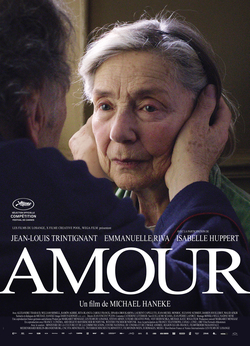
Amour

https://upload.wikimedia.org/wikipedia/en/9/95/Amour-poster-french.jpg
I have always admired the sweet dignity in Robert Frost's short definition of "Devotion":

The heart can think of no devotion
Greater than being shore to ocean
Holding the curve of one position
Counting an endless repetition.


The film Amour (2012), however, explores the indignities that befall us when we find that our repetitions are not endless - when the countdown to death begins. But it also asks us if it is truly the end of love or only a transition. It seems to answer that age-old question of the poets: what becomes of the beloved?

Austrian filmmaker Michael Haneke has made a substantial reputation for
creating works that combine a preoccupation with often brutal subjects and a formal coolness. In The Piano Teacher, the surface quietude of a woman's life is torn apart by a sado-masochistic affair with a much younger man. In Caché, a successful television host becomes the object of blackmail by a figure from his less than innocent childhood. In The White Ribbon, the serenity of a typically jewel-like German village before the First World War is ruffled by a series of increasingly disturbing incidents.

Amour (2012) involves us in the lives of Georges and Anne, both retired music teachers, enjoying what have come to be known as their "declining years." They live in a lovely old Paris apartment, of which we are given a brief tour when the film opens by the police, who have responded to complaints of a foul odor emanating from inside. They break down the doors and find the body of a dead woman lying on a bed, her head surrounded with flower petals. There is no one else, alive or dead, in the apartment, which leads us into one of the film's unexplained mysteries.

In the following scenes we are introduced to Georges and Anne, played by the venerable Jean-Louis Trintingnant and Emmanuelle Riva, who return from a concert one evening to find evidence of an attempted break-in to their apartment. Although the attempt is evidently unsuccessful, Anne is so disturbed by the event that it brings on a stroke, evidence of which appears the following morning when she goes "blank" at the breakfast table. Jumping forward in time, Georges discusses an unsuccessful operation on Anne with their daughter, played by Isabelle Huppert (who was formerly Haneke's Piano Teacher), and Anne is brought back to their apartment in a wheelchair.

These two people, proud of their accomplishments in life and of their place in the world, have nonetheless reached a tacit pact with each other, should their advancing years place either of them in a position of unavoidable and inescapable difficulty. Out of either shame or pride, Anne arrives at the decision to allow no one - not even her daughter - to see her deteriorating condition. Finally, when she is unable or, more likely, unwilling, to swallow some water that Georges tries to get her to drink, he reacts by slapping her. Can this possibly be looked upon as an access of tenderness? Even though he is ambulatory and is free to leave their apartment, he behaves as if he knows that her fate is his as well. He is as incapacitated as she. And because he is still marginally in control, he commits an act, in gently suffocating her with her pillow, that could be viewed (certainly from a legal perspective) harshly.

Haneke has been accused of being brutal by showing us the details of Anne's steady decline - how, for example, Georges helps her get off the toilet, pulling up her panties and, in a kind of broken pas de deux, moving her through the narrow bathroom door. Or when Anne pees the bed, and is overcome with the humiliation. It isn't Haneke's brutality but life's that he shows us. His film reminded me of the last scenes of Iris (2001), in which John Bayley (Jim Broadbent) endures the torments of the final stages of Iris Murdoch's (Judi Dench) alzheimer's.

I mentioned Haneke's formal coolness. His are the most meticulously composed films since Antonioni. His camera takes up a witness point that is only as engaged as Georges and Anne's apartment will allow. It is such a comfortable and lived-in space for the couple, who eventually, as the solitude of Anne's illness progresses, are the only people onscreen, that it becomes a kind of echo chamber. Anne looks through an album at photographs of herself, Georges and their daughter from half a century ago and remarks on their long, beautiful life - a life that is coming to a close.

We are shown Georges's dreams, some suffocating, others nostalgic, all of which are confined, like him, within his apartment. Finally, with Anne's body arranged in her bed among flower petals, Georges dreams she is there again, alive, and they depart together through the door that their daughter enters, seconds later, but after the apartment has been cleared. We are left to presume that Georges has died, too - although it is only Anne's body the police find. We see him carefully writing a long letter. Is it a suicide note? To whom is it addressed?

Haneke's camera (Darius Khondji was his DP) observes carefully but selectively, knowing when to be clinical and when to make the viewer guess at what is happening. The decor is uncluttered but apposite, but two things - a television and a computer - are conspicuously absent. In the salon, there are only a piano, books, and recorded music. The only music we hear in the film is played on a piano or on a music system.

Then there are the two actors. It would be very hard to find two who wear their age so beautifully. Unlike Hollywood actors, who undergo cosmetic surgeries to disguise themselves as younger people, these storied French actors are also human beings. I saw a recent photo of Jean-Paul Belmondo and Alain Delon last week. Both men are pushing 80 and they look it. Look at Warren Beatty and Jane Fonda. It's rather terrible that our superficial culture has forbidden them to grow old. I have recently seen Trintingnant in two films - Dino Risi's Il Sorpasso and a very minor French film from 1964, Les Pas Perdus, with Michèle Morgan. Trintingnant was the perfect foil to Vittorio Gassman in the former, and surpringly affecting as a gigolo with a heart in the latter. (Michèle Morgan, the siren of French poetic realism, died at the end of last year at the age of 96.) In Amour Trintingnant is the same quiet, intelligent presence. Emmanuelle Riva was one of the reasons that Hiroshima Mon Amour was - and remains - worth watching. Although the equation of the suffering of her character with the suffering of Hiroshima was insubstantially argued (in Marguerite Duras's script), Riva gave it all the heft and gravity it would've needed. It is she, not the Japanese gentleman (played by the late Eiji Okada), who insists on dredging up the past, which further invalidates Duras's labored point. Riva, still beautiful, is quite affecting in Amour. Her decline is all the more saddening for being so honestly presented.

In one of his characteristically brilliant but rather slanted essays, "Bourgeois Nightmares," the late Gilberto Perez wondered about Haneke's "happy ending":

"Earlier in the film a pigeon flies in through the window in the entrance hall, and Georges helps it fly out. After he kills Anne, it flies in again, but this time Georges gets up from his writing, shuts the window and captures the pigeon in a blanket. He writes that he let the pigeon go, but we never see him do it. He stays alone in the apartment. From his bed he hears the sound of water off-screen: Anne is there, washing the dishes in the kitchen. I’m almost finished, she says, put on your shoes if you want. She puts on her coat and reminds him to take his as she opens the door of the apartment and they go out for the evening. The shot is held after they leave. No doubt this is a dream, but it suggests something like their entering the afterlife together. Asked to comment on the pigeon, Haneke has observed that they often fly into Parisian apartments. But this one might represent the freedom from confinement that Georges refuses following his wife’s death, then accepts in his dream. Perhaps he flew out of the window, now open again, as the police noticed when they broke in."(1)

Haneke is certainly one of those directors who forces one to concentrate. But in support of his argument, Perez indulges in a somewhat creative solution to Georges' mysterious absence. But if his explanation is unacceptable, what other explanation is there? Where did Georges go, if not with Anne in his dream?

If we are left with questions at the film's conclusion, perhaps they are in accordance with Haneke's poetry. As another poet, Alun Lewis, put it another way:

Time upon the heart can break,
But love survives the venom of the snake.


("In Hospital: Poona")


(1) London Review of Books, 6 December 2012.