Showing posts with label Roman Polanski. Show all posts

Tuesday, June 25, 2019

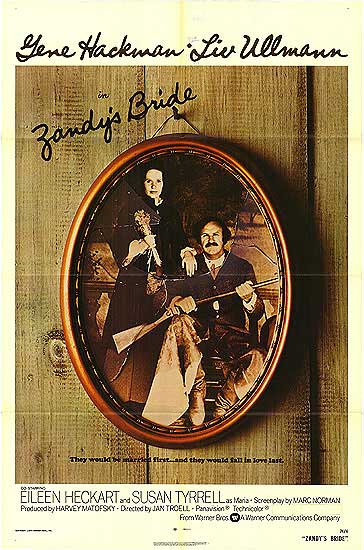
Zandy's Bride

From virtually the very beginning, in 1922 when, at the invitation of Mary Pickford, Ernst Lubitsch left his native Germany and moved to Southern California to make the film Rosita, successful foreign filmmakers have found the Hollywood pilgrimage irresistible. Lubitsch was followed, in no particular order, by F. W. Murnau, Victor Sjöström, Mauritz Stiller, Fritz Lang, Jean Renoir, Rene Clair, Max Ophüls, Michelangelo Antonioni, Milos Forman, Roman Polanski, Ivan Passer, Jan Kadar, Bill Forsythe, Louis Malle, Paul Verhoeven, Lina Wertmüller, Phillip Noyce, Peter Weir, Fred Schepisi, Lasse Hallström, Denis Villeneuve, Alfonso Cuarón, Guillermo del Toro, Alejandro G. Iñárritu ... the list is depressingly long. Lubitsch enjoyed a long and fruitful (in both commercial and creative terms) career in Hollywood. A majority of the others did not. For most, it gave their incomes a boost, but it took a significant toll on their art. Some of them managed to return to their native countries, with sad results. Their subsequent films failed to pick up the thread that they dropped upon going west.

The Swedish filmmaker Jan Troell (pronounced like Noël), who routinely directs, writes, photographs, and edits his films, is an exception to this dismal rule. The international success of his two-part epic film The Emigrants/The New Land (1972), about a Swedish family's migration to America in 1850 was noticed sufficiently by Warner Bros. that he was offered to direct a script based on the novel The Stranger: A Novel of the Big Sur by Lillian Bos Ross. Troell didn't like the script and turned it down, but on reading the novel, part of a Big Sur Trilogy, he was impressed enough by it that he found another writer, Marc Norman, to adapt it. Troell called the film Zandy's Bride (1974).

The "story" of the film is, despite the rewrite, unremarkable: Zandy Allan, a cattle rancher in Big Sur, needs help running things, but instead of looking to hire extra hands, he opts for a mail order bride from Minnesota. He finds an ad in a newspaper classified section:

RESPECTABLE spinster, American stock, wants life in the West. Wishes to marry. Reply P.O. Box 192, Minneapolis, Minnesota.

He puts on a clean, ill-fitting white shirt and rides all the way down to an incongruous outpost smack on the coast where the woman from Minnesota, Hannah Lund, has just arrived by stage. After sizing each other up, he chides her for lying (by 7 years) about her age, telling her she's "on the long side of child-bearing."

Immediately we are faced with incongruity. The leads are Liv Ullmann and Gene Hackman. Ullmann had shown up to act in the film, whereas Gene Hackman showed up to be Gene Hackman. In every film he's exactly the same, no matter how he's dressed or what he's saying. Ullmann is given so little to work with, but you can see her working with it, filling out her period costume like she's been dressed like that all her life, assured, responsive, engaged with her role and the "West" that Troell introduces to us. She makes us wonder what drove her to place that ad. Gene Hackman interests us only so far as his actions divulge, and his limitations are visited upon Zandy.

The two are married then and there, and after the long ride back up the mountain Zandy stables the horses and returns to the house to find Hannah passed out in bed in her traveling clothes. There follows a scene that makes it very hard for us to like Zandy much further. "I got the right!" he screams as he violently rapes her. The following morning he acts like what transpired either didn't happen or was unimportant. He spends the day with his cattle and returns to find some improvements to what Hannah calls his "pigsty." Gradually they wear each other down - she growing tougher, he growing gentler. The result is, of course, no surprise, but the progress to the film's anticlimax holds a few surprises. Some beautiful scenes unfold as Zandy becomes captivated by the beauty of Hannah, reminding me how, for about a decade, between Persona and The New Land, everyone seemed to be in love with Liv Ullmann. Jordan Cronenweth does capture some lovely images: of Zandy and Hannah at table, lit by the light coming off a basket of wildflowers on the table between them, or Zandy watching in admiration as Hannah brushes her long blonde hair by the firelight. Cronenweth certainly might have had some guidance from Troell, or indeed from George Oddner, who is listed in the end credits as "consultant to Jan Troell". Some things, however, don't work so well. Like the scene in which Zandy engages in hand to claw combat with a not very large black bear. The bear-mawling of Leo DiCaprio in The Revenant, albeit abetted by CGI, has set an impossibly high bar for any such scenes.

Troell was promised that he could also operate the camera, but the American cinematographers' union threatened to fine the appointed director of photography (Jordan Cronenweth) $500 every time Troell touched the camera. The result of depriving Troell of access to the camera, which introduced more cooks to the kitchen, is what really prevented Zandy's Bride from getting off the ground. “The biggest difference for me about working in America was the number of people around the camera. In the centre, it’s the same, the relationship between the director, the actors and the camera." (1) Troell started in film as a cinematographer, and he had operated the camera in his four feature films in Sweden. Forced to block only actors (deciding where they should stand in relation to the design that isn't his own), instead of his camera taking part in the blocking must have been crippling for Troell. The photography of his Swedish films is a marvelous voyage of discovery for the viewer.

Zandy's family - father, mother, and a brother - are introduced, only to give the viewer a good idea where Zandy learned about domestic violence. A Mexican woman, Maria Cordova (played by Susan Tyrrell, who was misidentified as "Maria Cordova" in The New York Times review of the film)(2), with whom Zandy has a history, gives the story - and Zandy - an excuse to go astray from Hannah's story, which is the reason the film exists. At least Tyrrell doesn't subject the viewer to her usual crazy lady schtick, for which she was nominated for an Oscar in John Huston's Fat City (1972).

Zandy's Bride gave me the feeling that what attracted Troell to the story's possibilities in direct human terms was precisely what turned critics away from it. You find yourself waiting for something to happen in the film and then you realize what happened went right on by without your noticing it: the gradual action of one force upon another, each resistant to the influence of the other, in which the trajectories of both are eventually altered. The notion that Zandy's Bride is somehow in the tradition of a Western is more than a little silly when you remember that Troell accomplished one of the greatest sequences on the theme of the West in The New Land, when Karl Oskar's brother Robert and his slow-witted friend Arvid trek all the way to California to strike gold, to encounter only death and disappointment. Troell's camera showed us no sweeping vistas, no Monument Valley horizons, no sense of immensities except what the face of Eddie Axberg, who plays Robert, discloses. It is all up close, through the mud and the dirt and the pain, with a bare minimum of dialogue and a handful of other actors. Yet it says so much more about the tragedy of the West than a thousand Westerns.

Zandy's Bride got some positive notices, but not enough with which to build a Hollywood career. Troell returned to Sweden none the worse for his experience. The most significant reason for Troell's failure in Hollywood was much more fundamental than his lack of control over the camera: a filmmaker's nationality is essential to his work. Remove him from his native soil and native language - his ethos - and he is more than simply uprooted. He has lost his frame of reference, his ability to navigate the strange new world around him. Troell returned to Sweden to make Bang! (1977), and finished Hurricane (1979), which Roman Polanski was hired to direct before his sexual predilections ended his own Hollywood career. While making Hurricane, Troell met the Swedish journalist, Agneta Ulfsater, who would become his wife. So Troell emerged the winner from his encounter with Hollywood.


(1) Troell to Michael Dwyer, "A Life Calling the Shots," The Irish Times, May 21, 2009.
(2) Howard Thompson, The New York Times, May 20, 1974.


Saturday, October 27, 2018

The Fearless Vampire Killers


Before proving himself a master of the horror film genre with Rosemary's Baby in 1968, Roman Polański made the horror spoof Dance of the Vampires (1966), based on his own (and Gerard Brach's) original story. I have loved it ever since I first saw it on TV, probably a few years after its theatrical release in the States. Unfortunately, the film that I saw was called The Fearless Vampire Killers, or Pardon Me, But Your Teeth Are in My Neck, Martin Ransohoff's clumsily edited (and foolishly retitled) American release version, with 12 minutes cut from the original and a "goofy" voice dubbed over Jack MacGowran's to try and amplify the "wacky" elements of Polański's film. Writing for the Chicago Sun-Times, Roger Ebert devoted the entirety of his (short) review of the edited film to pointing out the conspicious absence of laughter coming from the movie theater audience. "The night I went to see The Fearless Vampire Killers," wrote Ebert,  "nobody laughed. One or two people cried, and a lady behind me dropped a bag of M&Ms which rolled under the seats, and a guy on the center aisle sneezed at 43 minutes past the hour. But that was about all the action." (January 22, 1968) From his enviable perch at The New York Times, Bosley Crowther acknowledged Polański's desire that his name be removed from the version of his film screened in Manhattan,(1) but, based on what he saw, "there is no sign that Mr. Polański was pointing towards some sly satiric jest, some arrangement of weird allegory so that his society of vampires would have significance apt for today. He was evidently only trying to make fun of horror films, forgetting that horror films, played straight, are now more often funny—unconsciously to—than horrible." (November 14, 1967)

MGM tried to market the U.S. release version as a "farce," but the film that Polański and Brach conceived at an Alpine ski resort during the cutting of Cul-de-Sac was a kind of gothic fairy tale, a "satirical horror drama" with strong Eastern European overtones (Transylvania is in Romania), streaked with Yiddish comedy (the innkeeper, Yoine Shagal, and his wife Rebecca). It parodies every vampire movie cliché (the garlic, the crosses, the sleeping in coffins, the wooden stake through the heart, reflections in mirrors), and toys with the erotic element by introducing a gay vampire (Count von Kroloch's son, Herbert).

Shooting commenced inauspiciously in Austria when all the snow suddenly melted and the production had to relocate to the Italian Alps (the Seiser Alm in the Dolomites). It was Polanski's first film both in color (Metrocolor) and widescreen (Panavision), and he got considerable help realizing his vision from cinematographer Douglas Slocombe, production designer Wilfred (spelled "Wilfrid" in the clever opening credits designed by André François) Shingleton, and a certain "Christopher" Komeda, better known by his Polish name Krzysztof. Komeda composed scores for other Polanski films, including Rosemary's Baby. For Dance of the Vampires, he composed an especially pretty waltz for the grand ball of risen vampires in Von Krolok's castle.(2)

Old Professor Abronsius (Jack MacGowran) and his young assistant Alfred (Polański) have arrived "deep in the heart of Transylvania" hoping to confirm the existence of vampires. Arriving at an inn run by Yoine Shagal and his wife Rebecca, the professor has to be thawed out from the long sleigh ride through the frozen countryside, and the first thing he notices upon coming to is garlic hanging overhead. He points this out to Alfred and inquires of Shagal if there is a castle nearby. Shagal and the villagers present, but for the village idiot, are suspiciously mum. What's funny about these early scenes is that Abronsius is clearly a fool, but his preposterous theories about vampires are proven to be totally right. The Shagals have a young daughter, the lovely Sara (Sharon Tate, given a pile of red hair to appease a producer who wanted Jill St. John in the role), who has a fetish for bathing "at least once a day." Arthur at first thinks she's referring to sex at least once a day, which wins his somewhat abashed approval. Spying on her through a keyhole, he witnesses the vampire, Count Von Krolok (Ferdy Mayne) attacking her in the bath, setting off the film's main plot - rescuing Sara from almost certain undeath.

Ill advisedly, Yoine takes a big bite out of a garlic knob and goes out into the night to save Sara. He is found next morning frozen to a tree stump. Upon examination by Abronsius, however, he finds that Yoine's death did not come from exposure to the freezing elements. He finds bite marks on Yoine's neck, his wrist, and his belly. When Abronsius tells Rebecca that he must now drive a wooden stake through Yoine's heart, she attacks him with the stake and drives them upstairs. By the time they have a chance to do the deed, Yoine the vampire awakes. He's his same joking self (Alfie Bass is inspired as Yoine) until he sees how intent Abronsius and Alfred are to destroy him. Pursued through the inn (Polański indulges in frequent transitions to silent-film speed in his slapstick scenes), Yoine finds himself in the maid's room. She (the toothsome Fiona Lewis) brandishes a crucifix at Yoine, who laughs and tells her, "Have you got the wrong vampire!" Yoine's appearances throughout the rest of the film provide comic relief. Who knew that a vampire could be funny?

Sneaking inside Von Krolok's castle is treacherous for Abronsius and Alfred. They are caught (Krolok turns out to be a fan of Abronsius's research into vampirism), are made comfortable in the castle, and are even invited to the grand ball to be held the following night. During the day Abronsius and Alfred must find the Count's resting place before the sun sets. After finding the way through a window into the Count's crypt, Alfred slips through, but the professor gets himself stuck halfway. So Alfred has to go back outside to pull the professor out. On his way, however, he finds Sara, as usual having a bath, after following the sound of her plaintive singing. With a bite mark on her neck, that she demurely tries to cover, Alfred finds her even more alluring than before. He remembers the Professor, now half-frozen hanging half-in, half-out of the window, and goes back out to extricate him. But their bag of wooden stakes and crucifixes tumbles off the parapet to the ground far below.

Looking for Sara again, this time Alfted encounters Herbert, the Count's son, in the bathroom wearing nothing but his nightshirt and aggressively interested in Alfred. He forces his attentions on the timid Alfred, who has a little book of love poetry. The little book saves him when Herbert tries to bite him and, thanks to Alfred's swift maneuvering, he sinks his teeth into the book instead.(3) A chase ensues, revealing Polański's knowledge of a scene from a Buster Keaton classic (the castle galleries resemble the decks of the derelict ship in Keaton's The Navigator).

I wondered why there would be mirrors in the castle, and such large ones, other than as convenient devices to reveal - or not reveal - to Alfred that the vampires cast no reflection in them and that Sara, though bitten, is still a mortal. At an appointed hour, the castle cemetery empties of a multitude of decrepit vampires, all dressed for a ball from centuries before, and a macabre dance ensues, accompanied by the aformentioned waltz played on a harpsichord.(4) Abronsius and Alfred skilfully manage to escape confinement, steal some clothes from a pair of particularly ancient vampires and join in the dance, intending to steal Sara from the Count's clutches. How they manage to pull off Sara's rescue and escape the castle I will leave you, dear reader, to discover for yourself. Polański proved himself to be a resourceful director in the film's climax, even sneaking in a twist ending that should come as no real surprise to aficionados of the horror genre.

This was to be Polański's last film made in Europe before his sojourn in Hollywood. He took a few Polish friends along with him to California, including Krzysztof Komeda and Wojciech Frykowski. Frykowski was present on the night - August 8, 1969 - the Manson family visited Polański's residence, brutally murdering Frykowski, Sharon Tate and two others (in addition to Tate's unborn child). It was a sobering reminder that Polański's preoccupation with death and violence in his films (his 1971 production of Macbeth is exceedingly bloody) had deeply personal origins.


(1) Polański stated, “I’ve called them and asked them to have my name removed because I don’t want credit for a film I didn’t really make. The one now showing is far from the one I filmed.”
(2) In December 1968, at a party in Los Angeles, Komeda was pushed off an ledge by the Polish writer Marek Hłasko and suffered a serious head injury which left him in a coma. Komeda died in Poland four months later. Hłasko said, ""If Krzysztof dies, I'll go along." Hłasko died in Wiesbaden shortly after Komeda's death, possibly by his own hand.
(3) Incidentally, the Polish actor Vladek Sheybal supplied the voice of Herbert, a clever trick Polański learned when he had to re-record all the dialogue for Knife in the Water. Since the actor who played the hitchhiker was unavailable, Polański dubbed his lines himself.
(4) The ditty is conspicuously absent from the soundtrack album.

Friday, December 18, 2009

Mouthing Off

Give Back the Prize


I have already said enough about the Nobel Prize for Literature (see Two Cheers for the Nobel Prize). I would only add that it has been awarded occasionally more for political reasons than for literary ones. Judging from the list of its laureates, the Nobel Peace Prize is a rather dubious honor. Gandhi, easily the greatest activist for peace in the 20th century, was nominated five times, including just a few days before his assassination, but he never won. Martin Luther King, whose non-violent philosophy was borrowed from Gandhi, won the prize in 1964, and paid tribute to Gandhi in his Nobel lecture. Others who never won the award include Corazon Aquino, Liu Xiaobo, Václav Havel, and Eleanor Roosevelt. Meanwhile, some of the people who actually won the award have extremely spotty records regarding the promotion of peace, like Charles G. Dawes, Henry Kissinger, Yassir Arafat, and Mother Teresa.

Since U.S. president Barack Obama was nominated for the Nobel Peace Prize, critics at home and abroad have questioned the award. The protests that Obama was undeserving of the prize, which Obama dignified by responding to, assume that it is a sacrosanct honor. There was even a sign telling Obama to "earn" the award that he did not deserve. Listening to Obama trying to justify himself to that grotesque audience in Oslo made my stomach turn. If Obama really wanted to take the moral high ground in this controversy, he should give back the award. Giving back the $1.4 million might be a bit harder to do.


Pershing Was a Prick


Some of my ex-military friends have spread stories, mostly apocryphal, about the American general John J. Pershing. While he was merely "a man of his time," which is one of the most commonly-used alibis of all time, Pershing participated in and carried out acts that should have forever besmirched his historical reputation. He took part in the massacre at Wounded Knee while a 1st Lieutenant. He is rumored to have committed acts during his service in the Philippines during the Spanish-American War, including the execution of Muslim prisoners in Mindanao with bullets dipped in pig's blood. (This anecdote is often used in praise of Pershing nowadays.) When appointed commander of the U.S. expeditionary force in World War I, he banned the service of black soldiers alongside, or anywhere near, white soldiers, and sent them to bivouac with the French army, which had no such racist compunctions. On Armistice Day, 11 November 1918, he showed his contempt for the treaty by ordering his soldiers to keep fighting (and dying) all the way up to the eleventh hour, when the ceasefire went into effect. Pershing made no secret of his conviction that the Germans should have been fought all the way to Berlin.

In 1871, when Prussia defeated France and terms of peace were being argued, French General de Wympffen is reported to have said to the Prussian leaders, "It is to your interest, from a political standpoint, to grant us honorable conditions . . . A peace based on conditions which would flatter the amour-propre of the Army would be durable, whereas rigorous measures would awaken bad passions, and perhaps bring on an endless war between France and Prussia."

Whereat Otto von Bismarck disagreed: "I said to him," he recorded in his memoirs, "that we might build on the gratitude of a prince, but certainly not on the gratitude of a people - least of all on the gratitude of the French. That is France neither institutions nor circumstances were enduring; that governments and dynasties were constantly changing, and one need not carry out what the other had bound itself to do. . . . As things stood it would be folly if we did not make full use of our success." Thus, the peace terms were such that the French would remember them when they forced far bitterer terms on the Germans in 1918. And those terms in their turn would give Hitler sufficient grounds to justify the most savage war in history.


Roman Holiday


I am afraid that the Swiss authorities who have the Polish film director Roman Polanski under house arrest at his Gstaad chalet may agree to extradite him to the United States to face thirty-year-old charges of forcing sex on a thirteen-year-old girl. What makes me afraid is not that that I am an admirer of Polanski's work, but that his trial in the U.S. and his possible imprisonment may turn the 76-year-old into yet another martyr for his art, like Ezra Pound, and will lead many to overestimate the value of his work. Polanski has made, in his fifty year career, two fine films, three good ones, and a pile of quite bad ones. His personal history is filled with sadness - losing his mother in a Nazi concentration camp, his wife and unborn child to the Manson family, and his somewhat forced exile from a lucrative career in Hollywood. Of course, such a history is no excuse for pedophilia - something for which Polanski seems to have a penchant. If he is imprisoned, I can foresee his jail becoming a site of pilgrimage, as the rich and famous stop there to offer consolation and encouragement. But I wonder what Jack Nicholson thinks of all this, since it was in his hot tub that the underage seduction took place?

Monday, July 6, 2009

Knife in the Water


From the late 1950s, when the first films of Wajda and Munk were exported from Poland, until the late '60s, when the last films of the Czech New Wave were smuggled to the West after they had been banned, filmgoers were fascinated by what was then known as East European Cinema. (1) So many talented filmmakers, like Petrovic and Makavejev in Yugoslavia, Fabri, Jancso and Makk in Hungary, and Menzel and Jires in Czechoslovakia, whose careers were made possible by a thaw in Soviet policies after the death of Stalin, saw those same policies suffer a terrible freeze after Dubcek's fall in 1968 and the crackdown on his "socialism with a human face". It was as if a barred door that had been opened had suddenly been slammed shut again, and the directors who were lucky enough, if you wish to call it luck, to escape, like Forman, Passer, Makavejev and Skolimowski, managed to continue their careers in the West.


Roman Polanski's emigration to the West was due to the success of his very first feature film, in Poland, a cool examination of sexual warfare called Knife in the Water (1962). Never mind that it's still his best film. With a tiny budget and only three actors, Polanski worked a minor miracle. Some of the subtle details of this remarkably subtle film include: Andrzej and Krzystina boarding the boat after they remove their shoes - the hitchhiker simply steps onto the boat without removing his own; Andrzej and Krzystina continually use nautical terms that puzzle the hitchhiker, but emphasize - to him and to us - that he has entered another realm on boarding the ship; the last exchange between Krzystina and the hitchhiker is appropriately impersonal:

She: Ready?
He: Fend off?
She: Yes.
He: Aye, aye. Fend off.

The hitchhiker is allowed one last triumph. When Andrzej leaves his car at the pier on Sunday morning, the hitchhiker asks him, "You leave the windshield wipers?" To which Andrzej replies cocksuredly: "No one will steal them here." When Krzystina returns to the pier on Monday morning, Andrzej tells her morosely "The windshield wipers are gone." Surely, the hitchhiker wouldn't have stolen them, and risk being seen by Andrzej. But one of his like stole them.

I found two references in the film. Polanski and his co-scenarists, Jerzy Skolimowski and Jakub Goldberg probably got the idea for the script from the yacht scenes in Rene Clement's Plein Soleil (1960), in which two men - Maurice Ronet, Alain Delon - one an experienced sailor, the other not, compete for the affections of a woman, Marie Laforet. The woman belongs to the owner of the boat, who christened it after her (Marge - the boat in Knife in the Water is called Cristina). There is even a knife with which Delon is skillful.

The other reference is purely visual: the last shot of Knife in the Water, of the married couple's car stopped undecidedly at the wet crossroads, recalls the opening shot from Juan Antonio Bardem's Death of a Cyclist (1955), in which, after the credits, an old man cycles down a wet road toward a collision with the illicit couple's car.

Polanski's choice of music, a jazz score composed by his friend Krzysztof Komeda, is superb - a lilting blues motif underpinning the lyrical scenes of the boat on the lake.(2)

Everyone loses on this Sunday outing: the hitchhiker loses his precious knife and is beaten, in more than one sense, by Andrzej; Andrzej loses face with Krzystina by trying too hard to humiliate, and believes he has killed, the hitchhiker; and Krzystina, who cuckolds Andrzej with the hitchhiker and teases him with the truth about his fate, remains stuck with him. The long shot of them sitting in their car, going nowhere on a miserably wet Monday morning, says it all.


(1) One of the curious effects of the Iron Curtain was to transform Central Europe (Poland, Czechoslovakia. Hungary) into Eastern Europe.
(2) Komeda was a brilliant film composer whose life and career were abruptly cut short. He worked with Polanski, Wajda, Skolimowski, and most notably with the Swedish director Henning Carlsen. Alas, after following Polanski to Hollywood, he suffered head injuries in a road accident there, and died shortly after in Warsaw.