Monday, July 29, 2013

I Live Here

"Alone, even doing nothing, you do not waste your time. You do, almost always, in company. No encounter with yourself can be altogether sterile: Something necessarily emerges, even if only the hope of some day meeting yourself again."
- E.M. Cioran


I watched Martin Amis on the BBC's Hardtalk recently, where he spoke about how he enjoys being in the public's headlights occasionally, granting an interview or joining in discussions and debates, but that his chosen vocation and its demands for solitude always pulls him back where he knows he belongs - in a room, alone.

Amis wondered if a writer must have a taste for being alone. Such a regard for solitude is unique among writers (and religious ascetics), and none went as far in its accentuation and celebration as Philip Larkin. In so many of his marvelous poems he shows off the advantages of not just solitude but also for selfishness.

‘None of the books have time’

None of the books have time
To say how being selfless feels,
They make it sound a superior way
Of getting what you want. It isn’t at all.

Selflessness is like waiting in a hospital
In a badly-fitting suit on a cold wet morning.
Selfishness is like listening to good jazz
With drinks for further orders and a huge fire.

1 January 1960


But even in some of his more innocent poems, like "Autobiography at an Air-Station," in which Larkin captures perfectly the stressful boredom of airports, you can find lines like

Ought we to smile,
Perhaps make friends? No: in the race for seats
You're best alone. Friendship is not worth while.


Or, in "Autumn," which establishes its autumnal mood as a kind of life-condition:

Like a London court one is never sure of finding

But none the less exists, at the back of the fog,
Bare earth, a lamp, scrapers. Then it will be time
To seek there that ill-favoured, curious house,
Bar up the door, mantle the fat flame,

And sit once more alone with sprawling papers,
Bitten-up letters, boxes of photographs,
And the case of butterflies so rich it looks
As if all summer settled there and died.

1953


And in other poems, like "The Life With a Hole In It," Larkin returns to the scanty options that life offered him:

When I throw my head back and howl
People (women mostly) say
But you’ve always done what you want,
You always get your own way
— A perfectly vile and foul
Inversion of all that’s been.
What the old ratbags mean
Is I’ve never done what I don’t.

So the shit in the shuttered chateau
Who does his five hundred words
Then parts out the rest of the day
Between bathing and booze and birds
Is far off as ever, but so
Is that spectacled schoolteaching sod
(Six kids, and the wife in pod,
And her parents coming to stay)…

Life is an immobile, locked,
Three-handed struggle between
Your wants, the world’s for you, and (worse)
The unbeatable slow machine
That brings what you’ll get. Blocked,
They strain round a hollow stasis
Of havings-to, fear, faces,
Days sift down it constantly. Years.


But Larkin returns to his insistence that such a life is, after all, what he wants, what he needs:

Best Society

When I was a child, I thought,
Casually, that solitude
Never needed to be sought.
Something everybody had,
Like nakedness, it lay at hand,
Not specially right or specially wrong,
A plentiful and obvious thing
Not at all hard to understand.

Then, after twenty, it became
At once more difficult to get
And more desired – though all the same
More undesirable; for what
You are alone has, to achieve
The rank of fact, to be expressed
In terms of others, or it’s just
A compensating make-believe.

Much better stay in company!
To love you must have someone else,
Giving requires a legatee,
Good neighbours need whole parishfuls
Of folk to do it on – in short,
Our virtues are all social; if,
Deprived of solitude, you chafe,
It’s clear you’re not the virtuous sort.

Viciously, then, I lock my door.
The gas-fire breathes. The wind outside
Ushers in evening rain. Once more
Uncontradicting solitude
Supports me on its giant palm;
And like a sea-anemone
Or simple snail, there cautiously
Unfolds, emerges, what I am.

1951?


Larkin knew the inevitable allure of society, while seeing through it. Its chances for escape, if only for awhile, were a grim replacement for the surety of solitude.

Vers de Société

My wife and I have asked a crowd of craps
To come and waste their time and ours: perhaps
You’d care to join us? In a pig’s arse, friend.
Day comes to an end.
The gas fire breathes, the trees are darkly swayed.
And so Dear Warlock-Williams: I’m afraid –

Funny how hard it is to be alone.
I could spend half my evenings, if I wanted,
Holding a glass of washing sherry, canted
Over to catch the drivel of some bitch
Who’s read nothing but Which;
Just think of all the spare time that has flown

Straight into nothingness by being filled
With forks and faces, rather than repaid
Under a lamp, hearing the noise of wind,
And looking out to see the moon thinned
To an air-sharpened blade.
A life, and yet how sternly it’s instilled

All solitude is selfish. No one now
Believes the hermit with his gown and dish
Talking to God (who’s gone too); the big wish
Is to have people nice to you, which means
Doing it back somehow.
Virtue is social. Are, then these routines

Playing at goodness, like going to church?
Something that bores us, something we don’t do well
(Asking that ass about his fool research)
But try to feel, because, however crudely,
It shows us what should be?
Too subtle, that. Too decent, too. Oh hell,

Only the young can be alone freely.
The time is shorter now for company,
And sitting by a lamp more often brings
Not peace, but other things.
Beyond the light stand failure and remorse
Whispering Dear Warlock-Williams: Why, of course –

19 May 1971

Saturday, July 13, 2013

A Cry in the Dark

“Whose little boy are you?”
― James Baldwin, The Fire Next Time


Sixteen months ago, I commented - because I felt I had to comment - on the incidents in Sanford, Florida surrounding the death by homicide of Trayvon Martin. "Homicide" is the correct term in this case, since [pardon me, dear reader, for dragging in a legal definition] it is legally defined as "the killing of one human being by another human being." The legal definition continues:

"Although the term homicide is sometimes used synonymously with murder, homicide is broader in scope than murder. Murder is a form of criminal homicide; other forms of homicide might not constitute criminal acts. These homicides are regarded as justified or excusable. For example, individuals may, in a necessary act of Self-Defense, kill a person who threatens them with death or serious injury, or they may be commanded or authorized by law to kill a person who is a member of an enemy force or who has committed a serious crime. Typically, the circumstances surrounding a killing determine whether it is criminal. The intent of the killer usually determines whether a criminal homicide is classified as murder or Manslaughter and at what degree."

At the moment of this writing, twelve hours behind from my current time zone, the jury in the George Zimmerman trial for second degree murder is sequestered. It is getting late in Florida, and if they are being conscientious, those six women in the jury should be up late into this July night.

Sixteen months ago, I gave my comments on the taking of Trayvon Martin's life by George Zimmerman, which has never been in doubt, the title The Fire This Time. I was making reference to the title of James Baldwin's book-length essay, The Fire Next Time. Baldwin was quoting an old American hymn, "God gave Noah the rainbow sign,/No more water, the fire next time!" He was intimating that the racism that is deeply rooted in American culture will eventually end in disaster unless the problem is confronted and unless something is done about it.

The trial of George Zimmerman, which is about to end with a verdict, has taken place only because of the outcry of enough people when it became obvious that the state of Florida was not going to even bother charging Zimmerman with a crime. Despite the outcry against the obvious racial elements of the crime, the participants in the trial have been careful not to use the words "racial" or "racist". To some white people, Zimmerman was merely defending himself against Martin's alleged assault on him. He was "standing his ground". But to many black people, the simple presumption that Martin, dead on the sidewalk from a pistol shot to the heart, was the guilty one - not the man who pursued him that rainy night and had a confrontation with him that ended with a fatal gunshot. Black people perceive this as an essential racial element of the crime.

There is a splendid Australian film called Evil Angels in Australia and New Zealand, after the book of the same title, and A Cry in the Dark in the U.S. The film tells the "true" story of how Azaria Chamberlain, nine-week-old daughter of Lindy and Michael Chamberlain, was killed by a dingo in 1980. Without a body, and with a public turned hysterically against the Chamberlains by tabloid publicity, Lindy was put on trial for murder and found guilty. Late in her pregnancy, she is sentenced to life imprisonment at hard labor. Three years later, a small piece of a baby's clothing is found near a dingo's lair, and lab tests prove it was a l
knitted" matinee jacket" worn by Azaria on the night she disappeared. A new trial is convened with this evidence, and Lindy is aquitted and released from prison. 

The title of the film in its release outside Australia and New Zealand is a direct rebuke to everyone in the film who was so intent on establishing the validity of their interpretations of the truth. The truth is that one dark night in the Australian outback, a nine-week-old baby was killed by a dingo. Whatever happens to George Zimmerman, or to the judge and jury in his trial, and all the lawyers on both sides intent on establishing their own version of the events on the night of February 26, 2012, when a 17-year-old boy, while returning to his father's apartment with an iced tea and candy he's just bought at a convenience store, was shot to death by an armed neighborhood watchman. What does it matter whose voice it was on the 9-1-1 call, screaming for his life, when it was the only electronic record of the event of a killing in which the victim and the perpetrator are known?

I have been sickened by all of the legal talk on the news channels over this trial. Lawyers have done nothing but cavil over legal details, as if there were nothing more to consider, as if life and death are reducible to arcane statutory intricacies. By the legal interpretation, the trial is already over - Zimmerman has not been proven guilty, "beyond a reasonable doubt" of second degree murder. But to believe that George Zimmerman did not commit a criminal act is to believe that he was like the iceberg that sank the Titanic. Instead of leaving his car and hunting down Trayvon Martin, which is what must have happened, George Zimmerman was just standing there, minding his own business, when he and Martin collided.

Worlds collided that night, which is why the whole world has been captivated by the trial of George Zimmerman, and why so many people, all over the world, nervously await the verdict.

Wednesday, July 10, 2013

Hide and Seek

The Garden of Love

I went to the Garden of Love,
And saw what I never had seen:
A Chapel was built in the midst,
Where I used to play on the green.

And the gates of this Chapel were shut,
And Thou shalt not. writ over the door;
So I turn'd to the Garden of Love,
That so many sweet flowers bore.

And I saw it was filled with graves,
And tomb-stones where flowers should be:
And Priests in black gowns, were walking their rounds,
And binding with briars, my joys & desires.

William Blake


More than a week ago, while having my busted shoulder examined by a medical intern, the man asked me the usual questions - age, occupation, marital status. The intern was what is known here in the Philippines as a "bakla," a quite exaggeratedly effeminate type of homosexual that is virtually in a class by itself. You can see them in Filipino movies and television, usually providing comic relief, and in every hair salon and barbershop in the country. They are accepted by Philippine society, but only to a limited extent. Their sexuality sets them apart as unequals among equals, occupying a demi-monde of their own.

When the intern asked me if I had any children, and I said I hadn't, he looked up from his paperwork and started what quickly became an annoying harangue over my lack of offspring. Since the Philippines is by now inundated with children (1), a man who chooses not to have children is something of a curiosity. But the intern's commiseration was so unwelcome that it made me want to ask him why he had no children, even if his reasons were imposed on him.

I have commented before on this blog about my reasons for remaining childless. Something to do with my own memories of childhood has made me somewhat fearful of inflicting it on another innocent child. Being a contributing factor to another human being's existence is a matter that too few people, in my estimation, treat with the gravity that it deserves.

On returning home from the clinic, I mentioned the odd experience with the bakla to my girlfriend. Since she is Filipina, she also has difficulty understanding why I don't wish to have children, even now that I'm getting too old to even consider it. For the rest of the day I pondered the issue, and my thinking kept returning to an incident from my boyhood, a strange and disturbing incident that always seems to surface at the oddest of times. It sticks out from all of my other boyhood memories at an odd angle, and stubbornly refuses to let me off the hook.

The incident took place during what is surely the most inexplicable period of my life, when my mother sent my brother and me for a year to a Catholic orphanage in Washington, Georgia.(2) Reading George Orwell's essay "Such, Such Were the Joys," an account of his experience at St. Cyprian's, an exclusive English boarding school (Cyril Connolly was one of Orwell's schoolmates) gave me the impression that what I experienced at the orphanage, far from home, wasn't much different from Orwell's boarding school.

Orwell wrote of one of his own painful memories of his time at St. Cyprian's, when he was disciplined for wetting his bed. One of the masters at the school, whom Orwell called simply "Sambo," gave him such a beating with a riding crop that the crop broke, which only further angered Sambo:

"‘Look what you've made me do!’ he said furiously, holding the broken crop.

I had fallen into a chair, weakly snivelling. I remember that this was the only time throughout my boyhood when a beating actually reduced me to tears, and curiously enough I was not even now crying because of the pain. The second beating had not hurt very much either. Fright and shame seemed to have anaesthetized me. I was crying partly because I felt that this was expected of me, partly from genuine repentance, but partly also because of a deeper grief which is peculiar to childhood and not easy to convey: a sense of desolate loneliness and helplessness, of being locked up not only in a hostile world but in a world of good and evil where the rules were such that it was actually not possible for me to keep them."

Orwell felt that he learned from this event one of the abiding lessons of his childhood:

"I knew the bed-wetting was (a) wicked and (b) outside my control. The second fact I was personally aware of, and the first I did not question. It was possible, therefore, to commit a sin without knowing that you committed it, without wanting to commit it, and without being able to avoid it. Sin was not necessarily something that you did: it might be something that happened to you. I do not want to claim that this idea flashed into my mind as a complete novelty at this very moment, under the blows of Sambo's cane: I must have had glimpses of it even before I left home, for my early childhood had not been altogether happy. But at any rate this was the great, abiding lesson of my boyhood: that I was in a world where it was not possible for me to be good. And the double beating was a turning-point, for it brought home to me for the first time the harshness of the environment into which I had been flung. Life was more terrible, and I was more wicked, than I had imagined. At any rate, as I sat snivelling on the edge of a chair in Sambo's study, with not even the self-possession to stand up while he stormed at me, I had a conviction of sin and folly and weakness, such as I do not remember to have felt before.

In general, one's memories of any period must necessarily weaken as one moves away from it. One is constantly learning new facts, and old ones have to drop out to make way for them. At twenty I could have written the history of my schooldays with an accuracy which would be quite impossible now. But it can also happen that one's memories grow sharper after a long lapse of time, because one is looking at the past with fresh eyes and can isolate and, as it were, notice facts which previously existed undifferentiated among a mass of others. Here are two things which in a sense I remembered, but which did not strike me as strange or interesting until quite recently. One is that the second beating seemed to me a just and reasonable punishment. To get one beating, and then to get another and far fiercer one on top of it, for being so unwise as to show that the first had not hurt — that was quite natural. The gods are jealous, and when you have good fortune you should conceal it. The other is that I accepted the broken riding-crop as my own crime. I can still recall my feeling as I saw the handle lying on the carpet — the feeling of having done an ill-bred clumsy thing, and ruined an expensive object. I had broken it: so Sambo told me, and so I believed. This acceptance of guilt lay unnoticed in my memory for twenty or thirty years.

So much for the episode of the bed-wetting. But there is one more thing to be remarked. This is that I did not wet my bed again — at least, I did wet it once again, and received another beating, after which the trouble stopped. So perhaps this barbarous remedy does work, though at a heavy price, I have no doubt." (3)


What happened to me was no less troubling and ridiculously unnecessary. Looking back on it, I certainly should've acted differently, if only I knew how. I was 8 years old, spending a year a "boy's home" run by Catholic nuns. I always found nuns to be wonderfully gentle at times, but also unnecessarily cruel at others. The home was in an enormous old manor house in Washington, Georgia, probably from the ante-bellum days of slavery.(4) It was self-contained, with a small chapel, classes for the boys and for other children living in the nearby town, a dining hall, and dormitories upstairs. The boys at the home were segregated according to age. My brother was three years older than I, so he lived in a wing on the opposite side of the home. One of the rules that were drilled into us small boys incessantly was that we mustn't play around the "Big Boy's Fire Escape." This was, of course, on the outside of the dorm. The height of the old-fashioned metal fire escape, which presented two flights of stairs, seemed towering to me when I first saw it.

Regardless of all the warnings, however, I was playing hide-and-seek with a friend one Saturday near the fire escape. This is really a rather odd game when you think about it: the object for a child who is hiding is not to be found, to find a hiding place so remote or inaccessible that the child looking for him must inevitably give up. On this occasion, I was the one who closed my eyes and did the counting to ten, while my friend went off to hide. When I came out and said, "come out, come out, wherever you are!" I saw the boy lying on the ground at the foot of the fire escape. When I approached and saw that the boy was bloodied, I immediately reasoned what had happened. He had climbed up the fire escape, probably knowing full well that I wouldn't dare go up there looking for him, and had somehow fallen to the ground, where he laid, unconscious.

I was terrified - not that the boy was badly injured, but that my playing near the Big Boy's fire escape would be found out, and some terrible punishment would be meted out to me. And so, instead of running to get help at the nearest door, which was at the kitchen, I ran in the opposite direction, all the way around the home, to the other side of the huge building. I must have been a hundred and fifty yards, or so it seemed to me then, from where my friend had fallen. I could actually see him crawling toward the kitchen, and I remember I even waved at him from where I stood.

I learned later that the boy, who had sustained several fractured bones, crawled to the kitchen door, where, they told me, someone inside heard him scratching. He was taken straight to a hospital. Of course, as soon as he was able to speak to someone, he explained to them what had happened, and that I was a witness to his fall. The nuns were, needless to say, disturbed by my behavior, but rather than punish me for breaking one of their cardinal rules, they told me to re-create the event, to retrace my steps. I showed them where I was hiding while I counted to ten, and where I found my friend lying on the ground, and where I had run when I realized what trouble I would be in if anyone discovered I had been there. I remember standing with a nun on the opposite side of the home, showing her where I had stopped running, believing I was far enough from the fire escape to be safe.

I wasn't punished. The nuns must've realized that their emphasis on us boys not playing near the fire escape had, in this unique instance, backfired on them. I heard later that my friend, who wasn't permanently injured by his fall, had been removed from the home by a family member. I never saw or heard of him again. My brother and I went back to live with our parents just after my 9th birthday.


(1) As of last year, one-third (33.4%) of the population of the Philippines is under the age of 15.
(2) For the first time in my life, I was made aware of the strangeness this period of my life - of having two living parents (my father was a career soldier) and also being sent to an orphanage - a few years ago when a friend, who was astonished when he heard of it, offered me his sympathy.
(3) George Orwell, "Such, Such Were the Joys," first published in Partisan Review, September-October, 1952.
(4) Update: Information about the history of the home can be found here.

Friday, July 5, 2013

Stop Motion


The death of pioneering American stop-motion animator Ray Harryhausen on May 7 reminded some of us of how far his particular method of animation has come since his work on Mighty Joe Young (1949) and even the original Clash of the Titans (1981). Stop-motion animation is as old as the motion picture itself.

The marvelous thing about stop-motion animation is that it exploits the illusion created by film - originally called the "motion picture." It is created by pointing a camera at an inanimate figure like one of Ray Harryhausen's mythical figures in Jason and the Argonauts (1963), which I had the pleasure to see again recently, and moving it in minute stages while exposing only one frame of film for each individual movement. The result is a film made up of nothing but still photographs that, when projected at twenty-four frames per second, creates the illusion that the figure can move by itself, as if it were alive. Many stop-motion animators created their own puppet figures, with movable parts. The sophistication of the movements varied.

The European tradition of puppeteering is as old as the written record. Herodotus mentions puppets in his Historía, written in the 5th century BCE. In the Czech Republic, formerly (for 88 years) part of Czechoslovakia, and known as Bohemia for a thousand years before that, puppeteering has a particularly long tradition. According to Kevin Nance in a recent Wall Street Journal article, "Czech puppetry has its roots in the Renaissance. By the 19th century, about 3,000 amateur and professional troupes were playing folk comedies and sophisticated dramas, often with patriotic themes." In a marvelous article for Senses of Cinema, The Passion of the Peasant Poet: Jiří Trnka, A Midsummer Night’s Dream and The Hand, Cerise Howard reminded me that last year was the centenary of the birth of probably the greatest 20th century stop-motion animator, the Czech Jiří Trnka.(1)

When I consulted Wikipedia's entry on stop motion, and even looked at their "list of stop motion artists," Ray Harryhausen figures prominently, as he should. But I was astonished that no mention is made of one of Trnka. Not that I expected voluminous information about him from Wikipedia, a "peoples' encyclopedia." Trnka does show up as "a Czech puppet-maker, illustrator, motion-picture animator and film director," but only after his name is "disambiguated" from that of "Jiří Trnka (footballer)." This sort of indignity is suffered by innumerable artists whose work is regarded as out of style or out of date. Trnka's work is, by virtue of its own virtuosity, in a category of its own.

For me, the fascination of Trnka's films derives from the fantasy of a puppet that moves of its volition, without strings. The camera catches it, or catches the illusion. Another part of the fascination of stop-motion animation is that its animated figures exist in the real, air-breathing world. The sets and the animated figures are artificial, but their world is part of our world. They don't breathe our air, but they move around in it - with the intervention of hands made invisible by the illusion of film.

Trnka's life story is typical of generations of artisans who lived in Europe in the middle of the 20th century. We are told that at an early age he helped his grandmother make toy horses and dolls and helped his mother at dressmaking. At 11, he was working with a puppeteer famous at the time named Joseph Skuba, who encouraged him to enter the Prague School of Applied Arts.

On graduating, Trnka started out as an illustrator for newspapers, but was soon getting attention as a painter. One critic dubbed him an heir to Odilon Redon. He then made his mark as an illustrator of children's books, which also showed the influence of Redon. Finally, in 1945, Trnka made his first short film, Grandpa Planted a Beet. It was a "cell cartoon" in the manner of Walt Disney, except that critics noted Trnka's quite un-Disney use of adult, human characters. Three short cell films later, Trnka made his first puppet stop-motion feature film, The Czech Year (1947). The film won several international awards, and Trnka was even dubbed (quite unthinkingly) the "Walt Disney of Eastern Europe." Trnka's films are actually the perfect antidote to Disney's unbearable cuteness.

1949 was an extraordinary year for Trnka. Not only did he complete the film for which he became world famous, The Emperor's Nightingale (Cisaruv Slavik), based on a Hans Christian Andersen story, (subsequently released in the U.S. with an unnecessary and obtrusive narration spoken by Boris Karloff), but he also made Song of the Prairie (Arie prerie), which was a parody of John Ford's Stagecoach, as well as what is probably his most perfect film, based on a story by Chekhov, Story of the Bass Cello (Roman s basou).

Trnka made four more features and numerous shorts before his death in 1969 at the age of 57. The work he considered his best was a short film called The Hand (Ruka-1965), which tells a quite Orwellian allegory of the plight of the artist in a totalitarian state. In the film, we see a man rise from his bed in his humble one-room house. We notice from the array of clay pots on the floor that he is a potter by trade. After placing a potted flower on a table by the window, he sits down to work. There is an unexpected knock on his door. The potter pauses and, expecting no one to be knocking at that hour, returns to his wheel. But he senses that someone is at the door, and approaches it, putting his ear to the wood. He opens the door and peeks out. The wooden shutters of his window spring open, knocking his potted plant onto the floor. A giant hand enters his room. The potter chases the hand out, but it keeps getting back in. Eventually, the hand forcefully reshapes one of the potters clay pots into a sculpture of a hand, despite all his efforts to return it to the shape of a pot. The hand is persistent, and the potter grows exhausted. Eventually, the potter obeys the hand. The short film can be seen in its entirety here.

The upsurge in interest in stop-motion animation is one of the most heartening trends in contemporary film. Its techniques may seem prehistoric to filmgoers for whom CGI is the be-all and end-all of animation. But CGI is guilty of making animation both easy and impossible. It has yet to make a believer out of me, simply because it has been used by mostly untalented filmmakers as a crutch. Casts of thousands are now prohibitively expensive and old-fashioned, frame-by-frame animation too painstaking and time-consuming. But, for me, film is about capturing images of real people, objects and places, whether manufactured purely for the purpose of the film or not.

The trouble with ninety percent of current animation can be summed up in a joke. Two thoroughbred race horses are standing together at the track. One of them says to the other, "How'd you do in the race today?"

"I won," the other horse replies, "but my arse is sore!"

The first horse says, "You know, I won the race yesterday and my arse was sore too!"

Just then a dog walks by and says to the two horses, "You idiots! Don't you know they're shooting you up with steroids so you'll run faster?"

And one of the horses says, "Look at that! A talking dog!"


(1) It was also the centenary of Michelangelo Antonioni. A propitious year!

Saturday, June 29, 2013

Restricted Viewing

The Motion Picture Association of America (MPAA) is a powerful and much-maligned organization that practices "voluntary" censorship on movies made and released in the United States. Of course, it continually denies that it is involved in censorship and claims only that it is performing a service to moviegoers - particularly those with children. It provides guidance to parents about a movie's content that is supposed to help them choose which ones are suitable for exposure to their children. A rating caveat is assigned to every movie, from G for "General" audiences, "all ages admitted", to NC-17 for "no one 17 and under admitted".

Nowadays, movie producers tolerate such blatant censorship for liability reasons: if a parent tries to bring legal action against them because the content of a movie was unsuitable for a child, a producer can always use the MPAA rating caveat in his defense. The sheer paucity of films designed for adults cries out for a revamp of this necklace of skeletons that hangs around the industry's neck.

Over the years, as violence and sexuality have grown increasingly graphic in their representation in movies, the MPAA has reserved its hardest ratings, "R" and "NC-17" for movies that are - supposedly - off limits to under-17-year-olds. While the majority of movies manage to land a PG or a PG-13 rating, even when, in some cases, they are extremely violent, many adults - moviegoers and critics - have sought out movie material that is suitable for grown-ups, that don't cater to a juvenile audience or to a juvenile mentality or morality. Since most Hollywood products have the combined intelligence quotient of a flea, this has often been a lonely hunt for grown-up moviegoers.

Since the majority of the blockbuster movies in release are derived from comic books or their euphemistic equivalent, "graphic novels," movie producers have tried to tailor them to teenage audiences (even when so many comic book fans are old enough to have teenaged children of their own), and have to persuade the MPAA to refrain from applying a rating stronger than a PG-13. As anyone who watched the mass shooting in Aurora, Colorado unfold on TV (I was able to do it from the opposite side of the earth), The Dark Knight Rises, which was having a midnight showing, was rated PG-13. It was so violent that, when James Holmes entered the theater - filled with children and teenagers - firing his weapons, most audience members believed it was a stunt staged for the special screening.

Since I am not a parent and I don't have to worry about finding anything but stupidity objectionable, the ratings are pointless to me. If they are going to persist, however, why not have one that cuts both ways, that serves families with children that need protection from sexuality and violence as well as adults who want protection from infantilism? I would like the MPAA to do me small favor. If a movie is tailored to appeal to children, like the Harry Potters and Hobbits that stink up the multiplexes, they could put some teeth in the rating system by restricting the audience to people under 17. No adults should be admitted without the accompaniment of a child. If nothing else, such a rating system would remind some people that they're too old to bother with such childish things any more. And it might even give them an appetite for more "adult" fare at the movies. Wishful think, I know.

Saturday, June 22, 2013

Death of a Character Actor


The things people say about you after you're dead are forgivable only to an extent. On the negative side, Baudelaire once asked, apropos the hysterically hostile obituaries of Edgar Allen Poe, "Is there no by-law in America to prevent dogs from entering cemeteries?"

On the positive side, excessive praise can sometimes invoke eternal damnation for its intended beneficiary. Think of Ronald Reagan or the recently deceased Margaret Thatcher. Ultimately, what does it matter what people say about you when you're dead?

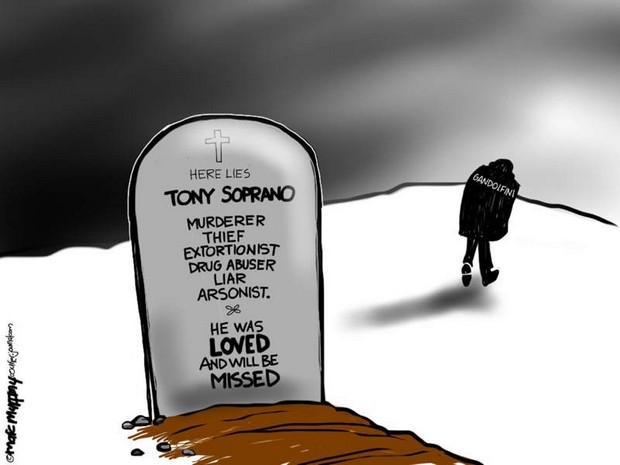
At the death of James Gandolfini this week, which wasn't altogether a surprise considering his size, I found that the sheer volume of praise expressed day after day was getting tiresome. And virtually all of it was for one role - Tony Soprano - which I never liked. How hard was it, really, for a big Italian man from New Jersey to play a mafioso?

I first noticed Gandolfini in Tony Scott's True Romance (1993). With a script by Quentin Tarantino, could the subject of facile violence have been avoided? Gandolfini played Virgil, a hit man (he claimed he was inspired by a friend who was a hit man) whose longest scene called for him to beat Patricia Arquette all over her cheap hotel room. When he finds her defiant to the last, he opens his shirt and tells her to give him her best shot. She drives a corkscrew into his foot, which inspires an even more brutal beating. (Arquette eventually kills him with a toilet tank lid.)

Gandolfini didn't get my attention again until Get Shorty (1995), in which he played a bodyguard known as Bear. Once a stuntman, Bear dreams - like everyone else in the Get Shorty - of making it big in movies. Since he gets beaten up every time he goes up against Chili Palmer (John Travolta), Bear's incipient humanity has a chance to show itself. Though it was the usual sort of role for a man his size, Gandolfini brought to his performance just enough truth to make me believe in him.

Listening to all the praise for Gandolfini was too often quite silly. They all managed to say pretty much the same thing - that he made audiences care deeply for Tony Soprano, who is a professional murderer. Did anyone in the series have the nerve to inform Tony that the real reason he was depressed and needed therapy was because he was a blood-thirsty murderer?

Post-Sopranos, which was an example of immorality masquerading as amorality ("Shakespeare didn't balk at writing about murderers, did he?" Yes, but Shakespeare never expected anyone to feel sorry for Macbeth.), Gandolfini's performance in the otherwise useless The Mexican (2001) stole the show away from its putative stars, Brad Pitt and Julia Roberts. He played a hit man again in that film, with the preposterous name of Winston Baldry, but we learn some time after he kidnaps Samantha (Roberts) that he is gay, and the film slows down considerably to indulge Winston in a fling with another man he meets in a truck stop. It was a surprisingly off-beat role for the redoubtable Tony Soprano. Gandolfini was clearly trying to stretch his image.

I next noticed him in Tony Scott's remake of The Taking of Pelham 123 (2009), playing the mayor of New York City. His last scene with Denzel Washington, thanking him for his acts of heroism during the movie's long hostage ordeal, was touching. Gandolfini next played a voice role in Spike Jonze's Where the Wild Things Are (2009). I found the film disappointing, since Jonze reduced Maurice Sendak's book, which I loved since I was a boy, to a rather dimly-realized shadow of itself. But Gandolfini's unmistakable voice for the wild thing Carol was a surprising presence, and the rock bottom gentleness of the big man shone through - even if Carol is little more than a more animate muppet in Jonze's sorry movie.

The last thing I saw him in was Killing Them Softly (2012), but neither the movie nor Gandolfini's small part in it - yet another hood, this time named Mickey - were otherwise mentionable.

James Gandolfini had a great deal going for him as an actor, and being deprived of his future performances, in which we would have seen more of his talent in a wider range of roles, is a true loss for everyone. His size was, as he knew too well, a shortcoming to be surmounted. It seemed to me that his physical presence, just like Shaquille O'Neal's on the basketball court, probably accounted for a large portion of his success as an actor. But he had a tough time convincing producers that he could do something more than beat the crap out of Patricia Arquette, even if he did it with so much aplomb and panache. But he wasn't, alas, the Great Actor everyone said he was this week. He was just getting started when his heart stopped.

Thursday, June 6, 2013

The Grey

There is a TV commercial currently airing here in Asia for the luxury Shangri-la Hotel chain that is like a gripping mini-movie. In the commercial, a man is alone in a forbidding snowbound landscape, apparently fighting to stay alive. The snow is deep and wolves are stalking him. His flashlight flickers out and he is overcome with fatigue and lies down in the snow. When the wolves approach him, they do something astonishing - they snuggle up around him, and when the man awakes he finds he is surrounded by warm sleeping wolves. Then a caption appears on the screen: "To embrace a stranger as one's own. It's in our nature."

What the commercial is supposed to mean, and how on earth it's supposed to represent Shangri-La Hotels, is subject to interpretation. But, in a powerful way, Joe Carnahan's 2011 movie, The Grey, is a perfect antidote to such unnatural nature.

The movie, with its uninspired title, is more exactly reminiscent of the world of Jack London's most elemental stories of man in extremis than any other film I've seen, especially the miserably lame movie adaptations of White Fang (1991) and The Call of the Wild (2009). Because they are narrowly regarded as "animal stories," I first encountered those books when I was in my teens in the "juvenile" section of a public library. This stupid categorization has resulted in a general underestimation of London's writing and its appeal to more than just juveniles. He was an uneven but an often serious writer whose work, inspired by an uncompromising view of the cruelties of life, is overdue for reconsideration.

The Grey is the story of seven survivors of a plane crash in the wintry Alaskan wilderness, led by John Ottway (played by Liam Neeson), a man who works for an oil pipeline company, protecting its workers from the large predators they inevitably encounter in Alaska. I lived in Anchorage for a few years. It's the largest city in the state, but if one were to take a secondary road north, south or east of the city for ten miles, especially in winter (October to April), one would be in a place remarkably similar to the one in which the seven men found themselves.

The plane crash is easily one of the most frightening of such scenes ever filmed, with unrestrained passengers depicted being thrown violently around the cabin, and the fuselage breaking off, exposing Ottway and others to the cold blast of air outside, as the plane descends. Ottway awakes, still secured to his seat, now sitting by itself in a snowy field, his face dusted with blowing snow. He finds and rescues as many men as he can find, but all but seven passengers are scattered, with the fuselage, over a large area, and wolves begin to turn up to devour their remains. Ottway takes charge, despite some resistance, and the men spend their first night taking turns watching out for the wolves. One of them, dropping his guard to urinate during the night, is found torn to pieces the following morning. Ottway determines that the group of survivors must walk to a distant forest if they are to escape the wolves.

There is an altogether unnerving moment when the men hear a wolf's growl in the dark, and Ottway grabs a flaming torch to find out where it is. All that the men can see, staring at them from the darkness, is a pair of illumined eyes, then another, and then a multitude of them, lit by the light of Ottway's torch.

From that moment, until the end of the movie, the filmmakers pursue, with commendable honesty, the grim fates of the men. The movie's lack of critical and commercial success was probably due to its very determination to be truthful to - if nothing else - the odds of survival under such circumstances. The final confrontation between Ottway and the "Alpha" wolf ends - for those who sit through the end credits - ambiguously.

There is a scene near the end of the movie that Catholic groups found objectionable in which Ottway, who has just watched the last of his companions drown, sits on the riverbank and shouts at the blank sky, "Do something! I'm calling on you!" It is Ottway's pathetic, desperate appeal for divine intervention. "Fuck faith! Earn it!" he shouts. He swears to God that, if He saves him, he'll believe in Him for the rest of his life. There were also complaints, believe it or not, about the portrayal of grey wolves in the movie. I found that the use of prosthetic wolves in some scenes was a little obvious. But at least the filmmakers avoided the horribly dishonest portrayal of the dogs in the two Jack London adaptations mentioned above.

The nearly exclusive cast of men (0ne woman and a little girl appear in flashbacks) reveals a degree of intimacy on the part of the director and script writers (1) of such places as a remote industrial outpost. Much of my experience in the military was similarly remote from the opposite sex. While not entirely like prison (it lacked only the interminability of prison), such societies suffer in many ways from the absence of women and their humanizing influence. In The Grey, the scenes in the makeshift after-hours club - the chaotic brawling, the sheer desperate exclusivity of it - comes across tellingly. The machismo among the crash survivors is chastened, but enough of it remains to create conflict. Besides Liam Neeson, still imposing at 59 when the film was made, some other notable performers, like Frank Grillo and Dermot Mulroney, turn up in surprising guises.

When the wolf pack shows up with its imperious hierarchy, the filmmakers obviously meant for us to notice the parallel with the hierarchy among the men. Ottway assumes leadership because he is the strongest and the ablest of the group. The strongest compete for leadership of the group, while the weakest, one after another, are killed, die of hypoxia, or just give up and, in a painfully moving scene, explain how they can't - and don't want - to go any farther.

I can't say to what extent the raw power of the movie is derived from the story, "Ghost Walker," by Ian MacKenzie Jeffers, on which it is based. The movie is reminiscent of another story, by Jack London, called "Love of Life," (2) in which a man becomes separated from his companion in the wilderness because of an injured ankle. He has a rifle, but no ammunition, and can only manage to survive the following days on some ptarmigan eggs, a few minnows, and the pink bones of a dead caribou calf. As snow begins to fall and he realizes he is starving, the man discovers that an old, sick wolf (what Ottway would've called an "Omega") is following him. He is entering a delirium brought on by starvation, and his hallucinations are hard for him to distinguish from reality.

He is finally reduced to crawling on his hands and knees. He finds more bones, and realizes they are the remains of his companion, attacked and eaten by wolves. The sick wolf continues to stalk him, approaching when he seems to fall asleep, but the wolf's wheezing breath and cough awakes the man. Finally, half-alive, the man and the wolf engage in a life-or-death struggle, with the man succeeding in biting the wolf's throat so deeply that he drinks its blood. The man is later discovered by a scientific expedition:

"From the deck they remarked a strange object on the shore. It was moving down the beach toward the water. They were unable to classify it, and, being scientific men, they climbed into the whale-boat alongside and went ashore to see. And they saw something that was alive but which could hardly be called a man. It was blind, unconscious. It squirmed along the ground like some monstrous worm. Most of its efforts were ineffectual, but it was persistent, and it writhed and twisted and went ahead perhaps a score of feet an hour."

They take the man aboard their ship, and he slowly recovers his senses and his health. He returns to civilization, but the savagery of nature that was London's subject, and the subject of Joe Carnahan's movie, is unforgettable.


(1) Joe Carnahan and Ian MacKenzie Jeffers.
(2) Both the film and the story utilize remarkably similar poems that capture their grimness. In The Grey, Ottway recites, on two occasions, a poem he believes was written by his father: "Once more into the fray. Into the last good fight I'll ever know. Live and die on this day. Live and die on this day." The story, "Love of Life" begins with a stanza from the poem "The Gold-Seekers" by Hamlin Garland:

This out of all will remain--
They have lived and have tossed:
So much of the game will be gain,
Though the gold of the dice has been lost.